

Instagram Hook Examples for Online Stores (2026)

A good Instagram hook is one line that makes a specific promise to a specific shopper and leaves a gap the rest of the post closes. Below you’ll find hook examples for Reels, carousels and captions, adapted to product posts, plus a routine for writing them without starting from a blank page every day. For a store with hundreds of products, the practical answer is to turn the hook formulas into a repeatable system that works from your product data, which is how we built Xyla to work.
TL;DR
- A hook is the first frame and first line of a post. It names who the post is for and what they get, then makes them want the payoff.
- Ten hook families cover most needs: curiosity, number plus promise, mistake, contrarian, “nobody tells you,” before and after, question, story, proof and call-out.
- Match the hook to the post: problem hooks for demos and how-tos, curiosity hooks for unboxings, result hooks for transformations, proof hooks for showcases.
- Treat the first caption line and the second carousel slide as hooks too.
- For dropshipping and catalog-heavy stores, consistency matters more than any single clever line, so build a template-based routine and automate the posting.
Table of Contents
- What an Instagram hook actually is
- The three-second habit, and what it really means
- Instagram hook examples by formula
- Match the hook to the type of post
- Hook ideas by niche
- Instagram for dropshipping: hooks that show benefits and answer questions
- Keeping posts from feeling like ads
- A repeatable routine for writing hooks
- Our view on hooks at catalog scale
- Put these hooks to work with Xyla
- FAQ
- Sources
What an Instagram hook actually is
A hook is whatever a viewer sees or reads first: the opening frame and spoken line of a Reel, the cover slide of a carousel, or the first line of a caption before the “more” cut-off. Its only job is to earn the next two seconds.
For a store, that means a hook has three parts:
- A who. The shopper it is for (“If you have a dog that pulls on the leash”).
- A promise. What they will get (“here is the harness fix that took me five minutes”).
- An open gap. Something unresolved that the rest of the post closes.
A writer at one caption-focused blog describes the same mechanism: a specific promise to a specific person, plus a gap the post then closes. Each family also fails in a predictable way. A curiosity hook fails when the payoff is smaller than the gap it opened, and a mistake hook fails when the mistake is obvious or invented. Keep both in mind as you read the examples below.
The three-second habit, and what it really means
You will see “the three-second rule” everywhere. Instagram has not declared an official rule of that kind; it is a creative principle that reflects how quickly people decide whether to keep watching short video. Treat it as a working habit: the hook is the first thing said on camera and the first frame seen, not the caption and not the payoff at second twelve.
Practically, that gives you three checks before you publish a Reel:
- Does the first frame show the product or the problem, not a logo or a slow fade-in?
- Is the first spoken or on-screen line under about ten words?
- Could someone watching with the sound off still understand the promise? Put the hook on screen as text.
On-screen text also has to sit inside the visible area of the Reel. Our guide to Reel dimensions and safe zones for stores shows where the interface covers your text.
Instagram hook examples by formula
These are original, fill-in-the-blank templates for a store. Swap the brackets for true details about your product and customer.
Hook family Template Store example Curiosity gap “Nobody expects [product] to do this.” “Nobody expects a $24 candle to do this to a room.” Number plus promise “[Number] ways to [result] with [product].” “3 ways to wear one linen shirt all week.” Mistake “The mistake that makes [thing] [bad outcome].” “The mistake that makes your cast iron pan rust.” Contrarian “You don’t need [common thing] to [result].” “You don’t need a bigger bag to pack for a week.” “Nobody tells you” “Nobody tells you this about [category].” “Nobody tells you this about buying handmade ceramics.” Before and after “Same [space or person], [short time], one [product].” “Same desk, five minutes, one cable organizer.” Question “Do you also [relatable annoyance]?” “Do you also lose one earring every month?” Story opener “I almost [dramatic thing] before I [found fix].” “I almost returned this mat before I tried it on a tile floor.” Proof “[Number] customers [result] with [product].” “Hundreds of reorders can’t be wrong. Here is why.” Call-out “If you’re a [specific person], watch this.” “If you’re a new plant parent, watch this.”Only use a number or claim you can back up. A proof hook with a made-up count loses the trust it was meant to build, and a mistake hook needs a real mistake your customers make.
Try writing three versions of the hook for every post and publishing the one you would personally stop scrolling for. It takes two extra minutes and it is the cheapest quality control available.
Match the hook to the type of post
A hook that suits an unboxing will flop on a how-to. A practical way to choose is to start from the Reel format:
- Problem-solution, demo and how-to Reels: open with the problem. “Your phone case slides off every table. Watch this.”
- Unboxing, day-in-the-life and voiceover: open with curiosity. “I wasn’t expecting this to be inside.”
- Testimonials and transformations: open with the result. “Three weeks later, this is the skin on her left hand.”
- Product showcases: open with social proof. “The one our repeat customers add to every order.”
For point-of-view clips, which suit product videos well, see our POV video ideas and hooks. For a wider bank of tested openings, our Instagram Reel hooks for brands page lists more by category.
Reel hooks to adapt
- “Stop [doing the common thing] until you’ve tried this.”
- “POV: you finally found a [product] that actually fits.”
- “I tested [number] [products] so you don’t have to.”
- “This is the $[price] fix for [annoying problem].”
- “Here’s what’s inside a $[price] order from our shop.”
Carousel hooks to adapt
Carousels work differently because Instagram can show a later slide to someone who skipped the first. That means slide one and slide two should each work as a hook on their own. One creator describes this as a two-hook rule for carousels: the cover promises the topic, the second slide gives a reason to trust you, and the real story starts on slide three.
For a store, that could look like this:
- Slide 1: “How to style a small entryway.”
- Slide 2: “We’ve set up hundreds of tiny hallways. Here’s what actually makes one feel finished.”
- Slide 3: the first tip, with your product in context.
For goal-based layouts, our list of Instagram carousel ideas groups them by what you want the viewer to do, such as save, share or buy.
Caption hooks to adapt
The first caption line is the second hook. Don’t repeat the on-screen text. Add what the video could not fit: a price, a full list, a material, a size range. If your Reel is “3 mistakes that make a bedroom look cheap,” the caption might open with “Mistake 2 costs nothing to fix.” Then point to a next action: save, comment, or tap the link in bio.
More on writing captions at scale is in our guide to AI social captions for ecommerce.
Hook ideas by niche
The same families look different in each category. Here are starting points:
- Pet products: “If your dog pulls on every walk, this is for you.”
- Fashion: “You’ll wish you had this in your closet before the weekend.”
- Home and decor: “Same corner, ten minutes, one shelf.”
- Beauty and skincare: “The mistake that makes your moisturizer sit on top of your skin.”
- Handmade and Etsy: “I make these one at a time. Here’s the 30 seconds that takes the longest.”
- Gifts: “Under $30 and it still looks like you tried.”
- Fitness and wellness: “Three things I’d tell myself before buying a yoga mat.”
Notice that every one names a person or situation. “Check out our new product” is not a hook because it promises nothing to anyone in particular.
Instagram for dropshipping: hooks that show benefits and answer questions
Dropshipping stores often have the same supplier images as every other store selling that product. The hook is where you differentiate, because the product itself may not. Three approaches work well:

Lead with the benefit, not the item. “Wait, this isn’t just another humidifier” gives the viewer a reason to stay. A dropshipping template from DSers suggests product captions should use about three of five elements: hook, benefit, proof, call to action and personality. You don’t need all five every time.
Answer a real customer question. Your inbox is a hook library. “Does it fit a 15-inch laptop?” or “How long does shipping actually take?” are both specific, and the viewer asking it is already close to buying. The same template includes an FAQ-answer Reel and a Story poll in its weekly plan.
Show a real customer. Reviews, unboxings and customer photos make proof hooks believable. We cover how user-generated content and brand trust connect, and our guide to AI UGC video made from your products shows how to make that style of content without filming everything yourself.
For captions, put the main keyword for your product in the first sentence, use a handful of niche hashtags rather than only broad ones, and end with one clear action. NicheDropshipping’s caption guide suggests three to five niche tags, for example a specific bag type rather than just a broad category like fashion.
Keeping posts from feeling like ads
A feed made only of product shots with discount codes reads like an ad, and shoppers scroll past ads. A mix is easier to sustain than most owners expect. Rotate through a few post types:
- Product in use: a demo or POV that solves a problem.
- Answer posts: a customer question turned into a Reel or carousel.
- Proof posts: a review quote, a before and after, a repeat-order story.
- Behind the scenes: packing an order, picking a supplier sample, making a batch.
- Direct offers: a launch, a restock or a sale, used less often.
If you keep the direct offers to a minority of posts, the feed has a reason to exist beyond selling. Hooks do much of this work: “Here’s what people ask us most” feels like help, while “Buy now” feels like an ad.
Stories can carry the lighter material, such as polls and quick tips, so the main feed stays focused. See our Instagram Stories for ecommerce guide for ideas and scheduling.
A repeatable routine for writing hooks
Ideas are rarely the bottleneck. Time is. Here is a routine that takes a product and produces a posting-ready hook:
- Pick the shopper. Write the one-line description of who buys this product and why.
- Pick the format. Reel, carousel or single image. Use the post-type guide above.
- Pick the family. Choose one of the ten and fill in the template with real product facts.
- Write three versions. Read them aloud and keep the one you would stop for.
- Put it on screen and in the caption. On-screen text for the first frame, a different first caption line for the second hook.
- Check the payoff. Does the post deliver what the hook promised? If not, change the hook, not the post.
- Track which families win. After a few weeks, you’ll see which ones your audience responds to. Our guide to social commerce analytics explains how to tie posts to store visits and sales.
Once the routine works for ten products, the challenge becomes doing it for a hundred. That is where it stops being a writing problem and becomes a systems problem.
Our view on hooks at catalog scale
We built Xyla for store owners who know they should post every day and simply don’t have the hours. The hook formulas in this guide are not secret. What costs you the time is applying them to every product, then cutting the video, adapting it for each network and scheduling it.
Our approach is to start from your real product data on Shopify, WooCommerce or Etsy and generate new UGC-style video and image content from it, instead of remixing a fixed template. Hooks, captions and assets are tailored to each network, and posts are scheduled and published automatically.
AI content generation is part of our standard plans, rather than a per-generation credit meter, so you can make enough content to test several hook families without watching a counter. Our aim is simple: take the weekly social workload, around eight hours for many small stores, off your plate, and leave you with the part only you can do, which is knowing your customers.
Toby
Put these hooks to work with Xyla
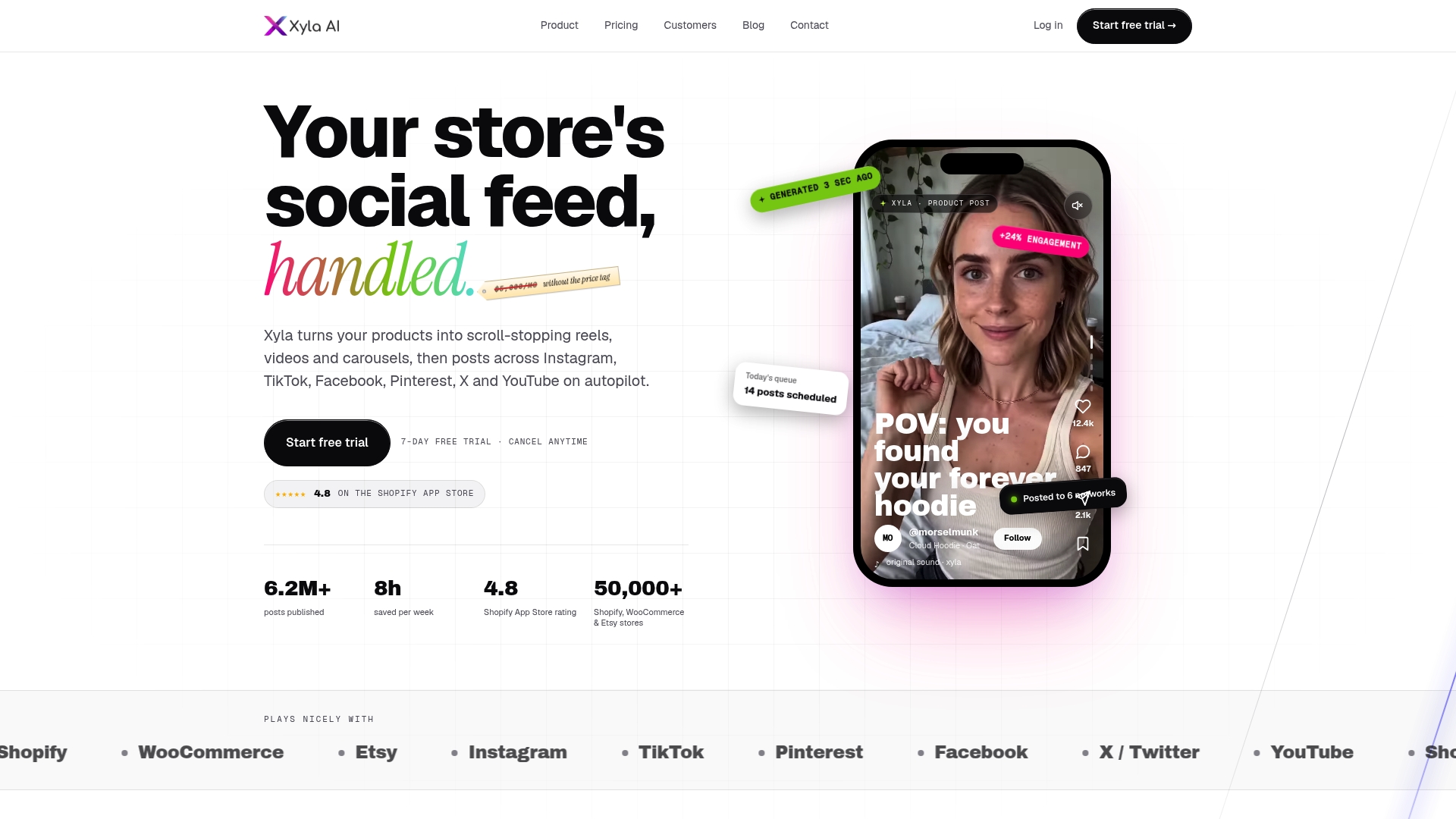
If you run a Shopify, WooCommerce or Etsy store, Xyla turns your product listings into reels, videos and carousels and posts them to Instagram, TikTok, Facebook and other networks on a schedule. Plans start at $29 per month on Growth, and Etsy sellers can see the Maker plan at $29 per month on the Etsy plans page. A free trial comes before any paid subscription.
If you’d like to see how products flow from your store to scheduled posts, our guide to auto posting product updates walks through it step by step.
FAQ
What are some good Instagram caption hooks?
The strongest ones are specific: a question your customer actually asks, a number plus a promise, or a mistake they are likely making. “Do you also lose one earring every month?” beats “New arrivals.” Add what the video could not fit in the first line, such as a price or material, and end with one action.
What is the three-second rule on Instagram?
It is a working habit, not an Instagram policy. Instagram has not declared an official three-second rule; the idea is that viewers decide very quickly, so your first frame and first line must show the promise. Put the hook on screen as text so it works with the sound off.
What is a three-hook strategy?
It means treating more than one element of a post as a hook: the opening frame of the Reel, the first line of the caption, and for carousels, the second slide. Each should work on its own and add something new instead of repeating the last one.
How do I use hooks for a dropshipping store on Instagram?
Lead with the benefit rather than the item, answer real customer questions, and show real customers. Rotate product demos, answer posts, proof posts and a few direct offers so the feed doesn’t read as one long ad. Write three hook versions per post and publish the strongest.
How many hook styles should I test?
Start with three or four from the ten families and run each across several products. Keep the ones that earn saves, shares and clicks to your store, and retire the rest.
Sources
- Hobo.video: why Instagram completion rate matters
- Hayley Price White: Yap vs. Hook Reels
- DSers: Free Social Media Strategy Template for Dropshippers
- NicheDropshipping: Instagram captions for dropshippers
- User-generated content and brand trust


