

AI Social Captions for Ecommerce: How to Write Them Well

AI can turn a product listing into a ready social caption in seconds. The captions that sell are the ones where you feed the AI real product data and real brand samples, adapt the result to each platform, and have a person check every claim before it posts. This guide shows how to set that up for a store, from the input to the review step to the numbers you track afterward.
TL;DR
- AI is good at the first draft: pulling features, benefits and a call to action out of a product listing and phrasing them for a feed.
- Output quality depends on input quality. Give the AI your product data, a few real captions in your voice, length limits, hashtag rules and a list of words you never use.
- Each network needs its own version. One caption pasted everywhere reads as spam on at least one of them.
- A human review step protects you from invented specs and from endorsement claims that break FTC rules.
- Tag links with UTMs and compare AI-assisted posts with your older posts before you decide what is working.
Table of Contents
- What AI captions actually do for a store
- Build the input before you ask for a caption
- From product description to platform-ready caption
- A weekly workflow that holds up
- How to review an AI caption before it posts
- The legal side: claims and endorsements
- Measuring whether AI captions work
- Our perspective
- Put it into practice with Xyla
- FAQ
- Sources
What AI captions actually do for a store
A caption has a narrow job: stop the scroll, say why the product matters, and tell the viewer what to do next. For a store with 200 products, the problem is volume. Writing a fresh, on-brand caption for every item, on three or four networks, every week, is the work that gets dropped first.
AI removes the blank page. Marketplaces have noticed. In 2023 eBay introduced an AI caption generator that helps sellers create posts with hashtags, emojis and links, available to sellers in the US, UK, Germany and Australia. When a marketplace builds the feature for its sellers, it shows how routine the task has become.
What AI does not do on its own is know your customers, your margins or what you can legally promise. It writes plausible text. Your job is to give it good raw material and to decide what goes live.
There is also a reason to care about the wording itself. An academic study of generative AI content and impulse buying found that perceived interactivity partly explains how AI content credibility, attractiveness, novelty and trust affect impulse buying. That is one study from one market, not a guarantee, but it points the same way as common sense: content that feels credible and engaging is more likely to move a shopper than content that merely exists.

Build the input before you ask for a caption
Most weak AI captions come from weak prompts. “Write an Instagram caption for my candle” gives the model nothing to work with, so it returns the same warm, cozy, generic text every candle store has posted.
A prompt that produces usable captions includes:
- The product facts. Title, materials, dimensions, scent notes, sizes, price, shipping promise. Copy them from your listing, not from memory.
- Three to five real captions you already like. These teach tone better than any adjective. “Friendly but not cutesy” means little; your own best posts mean a lot.
- The image or video context. Say what is shown: the product on a desk, a hand pouring, a before and after.
- Hard limits. Maximum characters, how many hashtags, whether emojis are allowed.
- The call to action. “Shop the link in bio”, “Tap the tag”, “Reply with your size”. Pick one per post.
- Forbidden words and claims. Anything you cannot back up: “best”, “guaranteed”, “clinically proven”, “eco-friendly” without certification.
If you want ready-made starting points, our copy-paste product caption prompts cover the common cases for sellers. Save the version that works as a template and only swap the product data.
Keep length in mind
Caption length changes how a post reads in the feed, because long captions get cut off behind a “more” link. The first line has to carry the hook. We break down the numbers in Instagram caption length rules for ecommerce stores, but the practical rule is simple: put the product name and the reason to care in the first sentence, and leave details for the lines below.
From product description to platform-ready caption
A product description and a caption are different documents. The description answers questions from a buyer who is already on your page. The caption interrupts someone who was not looking for you.
So the rewrite follows a pattern:
- Lead with the benefit or the moment of use, not the spec sheet.
- Keep one or two specs that prove the benefit (“fits a 15-inch laptop”, “holds 12 oz”).
- End with one action.
Our guide on rewriting a product description as a caption walks through this with listing examples. If your description is a wall of bullet points, ask the AI to pick the single most persuasive feature for a given audience, then write around that.
One product, four captions
Take a stainless steel water bottle. The same facts become different posts on each network:
Network What the caption should do Typical shape Instagram Hook in the first line, tie to the visual, point to the shop tag or link in bio Short story or benefit, a few relevant hashtags TikTok Support the video, add context or a question that invites comments One or two short lines, hashtags kept minimal Facebook Give a little more detail and a direct link, since links work in the post Two to four sentences, clear CTA Pinterest Describe what the pin shows in words people search for Plain, keyword-aware descriptionThe lesson is not to memorize this table but to tell the AI which network it is writing for every time. A prompt line such as “Write for TikTok, under 150 characters, conversational” changes the result more than most other edits.
Video is where captions and visuals meet. If you are making product videos from your photos, the caption should add what the video cannot say aloud. Our vertical video guide for store owners covers how to frame those clips. Tools that generate UGC-style clips for Instagram Shopping product tag videos show how the visual and the tagged product caption now work together in one post.
A weekly workflow that holds up
One-off captions are easy. The harder part is keeping a steady calendar. A workable weekly loop looks like this:
- Pick the products. New arrivals, restocks, best sellers and anything with a seasonal hook.
- Generate drafts in a batch. Run the same prompt template across all chosen products. Batching keeps the voice consistent. Our fact post ideas work well as batch prompts when you run out of angles.
- Review and edit. Fifteen minutes on a batch beats five minutes on every single post.
- Schedule by network. Queue each version for the right channel and time.
- Check results once a week. Keep what works, retire what does not.
The more of this that connects to your catalog, the less copying and pasting you do. If a price changes or an item sells out, a manual workflow leaves old captions promising things you no longer offer. The five steps from product updates to AI social posts show how to wire that connection. For the wider picture of removing manual steps, see how to automate your social media marketing.
Holidays deserve their own batch because they repeat every year. Build the prompt once and reuse it; our holiday post automation steps cover that routine.
How to review an AI caption before it posts
Treat every AI caption as a draft written by a fast, confident intern who has never touched your product. Run it through five checks:
- Accuracy. Does every spec, price, material and shipping claim match your listing? AI will happily invent a “waterproof” feature.
- Originality. Read it aloud. If it could be posted by any competitor with the word swapped, rewrite the opening.
- Brand fit. Compare it with your three best real captions. Remove phrases you would never say to a customer.
- Claims. Strike anything that promises a result: health benefits, income, guaranteed delivery dates, “best in class”.
- Tone for the moment. Check it is not cheerful on a day when the news is not, and that holiday copy matches the real shipping cutoff.
Write these five checks into a short checklist and give it to whoever approves posts. A shared checklist matters most when more than one person touches the queue.
The legal side: claims and endorsements
The risk most store owners underestimate is not an embarrassing caption but a deceptive one. In the US, the FTC treats endorsements as advertising. Its guidance says that endorsements must reflect the endorser’s honest opinion and cannot make claims the marketer could not legally make itself. That matters for AI because a model asked to “sound like a happy customer” will produce testimonial-style lines that no customer ever said.
The FTC’s enforcement letters show what it looks for. One warning letter to an individual influencer flagged unsubstantiated or deceptive performance claims and failure to disclose material connections that could affect how credible an endorsement is. The same guidance notes that action against an individual endorser may be appropriate in some circumstances, so the exposure is not only yours.
In practice, for a store:
- Do not let AI write fake customer quotes or invent reviews. Use real ones, with permission.
- If you send free product to creators, make sure the post discloses the relationship, and do not script claims you cannot support.
- Keep proof for any measurable claim (“holds ice for 24 hours”) on file.
- If you are unsure whether a health, safety or earnings claim is allowed, ask a lawyer who handles advertising law before it goes live.
These rules are for the United States. Stores selling elsewhere should check their own regulator’s advertising rules.
UGC-style content raises the same question at larger scale. Our piece on scaling compliant AI-generated UGC goes into how to keep that content honest. And since reviews influence how shoppers judge a store, this overview of online reviews and ecommerce SEO is useful for thinking about where real customer feedback should come from.
Measuring whether AI captions work
Do not judge captions by likes alone. A caption can earn comments and sell nothing. Measure in layers:
- Attention. Reach, saves and shares, which show whether the hook worked.
- Action. Link clicks and profile visits that follow a post.
- Sales. Orders and revenue from tracked links.
The tracking part is simple and often skipped. Add a UTM tag to every link, with a naming scheme that records the network, the post type and whether the caption was AI-drafted or fully hand-written. After four to six weeks you can compare like for like: AI-assisted product posts against your older manual ones, same network, similar products.
Change one variable at a time. If you alter the hook, the image and the posting time together, you will not know what moved the numbers. Our guide to UTM-first social commerce analytics shows a setup you can copy, and the notes on ecommerce posting times explain how to test timing separately from wording. For the big picture of how social activity relates to sales, read how social media affects ecommerce sales.
Keep expectations modest. A better caption lifts a good post; it does not rescue a weak product photo or a confusing offer.
Our perspective
We built Xyla because captions are only one piece of what a store has to publish. A caption without a matching reel, carousel or image still leaves the owner designing, resizing and scheduling by hand. So our approach starts from the product data already in your Shopify, WooCommerce or Etsy catalog and generates the visual and the words together, shaped for each network.
We also think AI content generation should not feel metered. That is why generation is built into our standard plans rather than sold as per-generation credits: when every draft costs something, owners stop experimenting, and experimenting is how you find the caption style your customers respond to.
The part we will not automate away is judgment. Posts can go out on a schedule, but a person should still know what the store is promising. Our best advice to any owner is to approve the first few weeks of posts closely, tighten the brand rules based on what you edit most, and loosen your review only as the drafts earn it.
— Toby
Put it into practice with Xyla
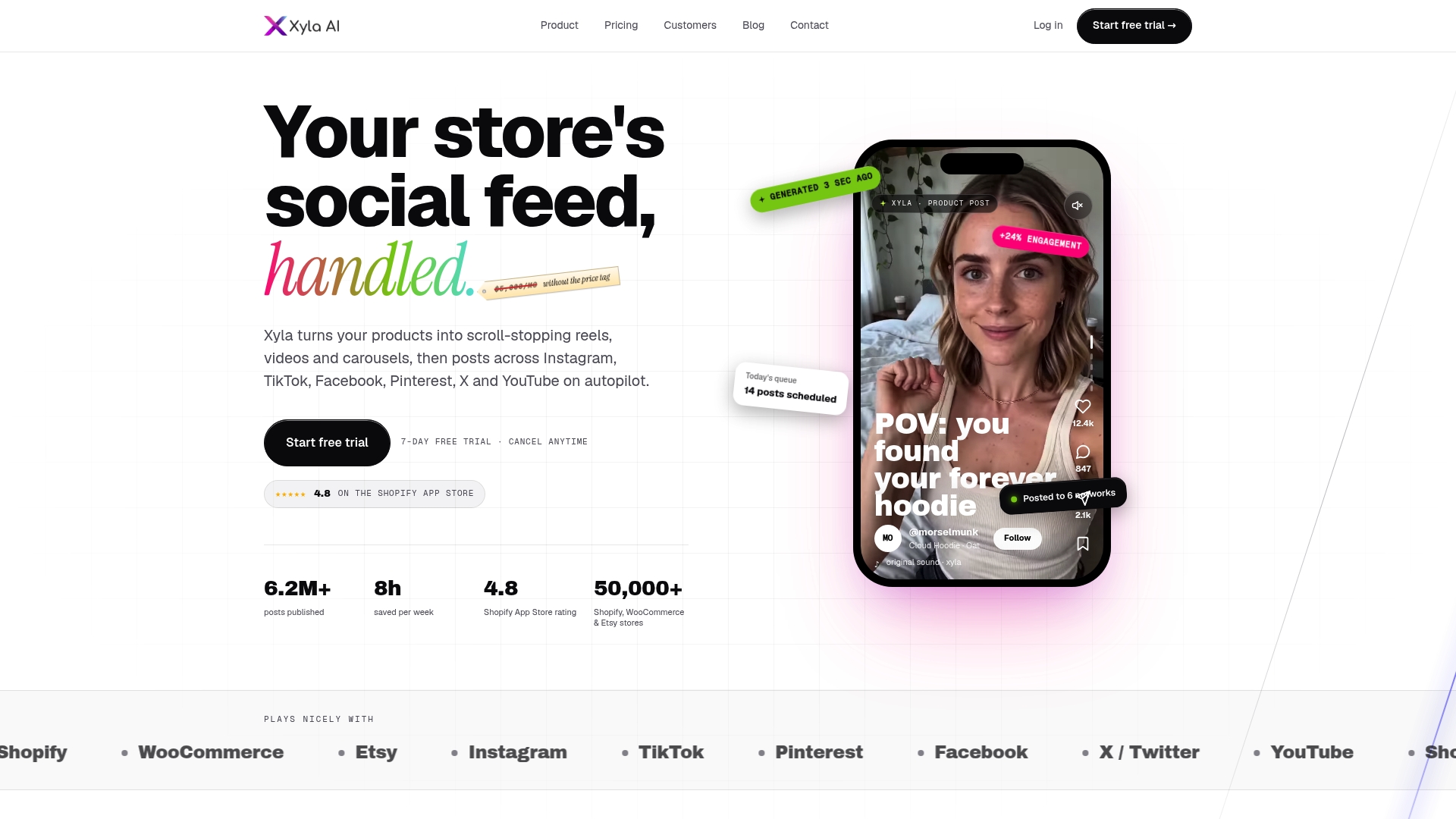
If you would rather not stitch together prompts, spreadsheets and a scheduler, Xyla turns your product listings into captions, reels, videos and carousels, then posts them to Instagram, TikTok, Facebook and other networks on a schedule. Plans on our pricing page start at $29 per month, with a free trial before you subscribe.
Shopify owners can see the plans built for their stores on the Shopify page, and Etsy sellers can find theirs on the Etsy page.
FAQ
Can AI write captions that sound like my brand?
Yes, if you show it your brand. Give it several real captions you are proud of, plus a list of words you avoid, and it will imitate the style far better than if you describe the tone in adjectives. Review the first batches closely and add to your rules each time you make the same edit twice.
Should I use the same caption on every social network?
No. Length, link behavior and audience expectations differ by platform, so a caption that works on Facebook can feel long on TikTok and unsearchable on Pinterest. Keep the core message and rewrite the opening, length and call to action for each network.
Are AI-written captions allowed under FTC rules?
The FTC does not ban AI-written copy, but the advertising rules still apply to what it says. Claims must be truthful and supportable, and endorsements must reflect real opinions with material connections disclosed. For a specific claim you are unsure about, ask an attorney who handles advertising law.
How do I know if AI captions are improving sales?
Tag every link with UTMs and record whether the caption was AI-drafted. After a few weeks, compare clicks and orders from those posts with similar manual posts on the same network. Change one variable at a time so the difference means something.
How long should an ecommerce caption be?
It depends on the network, but the first line must carry the hook because feeds cut off longer text. Put the product and the benefit up front and keep supporting detail short. Our caption length guide has the Instagram numbers.
Sources
- eBay: New Social Caption Generator Uses AI to Help Sellers Post More Easily
- FTC: The FTC’s Endorsement Guides: What People Are Asking
- FTC: Warning letter to Mary Ellen Phipps
- Examining the Impact of Generative AI Content on Impulse Buying
- Instagram Shopping product tag videos
- Online reviews and ecommerce SEO


