

WooCommerce to TikTok: Avoid the PNG Trap When Autoposting

Yes, you can autopost WooCommerce product videos to TikTok by sending product webhooks to an automation service that generates and publishes TikTok format media. The pipeline runs in four stages: a webhook or REST API call delivers product data, an engine builds a 9:16 video or image asset, the file gets hosted at a public URL, and the TikTok Content Posting API handles upload and publish polling. Most failures trace back to three things: wrong media format, private media URLs, and expired tokens.
TL;DR:
- Convert PNG assets to JPEG or WebP, then host them at a public HTTPS URL without redirects; TikTok may silently reject invalid formats or links.
- Poll each publish_id until PUBLISH_COMPLETE or FAILED, refresh access tokens automatically, and treat 4xx errors as permanent instead of retrying.
- Start with one lower priority SKU, then retain manual approval for flagship or high margin products and new categories before full automation.
- Begin at two to four posts weekly per product category, stagger launches, and judge results by engagement and product page referrals rather than publishing volume.
- Use hooks that state a product benefit, two or three relevant hashtags, and category templates; compare views, engagement, and product page clicks by SKU.
Table of Contents
- What you need before you start
- Building the pipeline: webhook to published post
- Turning product listings into TikTok posts people watch
- Keeping posts reliable after launch
- Obtaining and using WooCommerce REST API keys
- Scheduling and rate limits worth planning around
- Writing captions and hashtags that hold attention
- Handling errors beyond a simple retry
- Using TikTok analytics to improve future posts
- Securing TikTok account access and permissions
- Staying compliant with TikTok’s content and copyright rules
- Keeping AI-generated content on brand
- What to expect in the first month and beyond
- A plug-and-play way to run this pipeline
- FAQ
- Sources
What you need before you start
Before wiring WooCommerce to TikTok, confirm you have every piece of the chain in place. Missing even one of these turns a simple automation into a debugging exercise.
- WooCommerce admin access to create webhooks or generate REST API keys with read and write permissions.
- A server or automation platform that can receive webhook calls and serve media over public HTTPS URLs.
- TikTok Business API credentials, or access through a service that already holds TikTok Content Posting API permissions.
- Server-side media conversion tooling to produce MP4, JPEG, or WebP files, plus logging to track each upload_id and publish_id.
Store owners without a developer on staff typically route this last requirement through a managed platform rather than building conversion scripts from scratch. Either way, the four items above are non-negotiable: skip the public hosting requirement, for instance, and TikTok’s upload step will fail silently rather than with a helpful error.
Building the pipeline: webhook to published post
The technical flow has six distinct stages, and each one has a specific failure mode worth planning for in advance.
-
Configure WooCommerce webhooks for
product.createdandproduct.updated, or fall back to REST API polling if your platform does not support webhooks. WooCommerce’s webhook topics and JSON payload structure cover these events natively, and WooCommerce processes them through wp-cron in the background by default. - Validate incoming payloads using HMAC-SHA256 verification against your webhook secret before parsing any JSON fields. This stops malformed or spoofed requests from reaching your media pipeline.
- Send product data to an AI content engine that selects a lead image or clip, builds a vertical video, and drafts a caption and thumbnail.
- Convert any PNG assets to JPEG or WebP server-side. TikTok’s upload workflow rejects PNG files in many cases, so this conversion step needs to run automatically, not as a manual fix after a failed post.
-
Host the finished media at a public HTTPS URL with no redirects, then call TikTok’s initialize publish endpoint. The TikTok Content Posting API returns an
upload_idandupload_urlat this step, whether you use the direct publish or Creator Inbox variant. -
Upload the file to the provided URL, then poll the publish status using the returned
publish_iduntil it reachesPUBLISH_COMPLETEor a terminalFAILEDstate. A published TikTok Business SDK example wraps this inpublish(),getPublishStatus(), and awaitForPublish()helper that loops until the status resolves.
Build retries with exponential backoff into step six, and log the failure reason every time a publish attempt does not complete. Since the publish flow is asynchronous, a post that looks “sent” from your server’s perspective may still fail on TikTok’s side minutes later.
Pro Tip: Test your pipeline with a single low-priority SKU first and watch the full cycle complete before connecting it to your entire catalog.
Turning product listings into TikTok posts people watch
A product feed does not become a good TikTok video just because it gets formatted correctly. The mapping from WooCommerce fields to on-screen content needs a template.
- Use the product title as your opening hook, the main product image or a short demo clip as the visual lead, and the price or active promotion as your call to action.
- Overlay key features as on-screen text rather than burying them in the caption, since most viewers watch with sound off for the first few seconds.
- Favor 3 to 15 second UGC-style demos, quick before-and-after comparisons, or lifestyle use-case clips shot for vertical viewing.
- Test 2 to 4 posts per week per product category, staggering launches so you are not publishing every SKU in a single afternoon.
- Keep a manual approval queue for high-margin or flagship products, even if the rest of the catalog posts automatically.
Our internal hook-performance tracking shows that specific, benefit-led opening lines consistently outperform generic product descriptions in the first two seconds of a clip, which is the window that determines whether a viewer keeps watching. Pair that opening with a caption that includes two or three relevant hashtags and, where useful, a link routed to the product page or a link-in-bio landing spot. For more on crafting hooks and formats that hold attention, see our guide to TikTok product videos.
Keeping posts reliable after launch
Once the pipeline is live, the work shifts from building to monitoring. A few operational habits catch most problems before customers notice a gap in your posting schedule.
- Record every
upload_idandpublish_idfrom TikTok’s responses and poll status endpoints until you hitPUBLISH_COMPLETEor a terminal failure. - Build token refresh into the system rather than relying on a manually generated token that will eventually expire mid-cycle.
- Pre-check every hosted media URL for redirects or 4xx and 5xx responses before calling TikTok, since a bad URL often fails silently instead of throwing a clear error.
- Apply backoff and retry policies for transient errors, and set up alerts for repeated failures or permanent rejections so a human gets notified.
- Keep a simple log or dashboard showing publish timestamps, resulting post links, and basic performance metrics.
Pro Tip: Set an alert threshold of two consecutive publish failures on the same SKU category. That usually signals a format or permissions issue rather than a one-off glitch.
Obtaining and using WooCommerce REST API keys
WooCommerce ties directly into the WordPress REST API, which means product data access starts with generating a key pair rather than writing custom database queries. Go to WooCommerce > Settings > Advanced > REST API and create a new key with read and write permissions if your automation needs to update product metadata after a post goes live, or read-only if it only needs to pull product details.
The WooCommerce REST API documentation covers authentication through Basic Auth using the consumer key and consumer secret pair generated in that settings screen. Store these credentials outside your codebase, in environment variables or a secrets manager, since they grant direct access to your product catalog and order data depending on the permission level chosen.
Once authenticated, requests to product endpoints return structured JSON, which is what your automation engine parses to pull titles, images, prices, and categories. If your setup does not support webhooks, the same credentials let you poll the products endpoint on a schedule, filtering by status, SKU, or product type to catch new or updated listings. Rotate keys periodically and revoke any key tied to a developer or service you no longer use, since an old key with write access left active is a common, avoidable security gap.
Scheduling and rate limits worth planning around
Posting frequency on TikTok is a balance between staying visible and not training your audience to scroll past your content. For most WooCommerce stores, two to four posts per week per product category keeps a feed active without flooding followers with near-identical clips of every SKU in a collection.
On the technical side, both WooCommerce and TikTok impose their own constraints. WooCommerce webhooks fire as events happen, but because they process through wp-cron by default, high-traffic stores can see delays during peak load, which means your automation should not assume instant delivery. Build in a polling fallback using the WooCommerce products API for cases where a webhook event does not arrive as expected.
On TikTok’s side, the Content Posting API is built around an asynchronous publish flow: you do not get an instant confirmation, you get an upload_id or publish_id that you must poll until the status resolves. Hammering that status endpoint too frequently risks hitting rate limits, so a polling interval of a few seconds with a reasonable timeout window works better than checking in a tight loop. Space out your actual publish calls, too. Queuing ten posts to fire in the same minute increases the odds of hitting a rate ceiling and creates a backlog of failed or delayed publishes that are harder to debug individually.
Writing captions and hashtags that hold attention
The caption and hashtags attached to an autoposted product video matter as much as the video itself, since they are what TikTok’s algorithm and human viewers both use to decide relevance in the first half second of a scroll.
Lead with a short, specific line tied to the product’s main benefit rather than a generic description pulled straight from your product page. “This cuts your morning routine to 90 seconds” reads stronger than “New arrival: travel mug.” Keep hashtags to two or three per post, mixing a broad category tag with one or two specific to the product or niche. Stacking ten hashtags does not add reach and often reads as spam to viewers.
Where your automation supports it, route a caption variable so promotions or limited-time pricing can be swapped in without touching the video template itself. This keeps seasonal campaigns, like a holiday sale, from requiring an entirely new content pipeline. For a deeper breakdown of cadence and format planning across a full content calendar, our WooCommerce social media marketing strategy guide covers how to sequence these posts over a longer campaign window.
Finally, keep caption tone consistent with how your brand talks elsewhere. A caption that sounds like a press release next to a casual, UGC-style video creates a mismatch that viewers notice even if they cannot articulate why.

Handling errors beyond a simple retry
Retry logic with exponential backoff solves transient problems, a dropped connection, a momentary rate limit, a slow server response. It does not solve the underlying problem when a failure is permanent, and treating every failure the same way leads to wasted retry cycles and posts that silently never go live.
Build error handling in layers. First, classify failures: a 4xx response from TikTok’s API usually means a permanent issue (bad format, invalid token, policy rejection) that retrying will not fix, while a 5xx or timeout is more likely transient and worth a backoff retry. Second, log every failure with enough context to debug later: the SKU, the media URL, the response code, and the exact error message returned by TikTok’s API.
Third, set up alerting separate from logging. A log file nobody reads does not stop a week of failed posts from going unnoticed. A simple alert, an email or a message to a team channel triggered after two or three consecutive failures on the same product or category, catches problems while they are still small. Fourth, build a dead-letter queue or failure bucket for posts that exhaust their retries, so a human can review and manually resolve them instead of the system quietly dropping that product’s post entirely.

Using TikTok analytics to improve future posts
Publishing a video is the midpoint of the pipeline, not the end of it. Once a post is live, pulling basic performance data back into your workflow is what turns a one-off autopost system into something that improves over time.
At minimum, track view count, engagement rate, and any click-through to your product page or link-in-bio destination for each published post. Tie that data back to the product SKU and the content template used, so you can see which hooks, formats, or caption styles perform best across your specific catalog rather than relying on general TikTok best practices that may not match your audience.
Feed that performance data back into your content generation step. If lifestyle-use clips consistently outperform static product demos for a given category, weight future generations toward that format. If a particular caption style gets more saves or shares, test variations of it on upcoming posts. This feedback loop is what separates a basic autoposting setup from one that actually improves conversion over months of use, and it is far more useful as a success metric than raw publish counts alone.
Securing TikTok account access and permissions
Automated posting means a piece of software, not a person, holds credentials with the ability to publish content to your brand’s TikTok account. That makes access control worth setting up carefully from the start rather than treating it as an afterthought.
Grant API access through TikTok’s Business account structure rather than a personal account, since business accounts support more granular permission scopes and are built for this kind of third-party integration. Limit the scope of any API token to only what the publishing flow needs, typically content posting and basic profile read access, rather than granting broader permissions by default.
If multiple people on your team need visibility into what the automation is doing, use role-based access on whatever platform manages the integration rather than sharing a single login. Rotate API credentials on a regular schedule and immediately revoke access for any developer, contractor, or platform you stop using. Treat the token itself as a sensitive credential: store it encrypted, never in plain text in a configuration file committed to a shared repository, and log when it gets refreshed or reissued.
Staying compliant with TikTok’s content and copyright rules
Automated posting does not exempt a brand from TikTok’s content policies, and a system that posts without any compliance check can create problems faster than a human posting manually would, simply because of volume.
Make sure any product imagery, video clips, or music used in generated content comes from sources you have rights to use. Stock footage, licensed music libraries, or your own product photography are safe; pulling unlicensed music or third-party video clips into an automated pipeline is not, regardless of how the content performs. Review TikTok’s community guidelines and advertising policies periodically, since they update over time and automated systems do not adjust on their own.
Build a manual review step for any new product category or content template before it goes fully automated, since a template that works fine for one type of product might inadvertently violate a policy when applied to a different category, like health claims on a supplement product. A sandbox or staging period, before TikTok approves broader publishing access for a given app, is also typically required during initial API setup, so plan your launch timeline around that review window rather than assuming instant production access.
Keeping AI-generated content on brand
Generic AI output is the fastest way to make an automated TikTok presence feel like it belongs to no one in particular. The fix is building customization into the content generation step rather than treating every product the same way.
Set a brand voice profile, tone, vocabulary, even specific phrases to avoid, that feeds into caption and script generation so output reads consistently across every post, not just the first few you review manually. Build template variants by product category, since a skincare brand’s tone for a serum post should differ from its tone for a gift-set promotion, even if both come from the same catalog.
Reserve space for promotional overrides: a sale, a new launch, or a seasonal campaign should be able to swap in specific messaging without rebuilding the entire content template. This is also where keeping a manual approval queue for flagship products pays off, since those are the posts most worth a final human check before they go live on a brand’s most visible channel.
What to expect in the first month and beyond
Plan for one to three weeks to get templates and the media pipeline stable, longer if you are building the conversion and polling logic from scratch rather than using an existing service. After that, expect ongoing tuning rather than a finished system. Hooks that work well in week one often fade by week six, so revisit caption templates regularly.
Measure success by engagement lift and referral traffic to product pages, not by how many posts went out. A store publishing daily with flat engagement is worse off than one publishing three times a week with growing click-through. Prioritize manual review for your highest-margin SKUs even after the rest of the catalog runs on autopilot.
— Toby
A plug-and-play way to run this pipeline
Building the webhook validation, media conversion, and TikTok polling logic described above takes real engineering time, time most store owners would rather spend on products or customers. We built our platform to handle that entire chain for WooCommerce stores: product updates trigger AI-generated video and image content, media gets converted to TikTok-compliant formats automatically, and posts publish and get monitored through the retry and polling logic without anyone touching code.
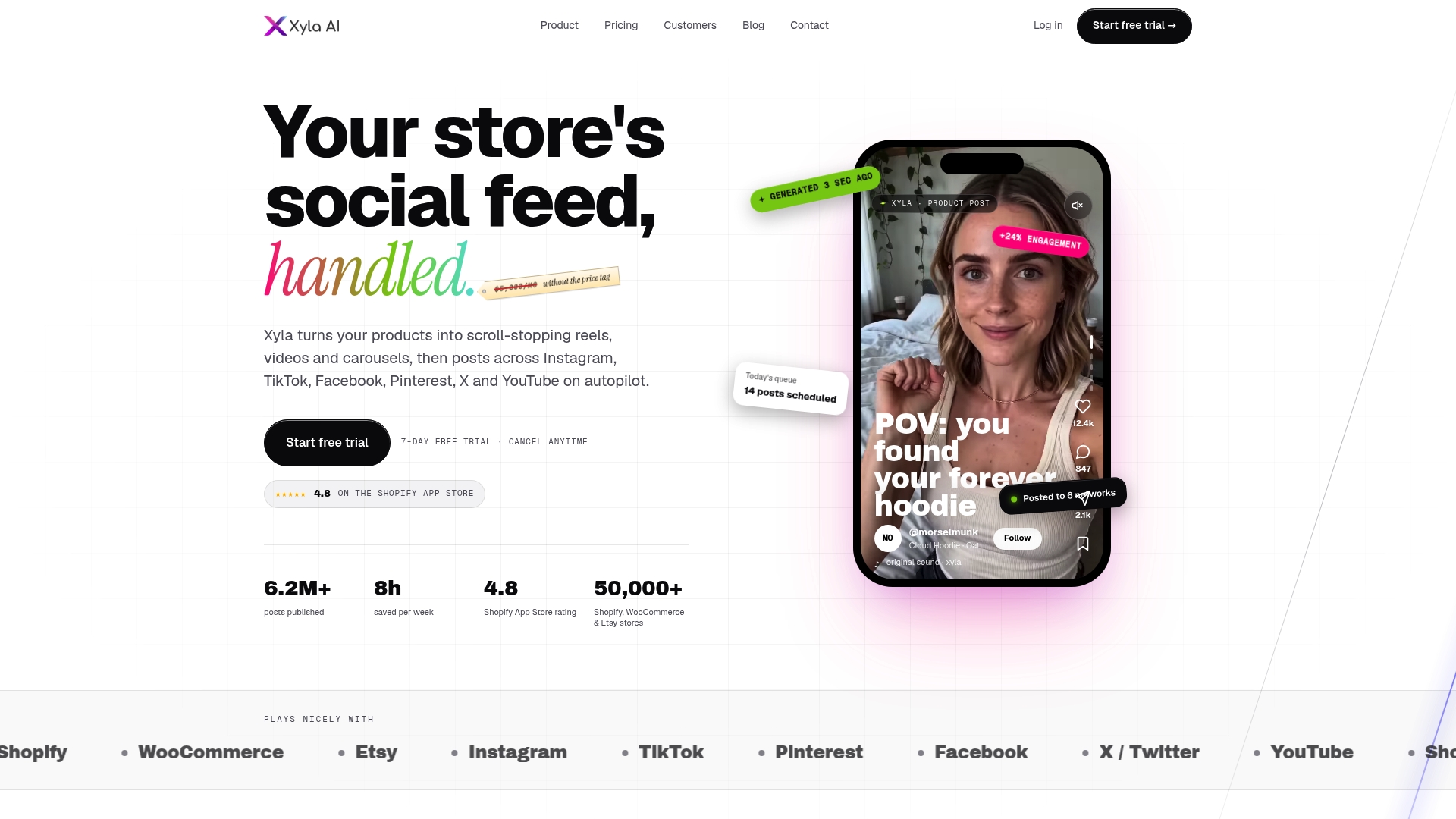
- We turn WooCommerce product listings into 9:16 video, carousel, and image content automatically, including clips built from product data.
- We handle format conversion, public media hosting, and TikTok publish polling to help reduce missed posts due to upload failures.
- We schedule posts across multiple social networks from a single product catalog connection.
If you run a WooCommerce store and want this pipeline running without building it yourself, see our WooCommerce integration or compare plans on our pricing page for current details.
FAQ
Can I autopost WooCommerce products to TikTok without coding?
Yes, a managed platform can handle the webhook setup, media conversion, and TikTok publish flow without you writing integration code. Building it yourself requires comfort with REST APIs, webhook validation, and polling logic, which is why many store owners choose a service that already connects WooCommerce to TikTok’s Content Posting API.
Why does TikTok reject my uploaded images?
TikTok’s upload workflow frequently rejects PNG files, so images need server-side conversion to JPEG or WebP before the upload step. Hosted media also needs a public HTTPS URL with no redirects, since a protected or redirecting link often causes a silent failure rather than a clear error.
How often should I post WooCommerce products to TikTok?
Testing two to four posts per week per product category is a reasonable starting cadence that keeps a feed active without overwhelming followers with every SKU at once, as explained in this small business video marketing approach. Staggering launches across the week, rather than posting an entire catalog in one batch, tends to perform better over time.
What happens if my TikTok access token expires mid-automation?
A token without a refresh flow will eventually stop working, causing publish calls to fail even though the rest of your pipeline runs correctly. Building automatic token refresh into the system, rather than relying on a manually generated token, prevents this from interrupting your posting schedule.
How do I know if a TikTok post actually published successfully?
Check the publish status using the publish_id returned when you initialize the post, polling until it reaches PUBLISH_COMPLETE or a terminal FAILED state. Because TikTok’s publish flow is asynchronous, a request that submits without an immediate error can still fail several seconds later during processing.
Sources
- WooCommerce webhooks | REST API v3
- WooCommerce REST API documentation
- TikTok open API spec (video publish snippets)
- TikTok Business SDK (publish workflow example)


