

Save Roughly 8 Hours a Week: Shoppable Instagram Reels for Shopify

You can make Instagram Reels shoppable on Shopify two main ways: through Facebook & Instagram by Meta, which lets you tag products directly on Reels, or through a shoppable-Reels app that builds curated on-site galleries. Most merchants should start with native tagging since it is free and built into Shopify. Larger catalogs or teams that need to post at scale often add an app or an AI tool like Xyla on top.
TL;DR:
- Native product tagging through Facebook and Instagram by Meta is free, scalable, and suitable for small catalogs with minimal post volume.
- Proper setup requires a business or creator account, connected store and catalog, verified domain, and approval from Meta before tagging.
- Tagging relies on an accurate, current Meta product catalog with correct variant mapping, especially for products with multiple options.
- Creating engaging Reels with immediate product display, vertical format, and trending audio increases purchase likelihood, especially when posted consistently.
- Automation tools like Xyla can streamline content creation and scheduling, saving time and handling large product catalogs more effectively.
Table of Contents
- Ways to add shoppable Reels to your Shopify store
- Setup and eligibility checklist before you start
- How product tagging connects Reels to your Shopify catalog
- Reels content that actually drives purchases
- Turning Reels views into tracked, attributable revenue
- When automation makes more sense than manual tagging
- When shoppable Reels are worth prioritizing now
- Let Xyla handle the Reels workflow for you
- Sources
- FAQ
Ways to add shoppable Reels to your Shopify store
Native tagging through Facebook & Instagram by Meta is the most direct route. Once your catalog is connected, you tag products from inside Instagram and the Reel shows a shopping bag icon that links viewers to product details, and from there to your Shopify product page. It costs nothing beyond your existing Shopify and Meta accounts.
Apps take a different approach: they pull your Reels into an on-site gallery or shoppable widget, which works well when you want curated, branded placement rather than relying on Instagram’s native shop pop-up.
Manual embed codes sit in a weaker spot. They display the video but carry no native product tagging, so a viewer has to hunt for the product elsewhere, which quietly kills conversion.
- Small catalog, simple tagging needs: use native Facebook & Instagram by Meta tagging.
- Large catalog or curated on-site display: use an app or automation tool.
- Basic video display only: an embed code works, but plan to add tagging separately.
Setup and eligibility checklist before you start
Before tagging anything, confirm you meet Meta’s commerce requirements. Shopify’s own guidance lays out what has to be in place, and skipping a step here is the most common reason approval stalls.
- Set your Instagram account to Business or Creator, not personal.
- Publish your Shopify store and connect it to a Facebook Page you control.
- Confirm the Page sits inside a Business Manager account you manage.
- Verify your domain and sync a product catalog that matches your live Shopify inventory.
- Check that your business operates in a supported country and complies with Meta’s commerce policies.
- Submit for Instagram Shopping review and wait for approval before tagging.
The most common errors are mismatched product data between Shopify and the Meta catalog, an unverified domain, and attempting to tag before approval clears. Xyla’s Shopify connection guide walks through the same sequence if you want a second reference while setting this up.
How product tagging connects Reels to your Shopify catalog
Tagging pulls from your Meta product catalog, not from Instagram itself, so every tag you place has to match an item that already exists in that feed. For products with multiple variants, such as size or color, you tag the specific variant rather than the parent product, and each variant needs its own identifier that matches the catalog mapping correctly, or the tag risks opening the wrong SKU page.
When someone taps a tag, Instagram shows a product pop-up with price and image, and a “View on website” link sends them to the Shopify product page to complete the purchase.
- Keep SKUs, images, and stock availability current so tags never point at sold-out or discontinued items.
- Double-check variant mapping any time you add new sizes or colors.
- Review and approve customer-generated tags on user posts before they go live, since unmoderated UGC tags can misrepresent a product or link to the wrong item.
Reels content that actually drives purchases
The first three seconds decide whether someone keeps watching, so show the product in use immediately rather than building up to a reveal. Shopify’s Reels guidance points to hooking viewers early and using trending audio as two of the more reliable levers, and Reels are reshared billions of times daily, which is part of why they outperform static formats for discovery.
Shoot in 9:16 vertical format and add text overlays for anyone watching with the sound off, since a viewer who cannot tell what you are selling will not tap the tag. Demos, quick how-tos, and UGC-style clips tend to convert better than polished ads because they read as authentic rather than promotional.

Pro Tip: Post at a consistent cadence, then A/B test one variable at a time, swap the hook, the caption, or the call-to-action, so you know exactly what moved the needle.
Turning Reels views into tracked, attributable revenue
A shoppable Reel is only useful if you can prove it drove a sale. Install the Meta Pixel and enable the Conversions API so ViewContent, AddToCart, and Purchase events get recorded even when browser tracking is blocked.
- Set your data-sharing level in the Facebook & Instagram by Meta channel, knowing that a higher setting improves accuracy but shares more customer data with Meta.
- Track click-through rate on tags, AddToCart rate, and return on ad spend for any Reels you boost as ads.
- Add UTM parameters to Reel links and reconcile the traffic against your Shopify order data to confirm the attribution lines up.
A partner resource on measuring social performance against Shopify conversions is worth a look if you want a deeper walkthrough of tying social traffic back to revenue.
When automation makes more sense than manual tagging
Manual tagging works fine for a handful of SKUs and a few Reels a week. It breaks down once you are managing dozens of products, multiple variants, and a posting schedule across more than one platform.
At that point, look for tools that auto-sync Reels into your Shop channel, stay catalog-aware as inventory changes, handle variant-level tagging without manual remapping, and schedule posts on a set cadence.
- Confirm the vendor supports catalog integration, not just video hosting.
- Ask how much editorial control you retain over captions and posting times.
- Check pricing against how many posts and networks you actually need.
- Verify how the platform handles your store data and account access.
Xyla builds Reels and short-form video directly from Shopify product listings and posts them automatically across Instagram, TikTok, and Facebook, which merchants use to reclaim roughly eight hours a week they would otherwise spend on manual content creation, according to Xyla.
When shoppable Reels are worth prioritizing now

Reels earn priority fastest for visually distinct direct-to-consumer products, things people want to see in motion before buying. If your catalog leans toward commodity goods with little visual story, the payoff is slower.
Start small: pilot three to five SKUs, test two or three creative angles per product, and watch add-to-cart rate before committing a full content calendar. If your catalog or team bandwidth already feels stretched, it is worth building automation into the plan from day one rather than bolting it on after burnout.
— Toby
Let Xyla handle the Reels workflow for you
Setting up native tagging gets you shoppable Reels, but keeping a steady stream of new content flowing is the part most store owners struggle to sustain. Xyla converts your existing Shopify product listings into short-form video content automatically, then schedules and posts it across Instagram alongside TikTok and Facebook, so you are not stuck filming and editing every week.
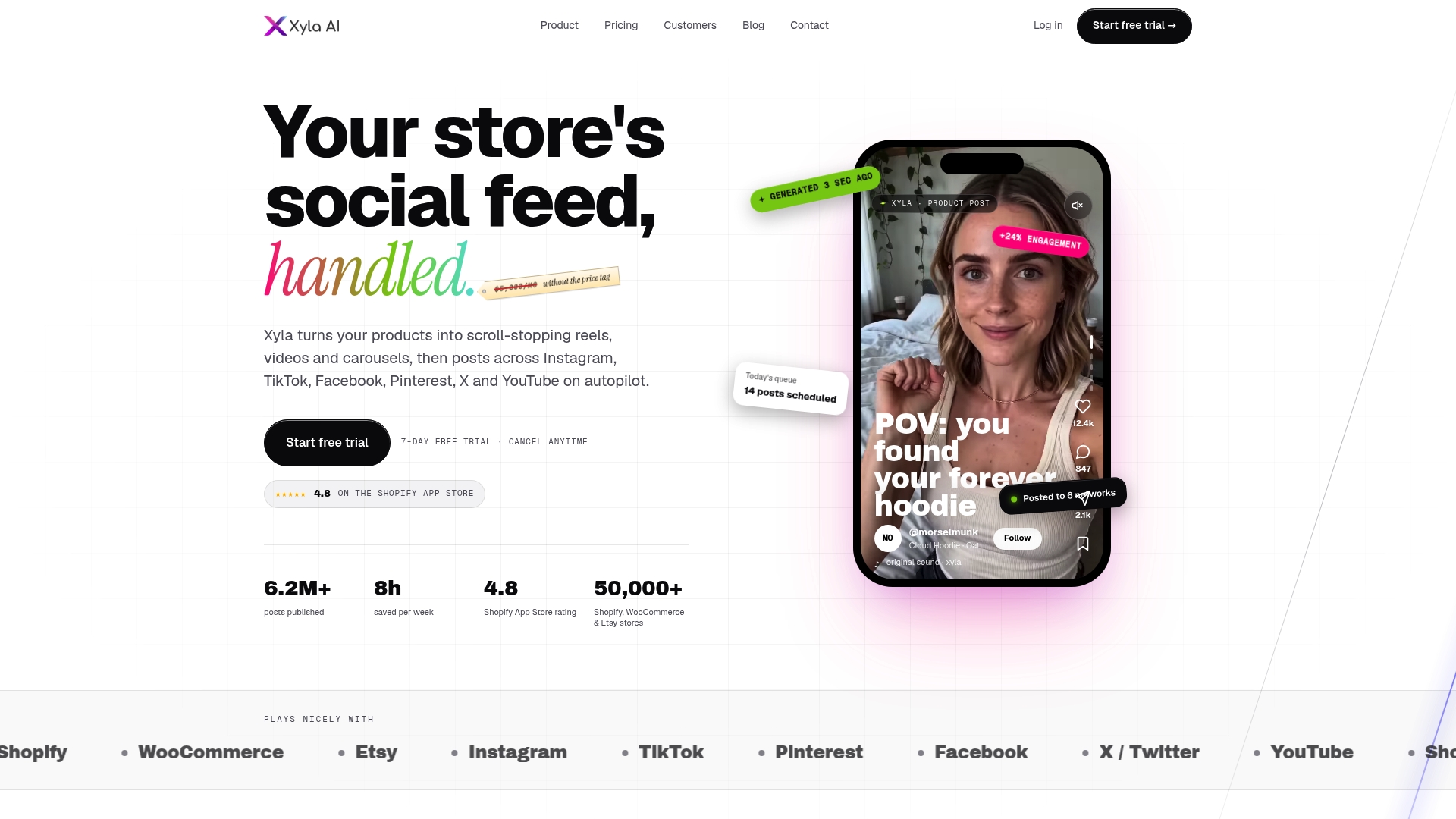
This fits best for stores with catalogs too large to tag and film manually, or teams without a dedicated person running social. A reasonable first step is connecting your Shopify store to Xyla and checking the pricing page to see which plan matches your posting volume.
- Product listings turn into ready-to-post Reels without manual editing.
- Posts publish automatically across Instagram, TikTok, and Facebook on a schedule.
- Plans scale with how many posts and networks you need active.
Sources
Shopify’s Help Center covers eligibility and setup in detail, and Xyla’s Shopify integration guide covers the connection steps.
- How To Use Instagram Reels For Growth and Engagement (2026) - Shopify
- Instagram Shopping — Shopify Help Center
FAQ
Can Shopify integrate with Instagram?
Yes, Shopify connects to Instagram through the Facebook & Instagram by Meta sales channel, which syncs your product catalog for tagging and shopping features. Setup requires a published store, a linked Facebook Page, and a professional Instagram account.
What sells fast on Shopify?
Products with strong visual appeal, things buyers want to see demonstrated or worn, tend to move fastest when paired with video content like Reels. There is no single universal bestseller category, since what sells depends heavily on your niche and audience.
What is the best Instagram feed app for Shopify?
Shopify’s own Shop channel lets you import Instagram Reels and posts directly, with new posts syncing automatically once connected. For merchants wanting AI-generated content on top of that sync, a tool like Xyla can create and schedule the Reels themselves rather than just displaying existing ones.
Can I sell directly through Instagram?
Yes, once your account is approved for Instagram Shopping, tagged products show a pop-up with pricing and a link that can send shoppers to your Shopify product page to complete checkout. The exact checkout flow depends on your store setup and Meta’s current shopping features in your country.


