

AI Content Disclosure: What to Label and Where

Label an AI-made post when a reasonable viewer could mistake it for something real: a real person, a real place, a real event, or a product result that did not happen. Put the label where it is seen at first glance, ideally on the image or video itself, and keep the wording plain and accurate. Stylized graphics, obviously impossible scenes and minor edits generally do not need one. If you run a Shopify, WooCommerce or Etsy store and post every week, a simple disclosure routine takes minutes and protects your account and your customers’ trust. We built Xyla to turn your product listings into reels, carousels and videos on a steady schedule, so a routine like this fits naturally into a calendar that is already running.
TL;DR
- Disclose when AI content is realistic enough to pass as real: a person who never said or did something, a scene that never happened, or footage of a real place that was altered. Platforms such as YouTube spell this out.
- Obviously stylized, fantastical or lightly edited content is generally outside the rules, though each platform has its own wording.
- Place the label on the asset (an overlay) and not only in the caption, and use neutral language such as “Made with AI” or “Image generated with AI assistance.”
- In the US, the platform rules are the ones you meet every day. State and EU laws add duties for providers and, in the EU, for some deployers, with fines that can be large.
- Holiday posts with realistic AI people, homes or events deserve a label. A clearly illustrated festive product card does not.
Table of Contents
- What an AI content label actually means
- Is AI disclosure legally required for your store?
- A quick test: does this post need a label?
- Where the label goes
- Wording that is accurate and calm
- AI holiday posts: festive does not mean exempt
- Build disclosure into your posting routine
- What happens if you skip it
- Our perspective
- Keep your calendar full and your labels consistent
- FAQ
- Sources
What an AI content label actually means
An AI content label tells viewers that a piece of media was created or materially changed by artificial intelligence. It is a transparency signal, not a quality grade and not a warning. The question every platform and regulator asks is the same: could the audience be misled about what is real?
YouTube’s policy is the clearest public example. It asks creators to disclose realistic content that is AI-generated or meaningfully altered when it:
- makes a real person appear to say or do something they did not,
- alters footage of a real event or place,
- generates a realistic scene that did not occur, or
- creates music that is the main focus of the video.
The same page says non-realistic content and minor aesthetic edits do not require disclosure. That distinction does most of the work for e-commerce sellers. A cartoon-style graphic announcing a sale is a different thing from a lifelike “customer” holding your product who does not exist.
A useful frame is the foreseeable context: label media that could falsely appear authentic where it will actually be seen, and you do not need to label recognizably impossible depictions or illustrations with no potential to deceive. Ask what a shopper scrolling quickly would believe, not what you intended.
Is AI disclosure legally required for your store?
It depends on where you and your audience are, what the content is and who is responsible for it. Three layers apply, and they are easy to confuse.
Platform policies: the layer you meet first
Meta, TikTok and YouTube often require disclosure for realistic AI-generated or altered media, whether or not a law in your jurisdiction demands it. Breaking those rules can lead to content removal, account suspension, demonetization or permanent bans. For a store that depends on one Instagram or TikTok account for traffic, that is the practical risk.
Some labels also appear without you adding anything. Meta, for example, automatically labels ads made or significantly edited with some of its own generative AI tools, or detected as made with third-party tools, and the disclosure appears in the ad’s “About this ad” menu. Do not assume a platform label replaces your own: the safest habit is to disclose accurately yourself.
US state law
California’s AI Transparency Act (S.B. 942) became operative on 2 August 2026. It targets generative AI providers with over one million monthly visitors or users, requiring a free AI detection tool and the option to include clear, conspicuous, hard-to-remove disclosures. Violations can bring civil penalties, injunctive relief and attorneys’ fees, and the Attorney General’s office may bring action, according to a practitioner guide from a law firm. Most small stores are not providers under that definition, but the tools you use may be, and the labeling features they offer are meant for you to use.
The EU AI Act
If you sell to customers in the European Union, Article 50 matters. It requires deployers to disclose AI-generated or manipulated image, audio or video content that constitutes a deepfake, and AI-generated text published to inform the public on matters of public interest. The information has to be clear and distinguishable by the viewer’s first exposure. The text obligation does not apply where a person or entity has editorial responsibility after human review.
Providers of AI systems face a separate duty from 2 August 2026: outputs in audio, image, video and text must be marked in a machine-readable format and detectable as artificially generated or manipulated. A Polish technology law expert pointed out that the editorial exemption covers text only, so synthetic images and video must be labeled even after human review. The same coverage reports that violations of these transparency duties can reach fines of up to €15 million or 3% of global annual turnover, whichever is higher.
One caution on interpretation: the exemption for content depicting things that do not exist leaves room for argument, and experts quoted in the same coverage disagree on edge cases. If you have a specific legal question, for example about a campaign aimed at EU customers, ask a lawyer who handles advertising or AI regulation.

A quick test: does this post need a label?
Run each post through five questions before it is scheduled.
- Does it show a real or realistic person? A lifelike human who never existed, or a real person made to say or do something new, calls for a label.
- Does it depict a real place or event? Altered footage of a real location, or a generated scene presented as something that happened, calls for a label.
- Could a shopper take it as documentary? A “customer review” video, a “behind the scenes” shot or a “before and after” that never took place is the classic case.
- Is it obviously stylized? Illustrations, cartoons, fantasy scenes and plain graphic cards generally do not need one.
- Is it a light edit? Color correction, cropping, background cleanup or caption text is the kind of minor aesthetic edit YouTube’s policy excludes.
If the answer to any of the first three is yes, label it. If you are unsure, label it. A label on a post that did not strictly need one costs you a few words. A missing label on a post that did can cost you the account.
Where the label goes
On the asset first
For social images and videos, the best practice is to embed the label on the asset as an overlay and not only in the caption. A caption can be trimmed, hidden behind “more,” or lost when someone downloads and reshares the file. An on-asset label persists wherever the media travels.
Under the EU Code of Practice, the pattern for video is a label at the start, repeated at regular intervals, especially after interruptions. For published text, the label goes at the top near the headline, and for audio-only content a plain-language audible notice comes at the start. Labels must be perceivable without any interaction, stay visible long enough to read and meet accessibility requirements. Those are EU rules, but they make a sound standard for any market.
Then in the caption and alt text
Add a short line to the caption too, and mention it in alt text where the platform supports it, so screen-reader users get the same information as everyone else. Use the platform’s own AI label toggle when it has one, in addition to your overlay.
Keep it away from the product
A 2025 study presented at the CHI conference found that users preferred labels positioned above or below the image over labels obstructing it. Put the tag in a margin or a clear strip, not across your product.
Wording that is accurate and calm
The same CHI study found people preferred neutral labels such as “Made with AI,” or other wording that includes “AI,” to warning-style labels using the term “Deepfake,” which caused ambiguity. Say what happened, in plain words, and say no more than the truth.
Here are phrasings that match common workflows:
Situation Example wording Image generated from a product photo Image generated with AI assistance Video built from your listing photos Video made with AI from our product photos Caption drafted by AI, then edited by you Drafted with AI, reviewed by our team Realistic AI person or scene Made with AI Holiday scene created with AI Festive scene created with AIMatch the label to your real workflow. If a person on your team reviewed and edited the copy, say so. If only the background was generated, say the background was. Over-claiming (“entirely AI”) and under-claiming both misdescribe what you did.
AI holiday posts: festive does not mean exempt
Holiday content is where stores lean on AI hardest: gift guides, countdowns, seasonal product shots, cozy lifestyle scenes. The test is the same as always. Label holiday posts that depict AI-generated people, places or events that could falsely appear authentic. Recognizably impossible depictions, such as a reindeer pulling a box of your candles through the sky, are not covered.
A practical split for the season:
- No label needed in most cases: a graphic holiday sale card, a product-on-festive-background composition that is obviously stylized, a countdown carousel with illustrations.
- Label it: a photoreal family opening your product around a tree, a lifelike “customer” unboxing, a realistic storefront or street scene that looks like a real location.
Mind audience expectations too. Coca-Cola’s 2023 attempt to remake its famous holiday ad with generative AI drew public backlash, a reminder that audiences care about authenticity at the most sentimental moments of the year. Research on consumer perceptions points the same way: brands do best when their AI use matches what their audience expects. The fix is not to avoid AI. It is to be upfront and to explain how AI helps you show your products, and to keep your real products at the center. Our guide to AI product visuals covers how to keep generated imagery tied to what you actually sell.
The broader point about trust is covered in these AI branding strategies, which connect transparent disclosure with audience expectations and concerns that AI may replace human creativity.
Build disclosure into your posting routine
Disclosure fails when it is an afterthought. It works when it is a fixed step. A routine for a small store:
- Write a one-page policy. List what you generate with AI (product visuals, captions, video), what a person reviews, and the standard wording you use for each.
- Decide the label by content type. Realistic people and scenes get the overlay and caption line. Graphic cards and stylized art follow your policy.
- Check once a week. When you review the upcoming calendar, scan for realistic people, places or events and add labels before posts go out.
- Keep the originals. Save the source product photos and your workflow notes so you can describe how an asset was made if a platform or customer asks.
- Re-read platform rules each quarter. Policies and laws change, so check the official help pages of the networks you post on.
If you automate posting, the schedule is the natural place for step three. Our walkthrough on auto posting from product updates shows how store changes become scheduled posts, and the AI social captions guide covers writing captions you can edit and sign off before they publish.
What happens if you skip it
On platforms, the consequences are practical: removed posts, restricted reach, suspended accounts. Under EU law, as noted above, the fines are set at a level that gets attention. The reputational side is quieter but real. A shopper who discovers a “customer video” was synthetic and unlabeled does not file a complaint. They simply stop trusting your feed.
The upside runs the other way. A short, calm label on a realistic AI image tells your audience you are in control of your content. That is the posture of a brand that has nothing to hide.
Our perspective
We think AI content disclosure is a workflow question, not a moral one. If your posts come from your real catalog, with your real product photos as the starting point, most of what you publish is stylized product content that sits comfortably outside the realistic-deception zone. The few posts that cross it, a lifelike person or a believable scene, are easy to spot and easy to label.
That is the idea behind how we built Xyla: it generates new visual content from your actual product data and photos, adapts it for each network, and posts it on a calendar. The product is at the center of the content, which is exactly what shoppers came to see. AI generation is included in the standard plans, so you are not rationing generations or cutting corners to stay under a credit cap, and that leaves time for the review step where you decide whether a post needs a label.
Our advice to store owners is simple. Decide your wording once, apply it consistently, and spend the hours you save on the part only you can do: knowing your customers.
Toby
Keep your calendar full and your labels consistent
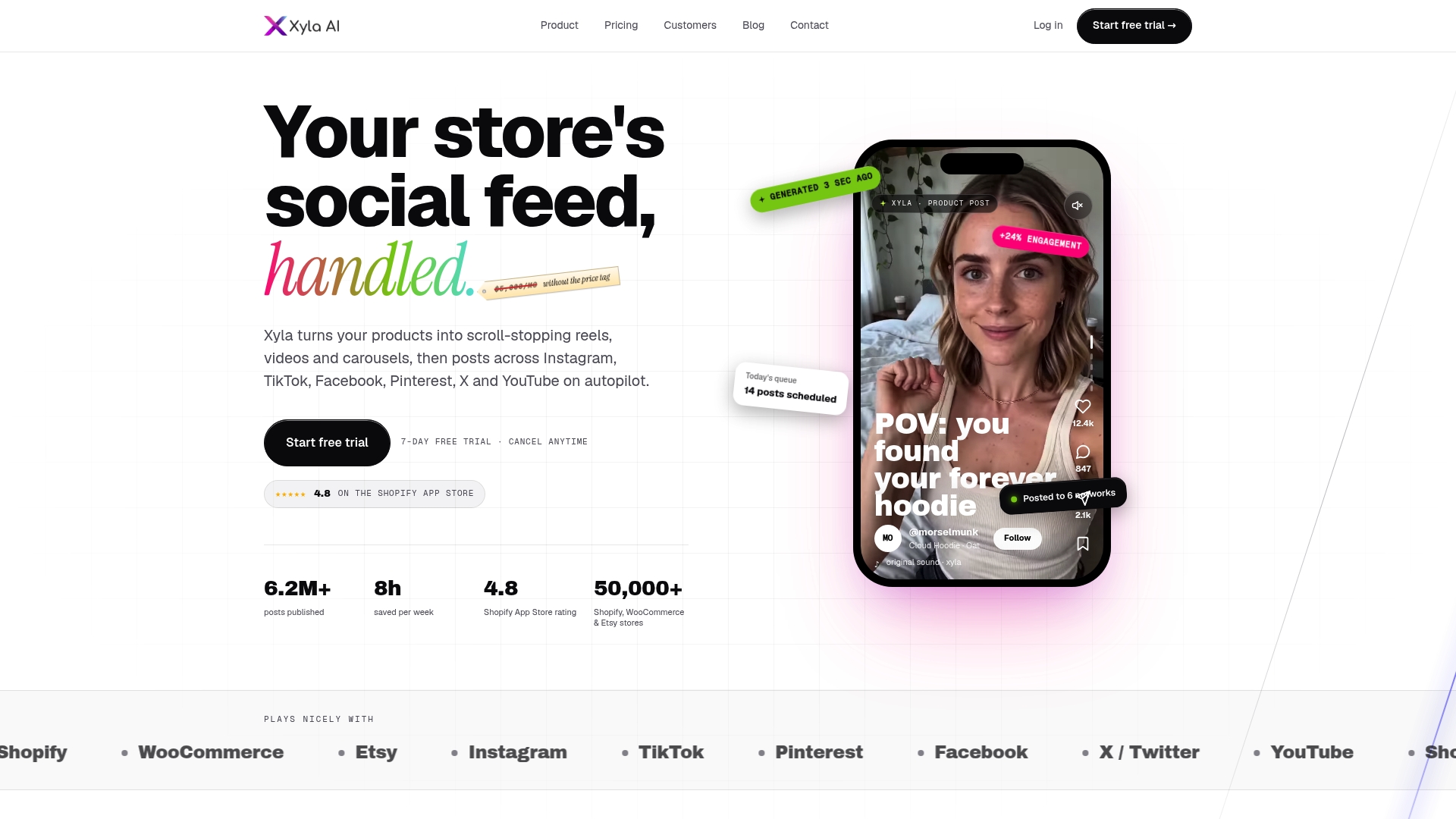
Xyla turns your Shopify, WooCommerce or Etsy listings into reels, videos, carousels and holiday posts, adapts them for Instagram, TikTok, Facebook and other networks, and publishes them on a schedule, which is built to save store owners around eight hours a week. Plans start at $29 per month, with annual billing from $209 per year for the entry tier. See the Xyla pricing page for every plan, or go straight to the Shopify plans or Etsy plans.
If realistic UGC-style video is part of your plan, read how to scale AI-generated UGC for ecommerce and how AI UGC video is made from your own products.
FAQ
Do I have to label every AI-generated post?
No. The common standard is to label realistic content that could be mistaken for real people, places or events. Platforms such as YouTube say non-realistic content and minor aesthetic edits need no disclosure. When you are unsure, add a short label.
Why does my post show an AI label when I did not add one?
Some platforms apply labels automatically. Meta labels ads made or significantly edited with certain generative AI tools, or detected as AI-made, and shows the disclosure in the ad’s “About this ad” menu. Check the platform’s help page for how its labels work in your account.
What should an AI disclosure say?
Keep it short, neutral and true to your workflow, such as “Image generated with AI assistance” or “Made with AI.” Research on label design found people preferred neutral wording that includes “AI” over warning-style terms like “Deepfake.”
Do AI holiday posts need a disclosure?
Only when they could pass as real: a photoreal family, a lifelike customer or a believable real-world scene. Obviously stylized festive graphics and clearly impossible scenes generally do not. Label the realistic ones on the image itself and in the caption.
Does the EU AI Act apply to a US store?
It can, if you reach customers in the EU. Article 50 sets disclosure duties for deployers of deepfake-type content, and provider duties started on 2 August 2026. For a specific campaign, ask a lawyer who handles advertising or AI regulation.
Sources
- Disclosing the use of GenAI content, YouTube Help
- Labelling AI-generated content: symbol, placement and exceptions, IONOS
- AI Disclosure Requirements: The Complete Guide for Businesses
- Meta adds updated disclosure tags for AI-generated ads, Marketing Dive
- Generative AI Disclaimers: A Practitioner’s Guide, FBT Gibbons
- Article 50 of the AI Act: Transparency obligations
- Code of Practice on Transparency of AI-generated Content, European Commission
- EU AI Act transparency rules take effect today, Pollar
- The EU’s new AI labelling rules, Lewis Silkin
- Labeling Synthetic Content: User Perceptions of Label Designs, ACM CHI 2025
- Transparency Without Trust, NIM Insights
- Capturing complex perceptions: a case study on consumer perceptions of AI, Kansas State University
- Branding Through Digital Marketing: AI Strategies for 2026


