

Store Owners: 6 Evergreen Social Posts That Work Without Daily Posting

Evergreen social posts are reusable, long-lived pieces of content that stay relevant months or years after you publish them, unlike news or trend posts that expire in days. Their main payoff is consistency: you post less often while keeping your feed active, which frees up hours every week. Paired with proven content formulas and a steady cadence, they form the backbone of what many marketers call an always-on content strategy.
TL;DR:
- Evergreen social posts are designed to remain relevant for months or years, reducing the need for constant new content creation.
- Building posts around specific “recipes” with clear visuals and captions enhances engagement more than unstructured content.
- Tips, FAQs, product basics, UGC, checklists, and case highlights adapt well across platforms like Instagram, TikTok, Pinterest, and Facebook.
- An automation tool can generate, schedule, and repurpose evergreen content from product catalogs, saving small teams significant time.
- Refresh posts when engagement declines or underlying facts like prices or features change, rather than reposting outdated content.
Table of Contents
- Why evergreen social posts matter for long-term engagement
- Practical evergreen post types and platform-fit examples
- How to create evergreen social posts step by step
- Repurposing, scheduling, and cadence to keep content working
- Measuring success and knowing when to refresh
- Templates, caption prompts, and visual briefs you can copy
- Building an evergreen-first system that frees time
- How Xyla automates evergreen social posts for stores
- Sources
- FAQ
Why evergreen social posts matter for long-term engagement
A one-off viral post can spike your reach for a day, then vanish from relevance. Evergreen posts work differently: a well-made product tip, FAQ, or how-to carousel keeps earning views, saves, and shares long after you hit publish, because the information behind it does not expire. That durability is what lets a small e-commerce team maintain a steady presence without producing new content daily.
Evergreen posts also form the structural backbone of an always-on content system. Instead of scrambling for ideas every morning, you build a rotating library of tips, FAQs, and product basics that you can schedule weeks or months in advance, then layer timely posts on top when something newsworthy actually happens.
The content itself matters as much as the schedule. An AMA study analyzing 516 Instagram stories found that specific combinations of visual, auditory, linguistic, symbolic, and social elements, what the researchers call content “recipes”, drove stronger engagement than optimizing any single element alone. Four recipes stood out: loud, informative, affective, and relational. That means an evergreen post built as a clear, informative recipe (a bold visual plus a plain-language tip plus a relatable caption) tends to outperform a post that is just a pretty picture with no structure behind it.
A few habits carry that research into practice:
- Build each evergreen post around one clear content “recipe” rather than a random mix of elements.
- Batch evergreen topics into a running list so you never start from a blank page.
- Treat evergreen posts as the default, saving spontaneous or trend-based content for the occasional real-time moment.
For a deeper look at what qualifies as evergreen versus what does not, the Digital Marketing Institute’s beginner’s guide is a useful primer.
Practical evergreen post types and platform-fit examples
Not every evergreen idea fits every platform the same way. Below is a working inventory you can pull from, organized by why each type holds up over time and how to adapt it across channels.
- Tips and how-tos. A short, practical tip (“3 ways to style this scarf”) never goes stale because the underlying advice does not depend on a season or trend. On Instagram, format it as a carousel; on TikTok, turn it into a 15-second demo with on-screen text.
- FAQs. Customers ask the same shipping, sizing, and care questions year-round, so answering them publicly saves you repeat direct messages and gives new followers instant context. A simple text-on-image post or a pinned Story highlight works well here.
- Product basics. Posts explaining what a product is made of, how it is used, or what makes it different rarely need updates unless you change the formula or materials. These make strong Pinterest pins since Pinterest users often search for exactly this kind of information months after it is published.
- User-generated content (UGC). A genuine customer photo or short review clip stays relevant as long as the product is in your catalog. Repost it as a Feed post, a Story highlight, or a testimonial slide in a carousel.
- Checklists. “5 things to check before buying a [product type]” style posts work as a single graphic or a multi-slide carousel and hold up because the checklist logic rarely changes.
- Case highlights. A short before-and-after or a customer outcome story (without time-sensitive numbers) can run on repeat, especially as a short-form video with a hook and a clear payoff.
Platform tailoring matters more than most people assume:
- Instagram favors carousels and Reels for tips, FAQs, and product basics.
- TikTok rewards short, hook-first video with a demo or transformation.
- Pinterest performs best with vertical, text-labeled pins that read well as a standalone search result.
- Facebook still works for longer captions paired with a single strong image, especially for FAQ-style posts.
A few one-line prompts you can copy and adapt right away: “The one thing customers always ask us about [product]”, “3 ways to use [product] you might not have tried”, “Before you buy [category], check this”, and “Here’s what’s actually inside [product]”. Swap in your own product name and category, and you have a starting draft in under a minute.
How to create evergreen social posts step by step
Building an evergreen library is less about creative bursts and more about a repeatable process. Start with topic selection: mine your own customer questions, product listing FAQs, and best-selling items for ideas, since these rarely go out of date. Search-driven “people also ask” style questions related to your niche are another reliable source, because they represent what buyers are already searching for.
Once you have a topic, write copy that avoids anything date-stamped. Skip phrases like “this year” or references to a specific sale, and instead write in a way that reads naturally whether someone sees it this week or next year. Keep captions focused on one clear idea, and use metadata (alt text, hashtags tied to the product category rather than a trending tag) that will still make sense months from now.
Design for longevity too. Avoid putting a date, a price that might change, or a limited-time offer inside the image itself. Use your brand colors and fonts consistently so the post still looks current even if you revisit it a year later.
Before you hit publish, run through a short checklist:
- Does the post avoid any date, price, or seasonal reference that could go stale?
- Is the topic something customers will still care about in six months?
- Does the visual follow your current brand style?
- Is the caption written as a standalone idea, not tied to a specific campaign?
Pro Tip: Keep a running spreadsheet of evergreen topics pulled from real customer questions, so you always have a backlog ready when you sit down to batch-create content.
Search Engine Land’s guide to evergreen content also flags what to avoid: breaking news, trend-based formats, and time-sensitive statistics do not belong in an evergreen rotation, even if they perform well in the short term.
Repurposing, scheduling, and cadence to keep content working
One evergreen post rarely has to stay in one format. A single idea can move through a repurpose matrix that stretches its life across every channel you run:
- A five-slide Instagram carousel becomes a 30-second TikTok or Reel by narrating the same steps on camera.
- That same short video gets cut down further into a Story with a poll sticker asking followers which tip they use most.
- The core tip gets folded into a newsletter section or product page FAQ, closing the loop between social and owned channels.
Cadence matters as much as format. A practical rule many social managers use is the 5-3-2 rule: out of every ten posts, five are curated or repurposed content, three are original value posts (your tips, FAQs, and how-tos), and two are more personal or promotional. Treat it as a flexible guideline rather than a strict formula, and fold promotional messages into value posts instead of isolating them as pure sales pitches.
Reposting an evergreen asset every few months is usually safe as long as the underlying facts have not changed. Refresh it instead of simply reposting when a product detail, price, or process changes.
Automation does the heavy lifting here. Scheduling tools let you queue a rotation of evergreen posts weeks in advance, and research on scheduling science suggests that posting at the right time for your audience, rather than an arbitrary time, has a measurable effect on clicks and engagement. Pairing structured scheduling with a small amount of human review for accuracy and voice keeps the system running without constant hands-on attention. A step-by-step guide to automating social media walks through setting this up in practice.

Measuring success and knowing when to refresh
Track evergreen posts by reach, saves, click-through rate, conversions, and engagement rate, in that rough order of priority for most e-commerce accounts. Saves and shares are particularly telling for evergreen content, since they signal a post is useful enough that someone wants to find it again later.
Set a simple threshold: when engagement on a previously strong evergreen post drops noticeably over a few consecutive posting cycles, or when an underlying fact (a price, a feature, a policy) changes, it is time to refresh the copy or visual rather than keep reposting it as-is.
A few cheap A/B tests worth running on your evergreen library:
- Swap the thumbnail or cover image and compare saves over two weeks.
- Test two different opening hooks on the same core tip.
- Post the same evergreen asset at two different times of day and compare click-through rate.
The AMA’s research on content recipes found that combining elements like a clear visual with an informative caption and a social hook consistently outperformed single-element posts, which makes hook and caption testing one of the higher-leverage places to focus your limited testing time.
Templates, caption prompts, and visual briefs you can copy
A few ready-to-adapt templates make starting easier than staring at a blank caption box.
Caption templates:
- Tip post: “One thing most people don’t know about [product]: [tip]. Try it and let us know how it goes.”
- FAQ post: “You asked, we answered: [question]? Here’s the short version: [answer].”
- Product demo: “Here’s exactly how to use [product] in three steps: [step 1], [step 2], [step 3].”
- Testimonial: “[Customer name or ‘a customer’] told us [result]. This is exactly why we made [product].”
A five-slide carousel outline for an evergreen how-to: slide one states the problem, slide two through four each cover one step with a simple visual, and slide five wraps with a call to save the post and a related product link.
A short-video shot list follows the same hook, value, call-to-action structure: open with a question or bold claim in the first two seconds, show the product solving the problem in the middle, and close with a direct next step, like visiting the link in your bio.
Building an evergreen-first system that frees time
Switching from constant fresh content to an evergreen-first calendar was less about working harder and more about building a system I could stop thinking about daily. Once I had a running list of product FAQs and tips, batching a month of posts in one sitting became routine instead of a scramble, and that freed real hours for actually talking with customers instead of just posting at them.
The clearest lesson: a repeatable flow (one topic, one recipe, one repurpose path across formats) beats chasing a new idea every single day.
— Toby
How Xyla automates evergreen social posts for stores
Building an evergreen library by hand still takes time: writing captions, designing visuals, and scheduling across five platforms adds up fast for a small team. An AI social media tool can turn product listings into evergreen visual content, such as reels, carousels, and UGC-style videos, then schedule and publish it automatically across major social networks, without manual management by a dedicated content person.
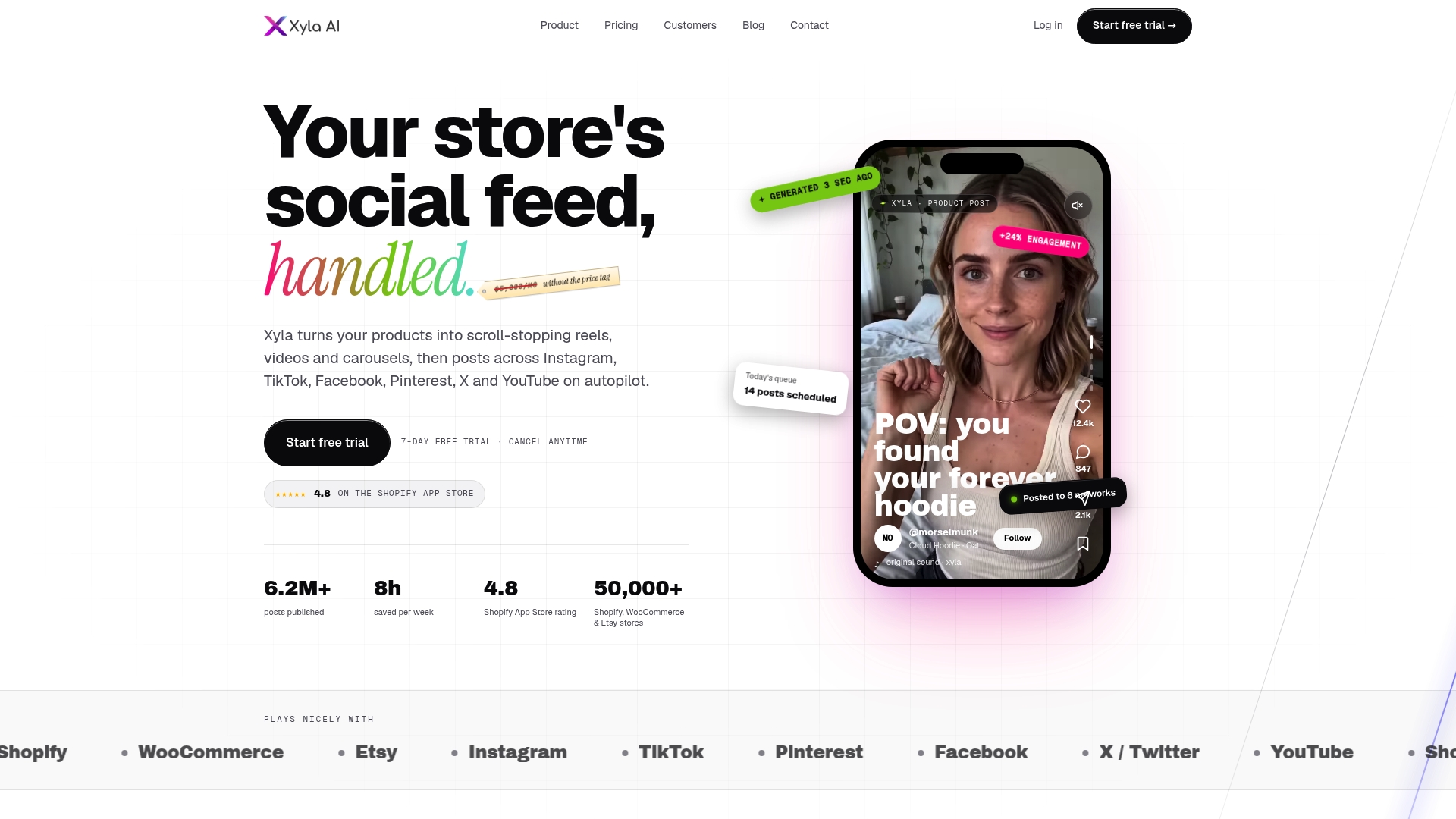
That maps directly onto the workflow in this article:
- Product basics and how-to content get generated straight from catalog data, so the underlying facts stay accurate as your listings do.
- Posts publish on a schedule tuned to when your audience is active, instead of a guess.
- Formats repurpose automatically across networks, covering the carousel-to-video-to-story path without redoing the work manually.
If you run a Shopify, WooCommerce, or Etsy store, you can see the pricing plans or walk through the automation guide to see how it fits your current posting routine.
Sources
This article draws on the AMA’s content recipe study, the 5-3-2 rule explainer, and the Digital Marketing Institute’s evergreen content guide, along with practical scheduling advice from Business.com on content calendar planning.
- Getting the recipe right: How different combinations of content drive social media engagement
- Explained: The 5-3-2 rule for social media
- The Beginner’s Guide to Evergreen Content
FAQ
What is an evergreen social media post?
An evergreen social media post is content built to stay relevant for months or years, such as a product tip, FAQ, or how-to, rather than a post tied to a specific date or trend. It keeps earning views and engagement long after publishing, which reduces how often you need to create something new.
What is the 5-3-2 rule for social media posts?
The 5-3-2 rule suggests that out of every ten posts, five should be curated or repurposed content, three should be original value posts like tips or how-tos, and two can be more personal or promotional. It works best as a flexible planning guideline rather than a strict formula.
What is another word for evergreen content?
Evergreen content is sometimes called “timeless” or “always-on” content, since it stays useful regardless of when someone sees it. All three terms describe content built to avoid dates, trends, or facts that expire quickly.
What does “evergreen” mean in slang?
Outside of marketing, “evergreen” is used casually to describe anything that stays relevant or popular no matter how much time passes, like an “evergreen joke” or an “evergreen recommendation.” In social media specifically, it refers to content that does not lose relevance the way news or trend posts do.


