

Influencer Marketing for Shopify: A Practical Guide

Influencer marketing on Shopify means paying, gifting or giving commission to creators so their audiences visit your store and buy. The workflow is simple: set one goal and a budget, choose creators whose followers match your buyers, give each a unique link and discount code, sign clear terms, and measure sales per creator. Your own social accounts matter just as much as the creators’ posts, because every shopper they send will check your profile before buying.
TL;DR
- Start with one goal (awareness, traffic or sales), a fixed budget and a small group of nano and micro creators rather than one big name.
- Give every creator a personal discount code and a UTM-tagged link so each sale traces back to a person.
- Put commission, content reuse rights, disclosure and termination in writing before any product ships.
- Treat published ROI averages as rough benchmarks. Your own code-attributed revenue is the number that counts.
- Keep your brand’s feed posting consistently, so the traffic creators send lands on an active, credible profile.
Table of Contents
- What influencer marketing means for a Shopify store
- Plan the campaign before you contact anyone
- Choose the right creator size
- Deal structures and what they cost
- What to put in the agreement and the brief
- Set up tracking so every sale has an owner
- Measure ROI honestly
- Follow the FTC rules on disclosure
- Perspective: the creator sends the visit, your feed closes the sale
- Keep your own feed active while creators work
- Put Xyla behind your creator campaigns
- FAQ
- Sources
What influencer marketing means for a Shopify store
A creator with a dedicated following reviews, features or uses your product, and their audience clicks through to your store. Shopify describes an influencer campaign as a partnership in which a brand works with a creator to promote a product, service or event, typically on Instagram, TikTok and YouTube through reviews, promotions, giveaways or takeovers.
Why merchants bother:
- Borrowed trust. A recommendation from someone the viewer already follows carries more weight than an ad from an unknown brand.
- Content you can reuse. A good creator video can feed your product pages, email and paid ads, if your agreement allows it.
- Trackable sales. Unique codes and links let you see which partnership earned what.
- Search benefits. Positive coverage from authoritative sources can help a site’s search visibility.
Some agencies claim influencer-referred traffic converts at several times the rate of cold paid social. Those are vendor claims, so use them as motivation to test, not as a forecast for your store.
Plan the campaign before you contact anyone
Shopify’s own campaign guide lays out six steps: set goals and a budget, decide which tier of influencer you need, find candidates, approach them, agree expectations in a contract, and measure results. Here is how that plays out for a typical small store.
Pick one goal
Most campaigns aim at one of three outcomes:
- Awareness: introduce the brand to people who have never heard of it.
- Traffic: send clicks to a specific collection or landing page.
- Direct sales: drive purchases now, usually with a code.
Choose one. A campaign built for awareness should not be judged on first-week sales, and a sales campaign needs a clear offer and a tracked code.
Set a budget you can afford to lose partly
Plan on the basis that some creators will underperform. A common approach in published budget guides is to put the majority of spend into nano and micro creators for engagement and conversions, reserve a smaller share for larger creators around launches, and keep a slice for experiments. One 2026 budget guide suggests 50 to 70% for micro and nano creators, 20 to 30% for macro creators at launches, and 10 to 20% for experiments. Treat those as a starting split, then adjust once your own data comes in.
A realistic timeline
A well-run campaign takes longer than most owners expect. One practical eight-week plan uses week one for goal, budget and offer, week two for a shortlist of two to three times more creators than you need, week three for outreach, weeks four and five for agreements and shipping, week six for drafts and revisions, week seven for going live and week eight for payment and reporting. Work backward from your selling season. If you are aiming at the holidays, our guide to seasonal campaign planning explains why offers should be locked well ahead of time.

Choose the right creator size
Shopify groups creators by followers: nano (1,000 to 9,999), micro (10,000 to 99,999), mid-tier (100,000 to 499,999), macro (500,000 to 1 million) and mega (over 1 million).
Bigger is not automatically better. A peer-reviewed study in the Journal of Marketing analyzed 802 Instagram campaigns with more than 1,700 influencers and found an inverted U-shaped relationship between follower count and engagement with sponsored content. In plain terms, engagement does not keep rising as audiences grow, and a middle range often works best. For a deeper look at the tradeoffs between creator tiers, see this overview of influencer marketing and brand visibility.
How to evaluate a creator
- Look at the content, not just the count. Does their style, tone and quality fit your brand? Have they promoted similar products before?
- Ask for numbers. Email or DM for audience demographics and engagement rates, and ask for screenshots of their analytics.
- Check that the audience is real. Scan comments for genuine conversation rather than generic emoji strings.
- Start with your own customers. People who already bought and posted about your product are the cheapest and most credible partners.
Deal structures and what they cost
There are four common ways to pay creators:
Structure How it works Typical range cited by 2026 guides Gift for content Free product in exchange for a post Landed cost of the product Flat fee Fixed payment per post Micro creators about $150 to $800; mid-tier about $800 to $5,000; macro $5,000 to $50,000+ Affiliate Commission on sales through a code or link About 10 to 20% Hybrid Smaller flat fee plus commission NegotiatedThe flat fee and affiliate ranges come from a 2026 Shopify influencer guide. Other sources quote different numbers, for example $500 to $5,000 per sponsored post and 15 to 25% affiliate commission. Rates vary widely by niche, platform and creator, so treat every figure as a negotiating starting point.
For most small stores, a hybrid or performance-based deal is the safest long-term choice, because a unique code per creator gives precise revenue attribution and makes the next negotiation grounded in your own results.

What to put in the agreement and the brief
A written agreement protects both sides. A solid affiliate-style agreement covers:
- The commission rate, what counts as a sale (net of discounts, returns and cancellations) and when it is paid.
- The attribution window and which link or code takes credit.
- Where codes may appear, and whether paid ads, whitelisting or bidding on your brand name are allowed.
- Whether and for how long you can reuse the creator’s content in ads.
- Disclosure requirements and what happens if a post is not disclosed.
- How either side ends the partnership and what happens to links and codes.
These points follow a 2026 affiliate program guide, which also recommends giving every creator their own link and code and holding commission until your return window closes.
Settle content reuse up front. Guides from other markets report that adding usage rights after a campaign costs two to three times more, so it is cheaper to negotiate them in the first conversation.
The brief
Shopify’s brief guide says a good one includes the campaign overview, target audience, deliverables, key talking points, brand assets and guidelines, inspiration, approval process and payment details. For affiliate campaigns, spell out how creators receive their code, when it expires and where it can appear.
One tip on tone: introduce your brand and send the product before you send a tracking link. Shopify’s guide quotes a marketer who advises against dropping an affiliate link on someone who has not tried the product yet.
Set up tracking so every sale has an owner
Two tools do most of the work:
- Unique discount codes show purchases even when a shopper never clicks the creator’s link.
-
UTM parameters show traffic by creator and platform. A typical link looks like
yourstore.com/?utm_source=influencer&utm_medium=instagram&utm_campaign=spring&utm_content=creatorhandle, as one Shopify agency guide shows.
Using both gives you a fuller picture than either alone. Inside Shopify, the Campaigns feature can group influencer activations with their codes, UTMs and conversion attribution.
Shopify Collabs, Shopify’s own affiliate app, lets merchants invite creators, run an open program and send gifts and codes. According to one 2026 guide, commissions are held for 30 days by default (configurable from 1 to 90) with a 2.9% processing fee on payouts. Confirm current terms inside the app before you commit.
If you want to see how the same tracking logic applies to your own posts, read our walkthrough on tracking social sales on Shopify post by post and our note on social commerce analytics.
Measure ROI honestly
Published averages vary, and most are self-reported:
- Shopify cites a Tomoson study with an average of $6.50 earned per $1 spent, and 13% of brands reaching $20 or more.
- The same Shopify article says a good benchmark in 2025 is at least $5 to $6 returned per dollar invested.
- Another analysis warns that survey figures often include earned media value, not just sales.
For product seeding, a stricter bar works better: code-attributed contribution margin that covers the landed cost of the gifts within 60 to 90 days, with the content as a bonus. The same source suggests a healthy cost per post of $30 to $100, and under $50 is strong.
Track these per creator: clicks, conversion rate, orders, revenue and revenue per click. A ROAS of 3 or more is a positive signal for most product categories. Review at 30, 60 and 90 days, then double down on the creators who keep producing and drop the rest.
Follow the FTC rules on disclosure
If you sell in the US, disclosure is your responsibility as well as the creator’s. Under the FTC’s Endorsement Guides, content that reflects a material connection between a brand and an endorser is an endorsement subject to disclosure. Summaries of the guides say disclosures must be clear and conspicuous, placed on the image or video rather than buried in a caption, and spoken as well as shown in video. Vague wording such as “thanks to” does not meet the standard, and the FTC holds brands responsible for compliance, not only creators.
Practical steps:
- Put disclosure language in the brief and the contract.
- Tell creators to use the platform’s own paid partnership or branded content tools.
- Review posts before and after they go live, and ask for corrections quickly.
- If creators use AI-generated or altered visuals, ask them to use each platform’s label. TikTok, Meta and YouTube each offer or require AI content labels.
Rules differ by country. If creators or customers are in the UK or elsewhere, check local advertising regulators before you launch.
Perspective: the creator sends the visit, your feed closes the sale
We built Xyla for store owners, and here is what we see again and again with influencer campaigns.
A creator’s post gets someone curious. Then they tap your profile. If the last post was six weeks ago, or the feed looks like random product shots, the trust that the creator built leaks away. Influencer spend only pays off when the brand’s own channels are alive.
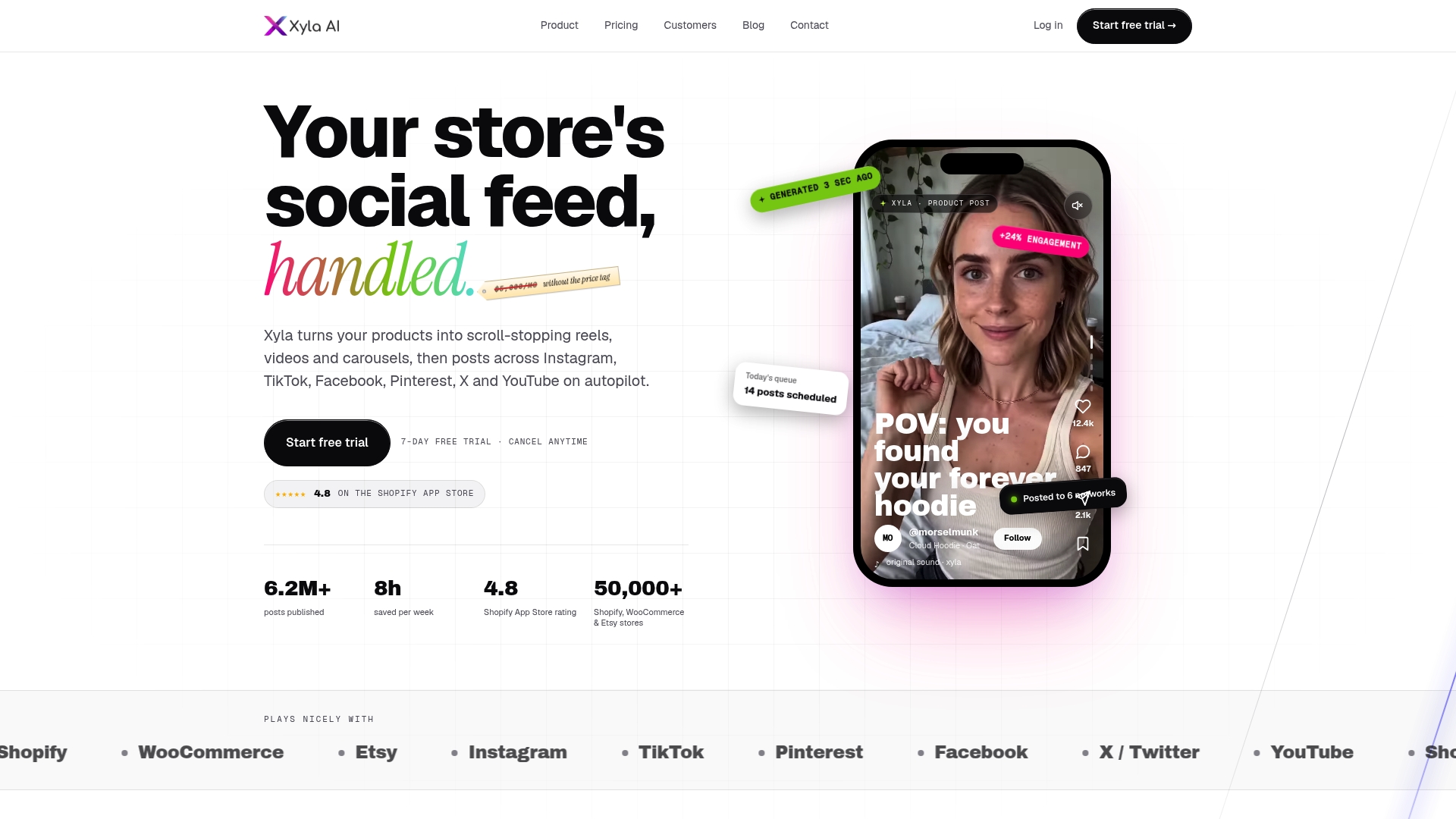
That is why we think the smartest setup pairs creators with automation. Creators bring their audience. Your catalog already holds the raw material for your own reels, carousels and posts. Xyla turns your product listings into new, UGC-style visuals and publishes them across Instagram, TikTok, Facebook and more, so your profile stays active while you manage creator relationships. Our approach is built to save store owners around eight hours a week, and that time is better spent on outreach, briefs and negotiations.
Creator content and your own content also work together. When a creator launches a product video, your feed can follow the same day with a matching post that links straight to the item.
Toby
Keep your own feed active while creators work
Influencer marketing runs in bursts. Your store’s social presence needs to run every week. If you want a lighter routine, these guides cover the basics:
- A five-step workflow that cuts weekly social time to under an hour.
- Shoppable Instagram Reels for Shopify, useful when a creator’s video sends traffic to Instagram.
- A same-day Instagram launch playbook for new products that creators are about to feature.
- Our broader Shopify marketing strategy for social media.
Put Xyla behind your creator campaigns
Xyla is an AI social media management tool for Shopify, WooCommerce and Etsy stores. It converts product listings into reels, videos and carousels, tailors them to each network, and schedules and posts them for you. Our content generation is built into the standard plans rather than sold as per-generation credits.
For Shopify stores, plans on our Shopify page start with Starter at $29 per month, or $209 per year, and Scale is $60 per month or $432 per year. You can compare every plan, including annual pricing, on our pricing page. Etsy sellers can see their own plans on the Etsy page. Every subscription begins with a free trial, so you can set up your store and see the content Xyla creates before you pay.
FAQ
How much should a small Shopify store spend on influencers?
Start with a budget you can spread across several small creators, not one large payment. Gifting product to nano and micro creators costs little beyond the item and shipping, and affiliate commission is only paid when a sale happens. Use your first round to learn which creators and offers produce code-attributed sales, then scale what works.
Do I need Shopify Collabs to run an influencer program?
No. Collabs is one convenient way to invite creators, send gifts and codes, and pay commission. You can also run a manual program with unique discount codes, UTM links and a simple written agreement. The key requirement is that every creator has their own trackable link and code.
Is a free product enough to get a creator to post?
Sometimes, especially with nano creators who already like your product. Many creators expect payment or commission once their audience grows, and a gift does not guarantee a post unless your agreement says so. Spell out deliverables and timing, and consider a hybrid deal with commission for stronger partnerships.
Do influencers have to disclose partnerships?
Yes, in the US if there is a material connection such as payment, commission or free product. The disclosure must be clear and conspicuous, and brands share responsibility for compliance. Build disclosure rules into your brief and contract, and review posts after they go live.
Sources
- Shopify: Best Influencer Marketing Campaigns
- Shopify: High Impact Marketing
- Shopify: Influencer Marketing Campaigns, Types and 6 Steps
- Shopify: How to Write an Influencer Brief
- Shopify: ROI of Influencer Marketing
- Journal of Marketing: Finding Goldilocks Influencers
- Syncly: How to Allocate Your Influencer Budget
- OneOnic: Shopify Influencer Marketing Guide
- UpPromote: How to Recruit Influencers for Shopify Affiliates
- TheShopStrategy: Influencer Contracts and Briefs
- Refer Studio: Influencer Affiliate Program Guide
- MYSense: Influencer Marketing Malaysia 2026
- Sutton Commerce: Influencer Marketing for Shopify
- Seeding Ops: Influencer Marketing ROI Calculator
- The Social Media Law Firm: UGC Legal Risks and FTC Compliance
- AuditSocials: AI Content Label Rules
- Influencer marketing and brand visibility


