

Tie Content Pillars to Ecommerce Product Pages and Social Repurposing
Content pillars for ecommerce are the 3 to 5 core themes that organize everything you post, from blog buying guides to Instagram reels, so that discovery content keeps feeding your product pages instead of dead-ending in likes. The single best first move is picking pillars tied directly to your product categories or the questions buyers ask before checkout. Get that mapping right, and every post has a job: pull someone in, then hand them to a page that sells.
TL;DR:
- Focusing on 3 to 5 pillar topics that tie directly to product categories or common buyer questions speeds up content mapping and ensures relevance.
- Building the pillar hub first with decision criteria and links, then adding supporting spokes on a steady schedule enhances search rankings and user navigation.
- Tracking impressions, clicks, and rankings over 3 to 6 months provides clearer insights into organic growth, while social engagement metrics spike almost immediately.
- Automating content repurposing with tools like Xyla AI accelerates production of videos, carousels, and social posts, ensuring consistent branding and message.
- Starting with three pillars, batching content weekly, and monitoring one key KPI per channel over 8 weeks offers a manageable, scalable approach to ecommerce content strategy.
Table of Contents
- What Are Content Pillars in Ecommerce, and Why Do They Need a Hub-and-Spoke Structure?
- The Five Pillar Types Every Store Needs (And How to Split Your Posting Week)
- Which Pillars Drive Discovery, and Which Ones Close the Sale?
- How Do You Build a Content Pillar Strategy Step by Step?
- Building a Posting Rhythm You Can Actually Sustain
- Internal Linking Rules That Actually Move the Needle
- What Should You Track, and When Will You See Results?
- Where Automation Fits Into a Pillar Strategy
- A Practical Starter Plan for Getting Pillars Off the Ground
- Speed Up Pillar Execution With Xyla AI
- Sources
- FAQ
What Are Content Pillars in Ecommerce, and Why Do They Need a Hub-and-Spoke Structure?
A pillar is a core theme, and a spoke is a specific piece of content that supports it. Think of the pillar as a hub page, a genuine buying guide or category deep dive, and the spokes as the individual blog posts, videos, and social captions that answer narrower questions underneath it. Shopify describes this as hub-and-spoke architecture: the pillar links out to every spoke, and the spokes link back, so authority compounds instead of scattering across disconnected posts.
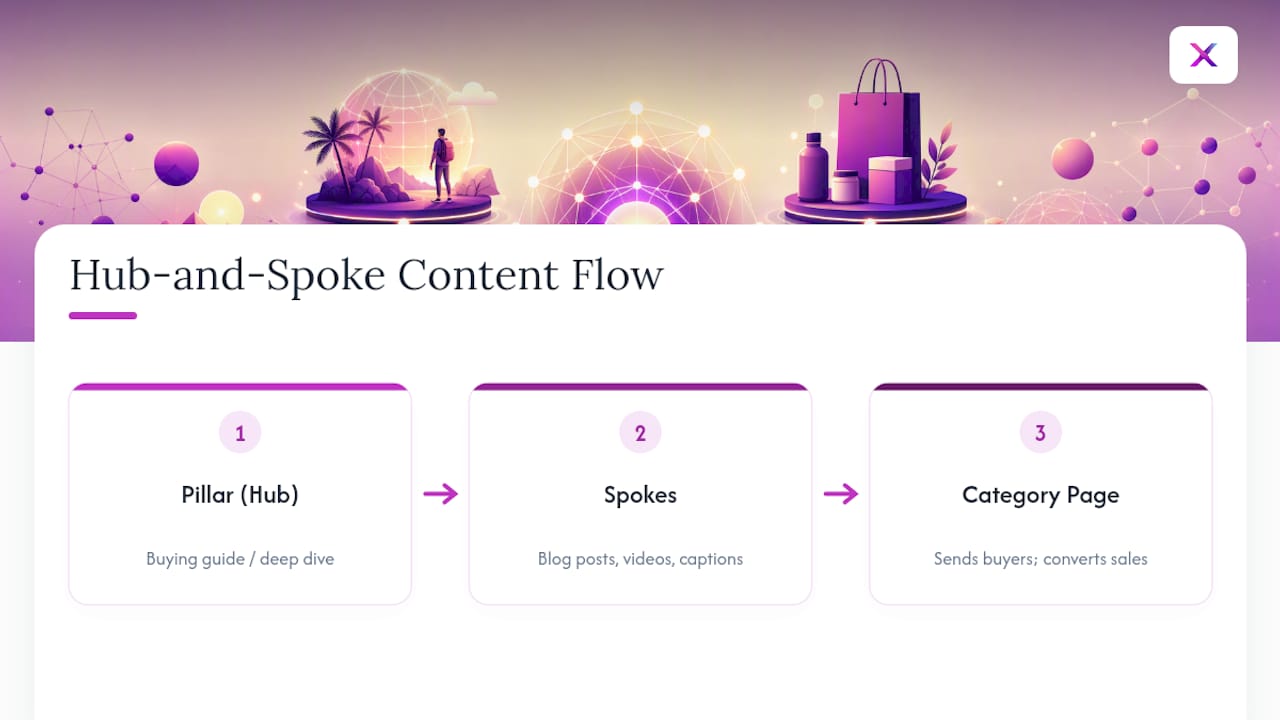
This matters for ecommerce specifically because a stray blog post with no linking structure rarely earns rankings or drives sales. A pillar hub built around, say, “choosing the right running shoe” can support multiple spokes on cushioning, terrain, sizing, and washing care, and each spoke sends a reader back toward the hub and onward to a category page. RunOctopus notes that a mature cluster for a major category often includes many supporting pages, built gradually rather than all at once. The pillar itself doesn’t have to sell. Its job is to organize the cluster and pass link authority down to the pages that do.
The Five Pillar Types Every Store Needs (And How to Split Your Posting Week)
Most ecommerce content breaks into five practical buckets. Virexo Media’s framework lays out a workable split, and it’s a solid starting ratio if you have no data of your own yet:
- Educate (about 30%): how-to guides, sizing charts, care instructions. Example: “How to layer a rain shell for spring hikes” as a long-form guide, repurposed into a short video walkthrough.
- Sell (about 25%): product launches, feature breakdowns, promotions. Example: a carousel comparing two bestsellers, or a countdown post for a limited restock.
- Proof (about 20%): reviews, UGC, before-and-after shots. Example: a customer unboxing reel, or a quote graphic pulled from a five-star review.
- Behind-the-scenes/culture (about 15%): sourcing stories, team features, packaging process. Example: a carousel showing how a product is made or packed for shipping.
- Engage (about 10%): polls, Q&As, community shoutouts. Example: an Instagram Story poll asking followers to vote on the next color drop.
A month of content built on this split might include a sizing guide, two product demo reels, a customer testimonial carousel, a “how it’s made” video, a poll about upcoming colors, a discount announcement, and a comparison post between two SKUs. That’s seven pieces feeding four different pillars without repeating a single format twice in a row.
Which Pillars Drive Discovery, and Which Ones Close the Sale?
Not every pillar earns its keep the same way. Educate and engage content tend to attract new eyes, awareness-stage traffic that hasn’t decided what to buy yet, while sell and proof content moves people who already know your brand toward checkout. Behind-the-scenes content sits in the middle. It builds trust during the consideration stage without pushing a hard sell.
Matching pillar topics to buyer questions at each stage keeps content from feeling random. An awareness-stage question sounds like “what fabric works best for humid climates?” A consideration-stage question sounds like “is this jacket worth the price versus the competitor?” A decision-stage question sounds like “does this come in my size, and how fast does it ship?” Write content that answers the exact question a stage implies, and the pillar does its job without forcing a sale too early.
Linking matters just as much as topic choice. Backlinkworks recommends that pillar and spoke content link to category and product pages contextually, inside a sentence that already makes sense, rather than as a bolted-on “shop now” button dropped into the middle of a paragraph. A buying guide comparing hiking boots should link the specific boot models it discusses, not just the general boots category, so the reader lands exactly where the content promised. Buying guides built with real decision frameworks, feature comparisons, and honest tradeoffs tend to both rank and convert, because they match what a consideration-stage shopper is actually trying to figure out.
How Do You Build a Content Pillar Strategy Step by Step?
Building pillars isn’t a one-afternoon task, but it also doesn’t need months of planning before you publish anything. Here’s the sequence that gets a pillar program live in weeks:
- Research first. Pull the actual questions your customers ask, through support tickets, product reviews, and search terms your site search logs already capture. Layer in basic keyword research for search volume and difficulty on your top candidate topics.
- Map pillars to products. Choose 3 to 5 pillar topics that tie directly to product categories or recurring buyer problems. For each pillar, list 8 to 15 spoke ideas, specific enough that each one could be its own page or post.
- Create the hub first. Build the pillar page as a genuine buying guide: decision criteria, comparison tables, and links out to every planned spoke plus the relevant category page. Spokes should run 800 to 1,500 words with a clear anchor back to the hub and at least one product link.
- Publish and interlink deliberately. Launch the hub before its spokes, or launch hub and a first batch of 3 to 4 spokes together, then add spokes on a steady cadence. Every new spoke needs a link back to the hub and forward to at least one sibling spoke.
- Repurpose everything. Turn each spoke into a short video, a carousel, and an email snippet. One 1,200-word guide can realistically produce four to six social assets without extra research.
Pro Tip: Publish the pillar hub with placeholder links to spokes you haven’t written yet, then update those links as each spoke goes live. It keeps the hub structurally complete from day one and saves you from a messy retrofit later.
Building a Posting Rhythm You Can Actually Sustain
A five-post-a-week cadence works well for most small ecommerce teams: two educate posts, one sell post, one proof post, and one engage or culture post, rotated so no single pillar dominates two weeks straight. The mechanism that keeps this alive isn’t inspiration. It’s batching.
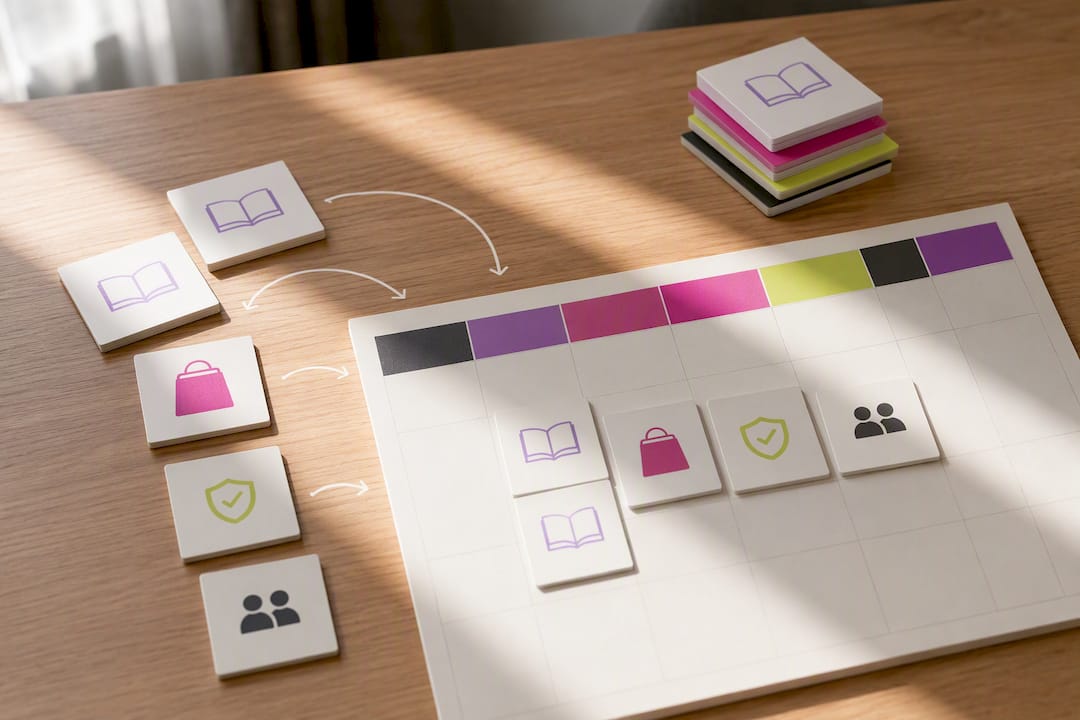
Virexo Media’s research found that a sustainable rhythm compounds reach more reliably than sporadic bursts of high-volume posting, and batching is what makes that rhythm survive contact with a busy month. A 90-minute weekly batching session, planning captions, cropping assets, and scheduling posts in one sitting, plus a monthly check-in to refresh or expand a pillar hub, keeps the whole system running without daily fire drills.
Repurposing follows a simple chain: blog post becomes a 30-second clip, the clip becomes a three-slide carousel, the carousel becomes an email subject line and snippet. A basic checklist for turning one hub article into six social assets:
- One short-form video hitting the core takeaway
- Two carousel slides breaking down subpoints
- One quote graphic pulled from the guide’s strongest line
- One poll or question tied to the topic
- One email teaser linking back to the full guide
Internal Linking Rules That Actually Move the Needle
Vague advice to “link internally” doesn’t help much. Concrete rules do. Cartiful’s guide to ecommerce content clustering recommends 3 to 5 contextual links between spokes within the same cluster, plus at least one link to a relevant product or category page from every spoke. The pillar hub, in turn, should link to every spoke underneath it, not just the two or three that happen to be newest.
Anchor text should describe what the linked page actually covers, “our guide to washing merino wool” reads better and ranks better than “click here”, and links belong inside sentences where they add genuine context, not stacked at the bottom of a post like a reference list.
The mistakes that undercut this structure show up constantly: force-linking a product into a sentence where it doesn’t fit, publishing spokes with no link back to their pillar (orphan pages that search engines struggle to place in context), and duplicating category-page copy inside a pillar post instead of writing something genuinely additive. A pillar page and its category page should never compete for the same search intent.
What Should You Track, and When Will You See Results?
Split your KPIs by channel since they move on different timelines. On the SEO side, track impressions and clicks for pillar and spoke keywords, ranking position over time, and assisted conversions, meaning how often a visitor touches a pillar page before buying, even if that page wasn’t the last click. On the social side, track engagement rate, saves, referral clicks back to product pages, and follower growth tied to specific pillar types.
Timelines vary sharply by channel. Social engagement effects show up almost immediately, often within days of a post going live. Organic search traction on new spokes typically takes 3 to 6 months to show meaningful movement. Full topical authority, the compounding effect where a mature cluster outranks competitors across dozens of related queries, tends to build over 6 to 12 months or longer, since a properly built ecommerce cluster gains ranking strength as more spokes go live and reinforce the pillar. Anyone expecting a pillar page to rank in week three is measuring on the wrong clock.
Where Automation Fits Into a Pillar Strategy
Pillars generate a lot of raw material, and turning one buying guide into six social formats is exactly the kind of repetitive production work automation handles well. Practical use cases include generating video and image assets straight from product data, formatting the same asset for Instagram, TikTok, and Facebook without manually resizing each version, scheduling posts to match your pillar cadence, and keeping visual branding consistent across every asset a brand kit produces.
If you’re evaluating a tool for this, check three things: how deeply it integrates with your store platform, whether the output actually looks like your brand rather than a generic template, and whether it preserves your pillar’s message instead of flattening every post into the same promotional tone.
A Practical Starter Plan for Getting Pillars Off the Ground
Skip the instinct to launch five pillars across six platforms in month one. Pick 3 pillars, map one hub and three spokes for each, and publish that first. Batch the content in one sitting, track one metric per channel, engagement rate for social, ranking movement for search, and give it a full 8 weeks before deciding what to expand or cut.
— Toby
Speed Up Pillar Execution With Xyla AI
Writing the buying guides and mapping the clusters is strategy work only you can do. Turning each spoke into a video, three carousel slides, and a TikTok clip is production work, and it’s usually the step that stalls a pillar calendar after the first good month. Xyla AI converts product listings straight into reels, carousels, and video content, then posts them across Instagram, TikTok, Facebook, and Pinterest on a schedule that matches your pillar rhythm instead of whatever time you happen to be free.
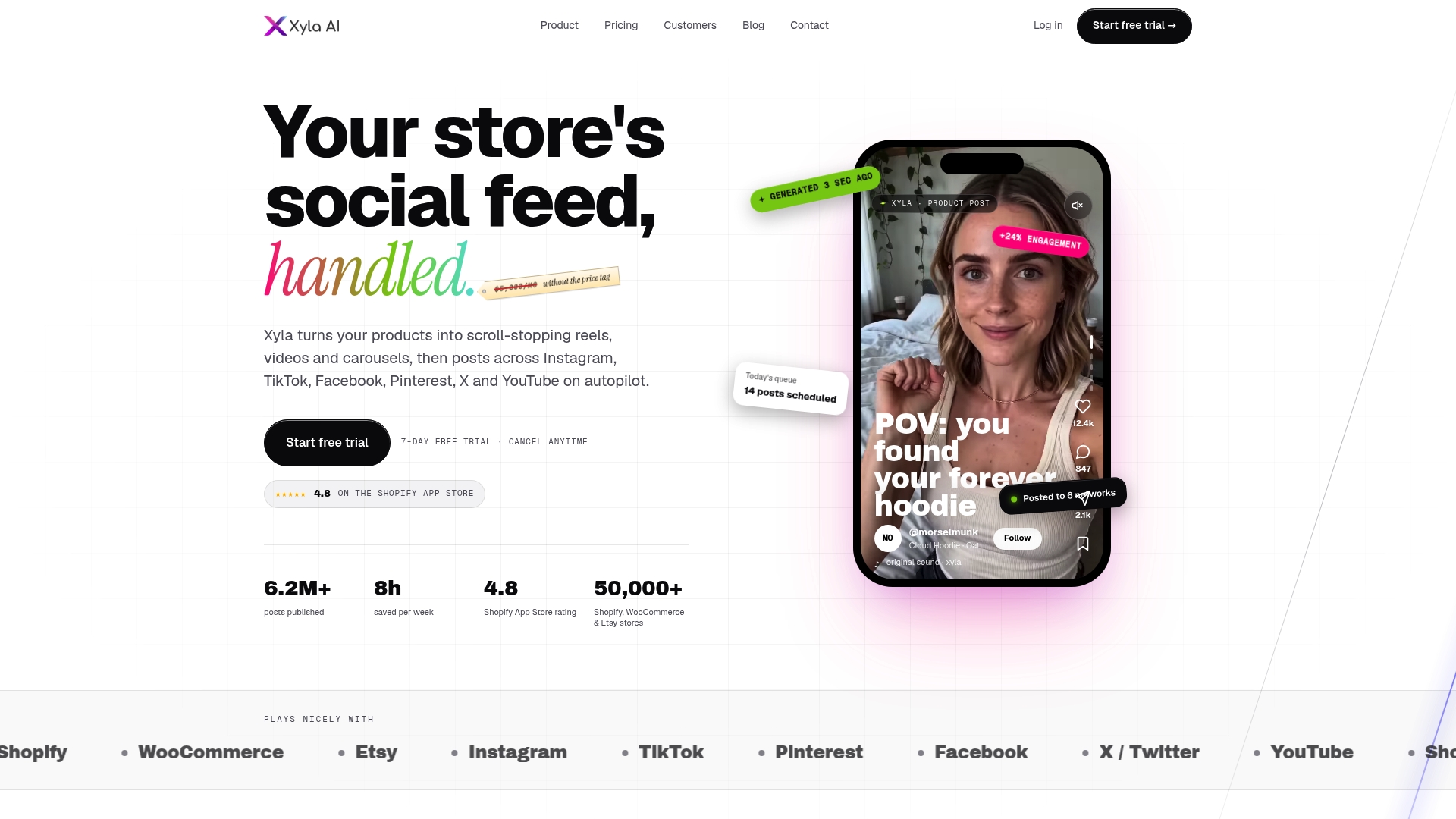
For a store running on Shopify, plans start at $29 a month on the Growth plan, scaling up to Pro and Enterprise as your catalog and posting volume grow, with Shopify specific and Etsy specific pricing tiers available on their respective pages. If your “proof” pillar needs more UGC style video without hiring a videographer, the AI UGC video tool builds that content directly from your existing product photos. Check the pricing page and see which tier matches your current posting cadence.
Sources
- Content Pillars: Types and How to Use Them — Shopify
- Topic Clusters for Ecommerce | RunOctopus
- Content clustering for ecommerce SEO - A complete guide — Cartiful
- Ecommerce content plan: 5 pillars + posting rhythm — Virexo Media
- Ecommerce pillar pages: A practical SEO guide for online stores — Backlinkworks
FAQ
What Are the Main Pillars of Content for a Business?
Most frameworks settle on four to five recurring themes: educating your audience, selling your product directly, showing social proof, and building engagement or community. Some brands add a behind-the-scenes or culture pillar as a fifth, and Virexo Media’s framework uses that exact five-pillar structure with a suggested posting split.
What Are the Three Pillars of the Ecommerce Business Model?
Definitions vary depending on the source, but the version most ecommerce operators recognize centers on product, platform, and fulfillment, what you sell, where customers find and buy it, and how it reaches them. This differs from content pillars, which organize marketing themes rather than business operations.
What Is an Example of a Content Pillar?
A “buying guide” pillar for a footwear store is a common example: one hub page comparing shoe types by activity, with spokes covering sizing, break-in tips, and care instructions, each linking back to the hub and forward to relevant product pages. Backlinkworks outlines this exact pattern for helping shoppers move from research to purchase.
What Are the Content Pillars of a Website?
For an ecommerce site specifically, website content pillars usually map to major product categories or core customer problems, each built as a hub page linking out to supporting articles, guides, and comparison pages. Shopify’s hub-and-spoke model treats these pillar pages as the backbone connecting blog content to commercial category and product pages.
How Much Does Xyla AI Cost for Automating Pillar Content?
Xyla AI offers tiered subscription plans that scale with posting volume and features; current prices and options can be found on their official pricing page. Full pricing details, including annual billing options, are listed on the pricing page.


