

Product Captions That Sell: Formulas, Examples and a Workflow

A product caption sells when it does what the photo or video cannot: it adds a reason to want the thing, puts that reason in the first line, and tells the shopper exactly what to do next. Describing the product is not enough. Below you get the frameworks, the exact wording patterns, examples for launches, promos and everyday posts, and a way to produce captions weekly without writing each one from scratch.
TL;DR
- Lead with the shopper’s outcome or problem in the first line, before the platform cuts your caption off at “more.”
- Add what the image does not show: a use moment, a detail, a story. Do not repeat the visual in words.
- Use one clear, low-friction call to action that says what happens next.
- Use PAS, AIDA or BAB as scaffolding, then swap vague adjectives for one precise detail.
- Disclose gifted or paid relationships clearly, and batch your captions so quality stays consistent.
Table of Contents
- What makes a product caption sell
- Write the first line for the cut-off
- Four frameworks you can reuse
- Words and tone: persuasive without sounding salesy
- Calls to action that get the next step
- Copy-ready examples for launches, promos and everyday posts
- Turn your product description into a caption
- Platform differences that change the caption
- Disclose gifted and paid products
- Our view: consistency beats a perfect caption
- Build a weekly caption workflow
- Common mistakes that kill sales captions
- Let Xyla write and post them for you
- FAQ
- Sources
What makes a product caption sell
An effective caption grabs attention, communicates the features and benefits that matter, speaks to a customer pain point, and points to one action. That is the core of the advice in Shopify’s guide to social media copywriting, which also notes that structures such as AIDA and PAS help organize persuasive posts for audiences who skim.
There is academic support for the idea that a caption should add something. A 2025 study in the Journal of Interactive Marketing looked at 95,155 single-image posts from 402 brands across 33 industries. It found that captions bringing in a new perspective, interpretation or imagination beyond the image raised consumer interest and engagement. The effect weakened when the brand felt psychologically distant from the audience.
Two practical lessons follow:
- Do not narrate the picture. If the photo shows a ceramic mug, “Our blue ceramic mug” wastes your most valuable line. Tell us what it is like to own it: “The mug that keeps your coffee hot through a 9 a.m. meeting.”
- Sound like a person the buyer could know. Closeness is part of what makes added interpretation work, so write in the voice you would use in a customer email, not in a catalog.
Write the first line for the cut-off
Most feeds show only the beginning of a caption. On Instagram the limit is 2,200 characters, but only the first 125 or so appear before the “more” link. Treat those first characters as a headline. For a deeper breakdown of how long to go on each network, see our guide to Instagram caption length rules for ecommerce stores.
The Strove Magazine’s ecommerce caption blueprint recommends putting the shopper’s promise before the truncation point, translating features into concrete outcomes, and adding one precise detail instead of an adjective such as “premium.” That works as a quick edit pass:
Weak first line Stronger first line What changed Our new premium leather wallet is here Fits 8 cards and still slides into a back pocket A feature became an outcome Soft, cozy, perfect blanket Washed 30 times and still no pilling A vague adjective became a precise detail Check out our skincare set Dry patches by 3 p.m.? This is the fix The pain point leads New arrivals in store Three new colors, one sells out first every time Curiosity replaces announcementOnly use claims you can stand behind. “Washed 30 times” is persuasive only if you tested it.
Four frameworks you can reuse
Formulas are scaffolding, not a script. Pick one per post and then rewrite it in your own words.
PAS: Problem, Agitate, Solve
Name a problem, make the cost of it felt, then present the product as the answer. Persuasive storytelling with PAS lets the product appear as a solution without an overt sales pitch.
Tired of tangled earbuds at the bottom of your bag? Every commute starts with a knot. Our magnetic cord wraps itself. Link in bio.
AIDA: Attention, Interest, Desire, Action
Open with a hook, add an interesting fact, help the shopper picture owning it, then ask for the click.
Your plants are thirsty and you forgot again. (Attention) This self-watering pot holds two weeks of water. (Interest) Imagine coming back from vacation to a living fern. (Desire) Shop the pot, link in bio. (Action)
BAB: Before, After, Bridge
Show life before, life after, and the product as the bridge between them. This is the same transformation technique the 303 London copywriting guide describes alongside PAS.
Before: a desk covered in sticky notes. After: one planner, one plan. The weekly planner is back in stock.
The “one detail” caption
When you have no time for a formula, pick a single specific detail nobody else would mention: stitch count, scent notes, the maker’s name, the exact dimensions of the pocket. Specificity reads as honesty.

Words and tone: persuasive without sounding salesy
Power words such as “rescue,” “limited” and “exclusive” trigger emotional responses, and urgency can prompt quick purchases. They also wear out. If every post is “limited,” shoppers stop believing any of them. Reserve urgency for things that are truly scarce: a small batch, a seasonal color, a real sale end.
To sound less like an ad:
- Write to one person. “You” beats “our customers.”
- Use the objection. “Yes, it is machine washable” answers the question before it is asked in the comments.
- Tell a small story. A two-sentence origin of the product, the workshop, or the fix for a customer complaint carries more weight than adjectives.
- Let customers talk. Hair care brand Ouai used real customer comments in product descriptions and ad campaigns. Quoting a reviewer in your caption gives the claim a voice other than your own. If you want to understand why this builds confidence, this piece on user-generated content for trust covers the logic well.
For a full strategy around the format, our quote post strategy with ready captions shows how to turn reviews into posts that earn comments and saves.
Calls to action that get the next step
A vague CTA creates work for the shopper. A good one is specific, low-friction and explains what happens next. One 2026 caption guide contrasts a vague “DM for info” with “Message us ‘RESERVE’ to hold one”, which names the action and the result.
There is some evidence that direct language helps, with a caveat. A 2026 exploratory study of just 12 patisserie captions found that imperatives and urgency appeared associated with higher interaction, but the authors warn that the tiny sample and lack of robust statistical testing rule out causal conclusions. Treat it as a reason to test, not a rule.
CTA patterns that work for online stores:
Goal Weak CTA Specific CTA Drive a purchase Shop now Tap the link in bio and pick your size, free returns on first orders Start a conversation DM us DM “SIZE” and we will send the fit chart Get saves Save this Save this for your next gift list Collect opinions Thoughts? Which color wins: sage or clay? Create urgency honestly Hurry! Only 12 left in this batchOnly write “free returns” or a stock number if it is true for your store at the time of posting. For more wording, see our ecommerce CTA examples for store owners.
Copy-ready examples for launches, promos and everyday posts
Adapt these rather than pasting them. Replace the bracketed parts with your real details.
Product launch
- “We made [product] because [specific problem] kept happening. It’s here today in [number] colors.”
- “Six months of testing, one change we are proud of: [detail]. Meet the [product name].”
- “First 48 hours: [bonus that you truly offer]. Link in bio.”
Promotions and sales
- “[X]% off [collection] until [day your sale ends]. Your cart has been waiting, so we gave it a push.”
- “Bundle the [item A] and [item B] and save [amount]. Gift wrap is on us.”
- “Restocked: the [product] that sold out in [timeframe] last time.”
Everyday posts
- “Three ways to wear the [product]: work, weekend, wedding.”
- “What we packed in this order today: [product], a handwritten note and a sample of [other product].”
- “This one came from a customer message: ‘Could you make it in [feature]?’ Done.”
Social proof
- “‘[Short, real customer quote]’ Thank you, [first name, with permission]. It means a lot.”
- “You asked, we answered: does the [product] fit [common question]? Yes. Here is the proof.”
Gift and seasonal posts
- “Gifts that ship in two days: [product] for the person who has everything.”
- “The under-$[amount] list for [holiday or occasion], in order of how fast they sell.”
Need prompts you can hand to an AI writer? See our four copy-paste product caption prompts.
Turn your product description into a caption
Your listing already holds the raw material: materials, dimensions, use cases, the reviews. The error is pasting it unchanged. A listing is built for someone who has already clicked. A caption is built for someone who is scrolling past.
A quick conversion process:
- Pick the single strongest benefit in the listing.
- Move it to line one as an outcome.
- Add one detail from the specs that proves it.
- Add one line of story or use moment.
- Finish with one CTA that names the next step.
We walk through the full process in rewriting product descriptions as captions.
Platform differences that change the caption
The same product needs different captions on different networks, because people behave differently on each.
- Instagram: the first line has to earn the “more” tap. Save-worthy details and a clear link-in-bio instruction fit well.
- TikTok: the caption supports the video. Keep it short and let the on-screen hook do the work. Our guide to product video hooks explains how to open a clip.
- Facebook: longer, friendlier, community-style captions and direct links usually fit the format. See ready Facebook posts for ecommerce.
- X: compactness wins, and one sharp line beats a paragraph. Read about selling product posts on X.
Disclose gifted and paid products
If you or a creator posts about a product with a material connection, such as payment, free product or a family tie, the audience needs to know. In a November 13, 2023 warning letter, the FTC said such connections must be disclosed clearly and conspicuously and that a disclosure placed only in small text on an Instagram Reel may be inadequate. Put the disclosure in the caption itself, near the start, and in the video or audio where the format allows. If you run influencer or affiliate programs, ask your legal advisor to review your wording against the FTC’s current guidance for the US.
Perspective
Our view: consistency beats a perfect caption
Most store owners we talk to do not have a caption problem. They have a consistency problem. They write a great caption on a Tuesday, then nothing for nine days, because the product catalog, the photos, the networks and the schedule all need attention at once.
That is why we built Xyla around your product data. Your listing already contains the benefit, the detail and the proof. Our approach is to turn that real data into new visual content and brand-aligned copy for each network, then schedule and publish it, so the work that stays with you is the part only you can do: knowing your customer and approving what goes out.
We designed AI generation to be part of the standard plans rather than a per-generation credit, because writing three different captions for one product should not feel like spending money. Our aim is to save store owners around eight hours a week, and we think the hours matter more than any single clever line.
Use the formulas in this article. Test them. And then make sure the system keeps posting when you are busy packing orders.
Toby
Build a weekly caption workflow
Captions that sell are rarely written one at a time on a busy day. Batch them.
- Choose five products. Mix a best seller, a new arrival, a slow mover, a bundle and a customer favorite.
- Pull one fact per product. Use a material, a measurement, a review line or a use moment, not a slogan.
- Assign a framework. PAS for a problem-solver, BAB for a transformation, AIDA for a launch.
- Write two first lines for each. Keep the stronger one, or post both on different days.
- Schedule with intent. Match posting windows to your own sales data. Our guide to ecommerce posting times with UTM tests shows how to track which posts bring orders.
- Review the results every two weeks. Look at saves, replies, link clicks and orders, not likes alone. Keep what sells and drop the rest.
If you want to cut the setup further, our step-by-step automation guide and auto posting from product updates explain how to connect the store to the schedule. More general ideas are in our ecommerce social media tips.
Common mistakes that kill sales captions
- Starting with the brand name. Nobody scrolls for it. Start with the shopper.
- Stacking adjectives. “Amazing, stunning, premium” says nothing. One measurable detail does more.
- Two or three CTAs. Pick one. “Shop, follow, comment and share” asks for nothing in particular.
- Copying the same caption to every network. Adjust length, tone and CTA for each.
- Overusing urgency. If it is always the last chance, it is never believed.
- Making claims you cannot support. Specific numbers and guarantees need to be true when published.
Let Xyla write and post them for you
If you run a Shopify, WooCommerce or Etsy store, Xyla turns your product listings into reels, videos and carousels with captions written for each network, then schedules and publishes them. Plans are published on our site: on Shopify, Starter is $29 per month and Scale is $60 per month. On Etsy, Maker is $29 per month, Shop is $39 and Studio is $60. Annual pricing and the full plan list are on the pricing page, and a free trial comes first.
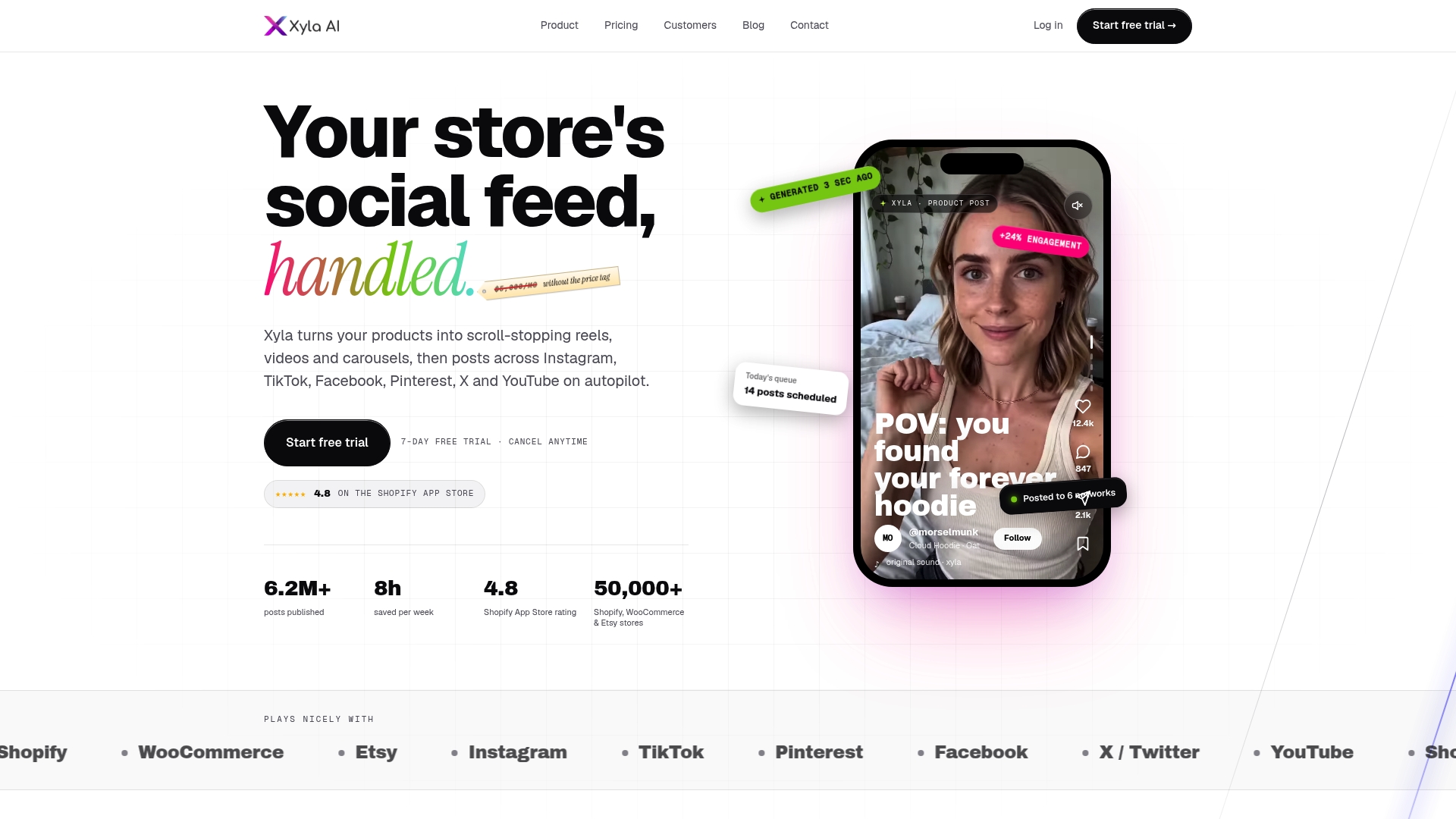
If you want captions that start from your actual catalog rather than a blank page, start with the plan that matches your store platform.
FAQ
What is the best caption to use to sell a product?
The best caption leads with the shopper’s outcome, adds one specific detail the image does not show, and ends with one clear action. A format such as PAS or BAB gives it structure. There is no universal winning line, so test two versions of the first line and keep the one that earns more clicks or replies.
What should I say when I sell a product on social media?
Say what changes for the buyer, not just what the product is. Name the problem it solves, give one precise proof point such as a measurement or a real customer quote, and tell people what to do next, for example “tap the link in bio to choose your size.”
What are some effective phrases to sell a product?
Phrases that work are specific: “Fits 8 cards,” “Back in stock,” “Only 12 left in this batch,” “Message us ‘SIZE’ for the fit chart.” Emotional words such as “limited” can help when they are true, but vague praise like “premium” adds little. Use urgency only for real scarcity.
How long should a product caption be?
On Instagram you can write up to 2,200 characters, but only the first 125 or so show before the “more” link, so put the promise first. After that, length depends on the story. A short caption suits a product video, while a longer one suits a launch or a customer story.
Sources
- What Is Social Media Copywriting? Examples and Best Practices (Shopify)
- How Do Image Captions Drive Consumer Engagement on Social Media (Journal of Interactive Marketing, 2025)
- Instagram Character Limits in 2026 (bundle.social)
- From Scroll to Cart: A Four-Part Caption Blueprint (The Strove Magazine)
- 10 Copywriting Techniques Luxury Brands Can Use (303 London)
- Power Words: 70 Terms for Marketing Copy (Shopify UK)
- Why Your Best Ads Are in Your Comments Section (Shopify)
- How to Write Product Captions That Actually Sell (Malaya Publishing)
- Directive Speech Acts Drive Higher Engagement (2026 study)
- FTC Warning Letter, November 13, 2023


