

Autopost Shopify Products to TikTok Without Weekly Filming

The fastest practical way for most Shopify stores to autopost product videos to TikTok is the native TikTok sales channel if your store qualifies for TikTok Shop, since it syncs your catalog and makes videos shoppable. For stores that aren’t eligible yet, or that want auto-generated video content without a production team, an e-commerce automation platform like Xyla is the more direct path. Below, we cover both setup flows, plus a short checklist to pick the right one.
TL;DR:
- TikTok Shop requires a verifiable location in a supported country and Seller Center verification; mismatched addresses or missing return policies can block catalog syncing.
- Organic videos can be scheduled without TikTok Shop, but shoppable tags require catalog sync and may need separate Seller Center approval.
- For automated videos, provide three to five clean product images, including a lifestyle shot, and verify vertical 9:16 formatting before publishing.
- The native channel is free to install, while Xyla starts at $29 monthly; test for two to three weeks, tracking views, clicks, and conversions.
Table of Contents
- At-a-Glance: Practical Options to Autopost Shopify Products to TikTok
- Which Method Fits Your Store? Quick Decision Checklist
- Step-by-Step Setup: Three Autopost Flows
- Content Creation Options: Templates, AI Generation, and UGC-Style Clips
- Scheduling, Shoppable Tags, and TikTok Shop Details Merchants Must Know
- Costs, Limits, and What to Measure
- Author Checklist: What I Do First for a Shopify Merchant Needing TikTok Autoposting
- Why Try Xyla for Autoposting Your Shopify Products
- FAQ
- Sources
At-a-Glance: Practical Options to Autopost Shopify Products to TikTok
Most Shopify merchants end up choosing between four realistic paths, and the right one depends on eligibility, catalog size, and how much creative effort you want to spend.
- Native Shopify TikTok sales channel: syncs your catalog, inventory, and orders directly, making it the right pick when your store qualifies for TikTok Shop and you want shoppable in-feed videos.
- E-commerce automation platform: generates UGC-style videos from your product photos and posts them on a schedule, which fits stores that want consistent TikTok content without hiring a videographer.
- Third-party schedulers: queue and publish video content across accounts but typically do not handle shoppable tagging or catalog sync, so they work best for brand-awareness posts rather than direct commerce.
- Hybrid workflows: pair automated creative generation with manual shoppable tagging or TikTok ads, which suits stores running paid campaigns alongside organic content.
Each path solves a different problem. The sales channel solves checkout friction once you’re TikTok Shop eligible. An automation platform solves the content bottleneck, since most store owners simply don’t have time to film and edit videos every week. Schedulers solve consistency for stores that already have a video library. Hybrid setups solve scale once you’ve found a creative angle that converts and want to put ad budget behind it.
Which Method Fits Your Store? Quick Decision Checklist
Before you commit to a setup flow, run through a few quick checks. They take a few minutes and save you from building the wrong workflow.
- Check TikTok Shop eligibility: confirm your business has a verifiable location in a supported country, since TikTok Shop setup requires completed seller verification before catalog sync works.
- Decide if you need shoppable videos now: if checkout-in-app matters immediately, prioritize the sales channel; if you’re still testing content, start with automated video generation.
- Look at your catalog size and posting cadence: a few hundred SKUs posted weekly favors automation over manual video production.
- Set your content quality bar: if you need distinct video hooks for each SKU rather than one template repeated, an AI-generation platform scales better than a static template library.
- Assess internal resources: if no one on your team edits video, automation removes that step entirely.
For most small-to-midsize Shopify stores that lack a dedicated content creator, an automation platform such as Xyla is the practical starting point, since it generates and posts the videos without requiring a production workflow.
Pro Tip: Run your eligibility check in Shopify admin before you choose a tool. It takes five minutes and determines which of the three flows below is even available to you.
Step-by-Step Setup: Three Autopost Flows
Here’s how each flow works in practice, from first connection to your first published post.
Flow A: Shopify TikTok sales channel
- Install the TikTok sales channel from the Shopify App Store and connect your TikTok Business account.
- Verify your shop details, including business address and return policy pages, since Shopify’s setup guide notes these are required for catalog sync to succeed.
- Select which products to sync to TikTok Shop and confirm pricing and variant mapping.
- Review how inventory and order behavior will work: stock levels and orders placed on TikTok Shop appear back in your Shopify admin automatically once connected.
- Complete any remaining Seller Center verification steps TikTok requires for your region before your products go live.
Flow B: Automation platform (Xyla)
- Connect your Shopify catalog to your Xyla account through the Shopify integration.
- Choose a video generation template or let the tool auto-select based on product category and images.
- Set your posting cadence, such as three to five videos per week per TikTok account.
- Map product fields, including title, price, and key benefit, so generated captions and hooks reflect your actual listings.
- Preview the first batch of generated videos, then enable auto-posting once you’re satisfied with the output.
Flow C: Scheduler-based posting
- Connect your TikTok account to a scheduling tool.
- Upload or queue pre-made videos, since most schedulers don’t generate content themselves.
- Set your publish times, keeping in mind that shoppable product tags require catalog sync or Seller Center involvement rather than being something a scheduler can add on its own.
- Add product links manually in captions or bio if shoppable tagging isn’t available through your scheduler.
Troubleshooting common sync errors
- Address mismatch: a mismatch between your Shopify Locations address and your TikTok Seller Center address is one of the most common reasons catalog sync fails, and correcting it in Shopify admin usually resolves it.
- Missing images: products without a complete image set often fail to generate usable video content, so fill in at least three to five images per SKU.
- File-format issues: videos that don’t match TikTok’s supported formats or aspect ratios get rejected at upload, so confirm vertical 9:16 formatting before publishing.
- Missing return policy: an incomplete return policy page can block TikTok Shop verification even when your catalog itself is ready.
Content Creation Options: Templates, AI Generation, and UGC-Style Clips
Your content source determines both your output speed and how fresh each video feels to viewers.
Template-based outputs are the fastest to produce and keep your branding consistent, but they can start to look repetitive once you’re posting several times a week across dozens of SKUs. AI-generated UGC-style clips solve that novelty problem by creating new video variations from your actual product photos rather than reusing the same template shell, which is part of why Xyla states it saves store owners a significant amount of time each week on content creation and scheduling, a claim based on the brand’s own internal data rather than an independent benchmark. Manual or creator-produced content still earns its place for major product launches or hero SKUs where you want a distinct campaign feel rather than batch-generated output.
- Photos: aim for three to five clean images per SKU, including at least one lifestyle or in-use shot.
- Short benefit copy: a one- or two-line hook per product works better than a full paragraph when feeding into automated generation.
- Caption ideas: a rough list of angles (problem solved, price point, seasonal tie-in) gives generation tools more to work with than a blank product title.
Pro Tip: Feed your automation tool your best-selling SKUs first. Stronger product photography produces stronger generated video, and your bestsellers usually have the most complete image sets already.
Scheduling, Shoppable Tags, and TikTok Shop Details Merchants Must Know
TikTok Shop eligibility starts with a verifiable business location in a supported country, and Shopify’s setup documentation walks through the exact verification steps required in the Seller Center before your catalog can sync. Once connected, the TikTok sales channel handles catalog, inventory, and order syncing automatically, which is what makes shoppable in-feed videos and live shopping possible without manual tagging for every post.
It helps to understand what syncs where:
- Catalog and inventory: stock levels update automatically between Shopify and TikTok Shop once the sales channel is connected.
- Orders: purchases made through TikTok Shop appear directly in your Shopify admin.
- Shoppable tags: adding product tags to in-feed videos or live shopping sessions sometimes requires separate approval or setup in Seller Center, even after catalog sync is complete.
- Organic scheduled posts: videos published without catalog sync can still be scheduled and posted, but they won’t carry shoppable product tags.
A TikTok business account paired with the Shopify sales channel also enables pixel-driven ad measurement, which lets you build retargeting audiences from video views and optimize ad spend using actual conversion data rather than guesswork.
For cadence, three to five product videos per week per account is a reasonable starting point for most catalogs, giving TikTok’s algorithm enough fresh content to test without overwhelming your team’s review process.

Costs, Limits, and What to Measure
Pricing shapes vary by path. The native Shopify TikTok sales channel itself is free to install, though TikTok ad spend is separate. Automation platforms typically run on tiered SaaS pricing based on post volume or connected networks, while some competitors charge per AI generation rather than bundling it into the plan. Xyla’s Shopify plans start at Starter for $29 per month or Scale for $60 per month (annual pricing is $209 and $432 respectively), with AI video generation included rather than billed per credit.
If you’re estimating time savings, some automation platforms report significant hours saved per week on content creation and scheduling, though such claims may be internal rather than independently verified. At a modest hourly value for your own time, that savings alone often outweighs the monthly plan cost within the first few weeks.
During a two to three week test, track:
- Views and completion rate: shows whether your hooks are holding attention in the first three seconds.
- Engagement (likes, comments, shares): signals whether the content resonates beyond a passive scroll.
- Click-through to product page: the clearest early signal of commercial intent.
- Conversion rate from TikTok traffic: the metric that ultimately decides whether to scale cadence or adjust creative.
If click-through is strong but conversion lags, the issue is usually the product page rather than the video, so test that before changing your posting schedule.
Author Checklist: What I Do First for a Shopify Merchant Needing TikTok Autoposting
When a Shopify merchant asks where to start, I run through the same five steps every time. First, confirm TikTok Shop eligibility in Shopify admin, since that single check determines which flow is even on the table. Second, pick one method rather than trying all three at once. Third, connect accounts and verify the catalog sync is clean before scheduling anything. Fourth, queue the first ten product videos and watch how they perform before committing to a full weekly cadence. Fifth, set a baseline for views, click-through, and conversion so you have something to compare against once you adjust creative or posting frequency.
— Toby
Why Try Xyla for Autoposting Your Shopify Products
If your bottleneck is content, not strategy, we built Xyla to close that gap directly from your product catalog. We turn your existing product photos into UGC-style videos, generate the captions and hooks, and post them to TikTok on a schedule you set, without requiring you to film anything new.
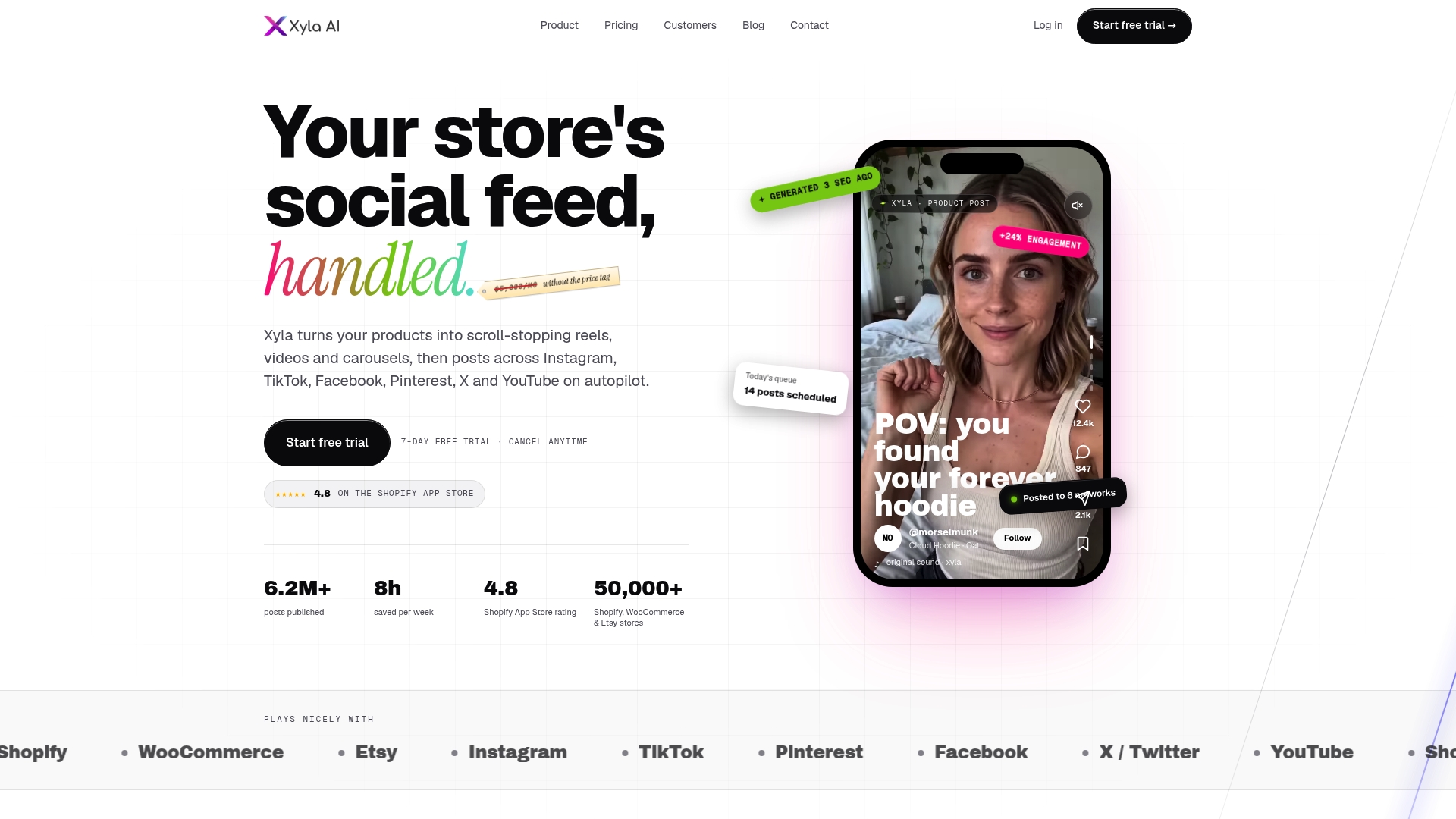
- We connect directly to your Shopify catalog and keep product data in sync as you add or update listings.
- We generate new video variations from real product photos rather than reusing one template repeatedly.
- We include AI video generation in the standard plan price rather than charging per generation.
Our Shopify integration page walks through setup, and our pricing page lists current plan options if you want to see the details before starting. If building this workflow yourself isn’t the best use of your time, a Shopify marketing agency can also help manage execution for stores that prefer hands-on support.
FAQ
How do I connect my Shopify store to TikTok?
You connect through the TikTok sales channel in your Shopify admin, which links your TikTok Business account and syncs your product catalog once your shop details and return policy are verified. For stores not yet eligible for TikTok Shop, an automation platform can still post product content to TikTok without requiring catalog sync.
What’s required for TikTok Shop eligibility?
Your business needs a verifiable location in a supported country and must complete seller verification in TikTok’s Seller Center. Common blockers include an incomplete return policy page or a mismatched business address in Shopify Locations.
Can I autopost to TikTok without TikTok Shop?
Yes, you can schedule and post organic videos to TikTok without TikTok Shop, though those posts won’t carry shoppable product tags. Automation platforms like Xyla generate and post this content directly from your Shopify catalog, which works well for stores still waiting on eligibility.
How much does it cost to automate TikTok posting for Shopify?
Costs vary by approach: the native TikTok sales channel is free to install, while automation platforms run on tiered subscriptions. Xyla’s Shopify plans run from $29 per month (Starter) to $60 per month (Scale), with AI video generation included rather than billed separately.
What should I measure after I start autoposting?
Track views, engagement, click-through to your product pages, and conversion rate over a two to three week window before judging results. If click-through is healthy but conversions lag, the product page is usually the issue rather than the video content itself.
Sources
- Shopify Help Center | Setting up TikTok Shop
- TikTok for Business: The 2026 Guide for Shopify Sellers - Shopify


