

TikTok Shop Strategy for Ecommerce: A Practical Plan

A good TikTok Shop strategy comes down to four habits: a clean catalog synced to your store, a steady flow of short product videos, creators who sell for you on commission, and fulfillment that never misses a deadline. Most stores fail on the second one. Not because they lack ideas, but because filming every week is exhausting. This guide walks through each piece in the order you should build it.
TL;DR
- TikTok Shop lets shoppers discover, watch and buy without leaving the app, so your videos are your storefront.
- Connect your store first, then prepare listings with strong images, a demo video, accurate weight and dimensions, and stocked inventory.
- Consistent, product-focused short videos beat polished ads. One European seller guide recommends 4 to 6 videos per week per product.
- Use creators on commission, then double down on the top few performers.
- Judge results on contribution margin and retention, not last-click numbers alone.
Table of Contents
- What TikTok Shop is and why it changes the game
- Step 1: Set up the shop and sync your store
- Step 2: Prepare products that are ready to sell
- Step 3: Build a video engine, not a viral hope
- Step 4: Add creators and affiliates
- Step 5: Fulfill like a marketplace seller
- Step 6: Measure what matters
- A simple 30-day launch plan
- Perspective
- Put your catalog to work with Xyla
- FAQ
- Sources
What TikTok Shop is and why it changes the game
TikTok Shop is a social commerce feature built into the app. According to Shopify’s overview of TikTok shopping, brands list products natively, and customers can go from shoppable video or livestream to checkout without leaving TikTok.
That changes what content has to do. On a normal social channel, a post sends people to your site and hopes they buy. Here the post is the product page. A video that holds attention for three seconds and shows the product in use is doing the job of your best listing photo, your sales copy and your ad, all at once.
For a small store, this is both the opportunity and the problem. The opportunity: discovery is driven by content quality rather than ad budget. The problem: content has to keep coming.
Step 1: Set up the shop and sync your store
If you sell on Shopify, the simplest route is the TikTok sales channel. Per the Shopify Help Center setup guide, you connect the channel, verify your shop information and upload the required documents. The channel then syncs your catalog, inventory, fulfillment and orders.
Access depends on where you are. A country availability list from August 2026 puts local seller access in 24 markets, including the US, UK, Brazil, Mexico and Japan. The same list notes that registration requires identity or business verification, and may require company registration and tax information depending on country and seller type. Since requirements differ by country, check TikTok’s own seller pages for your market before you start.
Two practical notes:
- Do the verification early. Document checks are the step most likely to stall a launch, and you can prepare content while you wait.
- Keep one source of truth for inventory. If the channel syncs from your store, edit stock there, not in two places.
Step 2: Prepare products that are ready to sell
A European seller guide from Ecommerce Germany lists what to have ready before launch: business registration documents, VAT and bank details, and a warehouse address. Its listing checklist asks for a title, four to nine images, a video demonstration, dimensions, weight and stocked inventory. Requirements for US sellers differ in the paperwork, but the listing basics are a sensible standard anywhere.
Beyond the checklist, choose your launch products deliberately:
- Start with three to five hero products. Pick items that demonstrate well in under 20 seconds: something that transforms, solves a visible problem or looks good in motion.
- Check your margin after commissions and shipping. You will pay platform fees and likely creator commissions. A product that barely breaks even on your website will lose money here.
- Make sure stock is deep enough. A video that takes off with no inventory behind it is a wasted win and a likely hit to your shop’s performance.
- Write titles for shoppers, not search engines. Lead with what the product does.
Step 3: Build a video engine, not a viral hope
The most repeated finding across ranking guides is that consistency beats one-off hits. The Ecommerce Germany guide advises short-form videos for discovery, 4 to 6 videos per week per product, and 1 to 4 hour live streams to convert viewers with real-time demos and limited-time offers. It also reports that sellers posting at that cadence see 5 to 8 times the conversion of sellers who upload product pages and wait. Treat that as that guide’s claim rather than a guarantee, but the direction matches what most practitioners say: volume of real product demos matters.

The same guide says product-focused demos tend to outperform polished advertising, because TikTok’s algorithm optimizes for watch-through. That is good news for small stores. You do not need a studio.
What to post
Rotate a handful of formats so the feed does not feel repetitive:
- Demo: the product in use, one benefit, one clear result.
- Problem and fix: open on the annoyance, then show the product solving it.
- Unboxing or packing: shows real stock and builds trust.
- Comparison or before and after: works especially well for beauty, home and cleaning products.
- Customer-style testimonial: short, specific, honest.
The first three seconds decide everything. Open on the result or the problem, never on a logo. Our guide to product demo video hooks shows short demo openings you can adapt, and TikTok product videos that drive sales goes deeper on structure.
How to keep up the cadence
Four to six videos a week per product across several products is a lot of filming. This is where most strategies quietly die in week three. Two ways to hold the pace:
- Batch. Film a month of raw clips in one session, then cut variations of each.
- Automate the repetitive part. Turn catalog data and product photos into short videos automatically, and save your own filming for the hero products and livestreams. Our walkthrough on posting Shopify products to TikTok without weekly filming covers how that works, and the Shopify TikTok integration explains the catalog connection. WooCommerce stores should read about avoiding the PNG trap when autoposting, and Etsy sellers can follow how to promote an Etsy shop on TikTok.
Content planning matters as much as content making. A steady calendar built around your products, seasons and offers is the same discipline behind good content marketing for ecommerce, and it applies to short video just as it does to articles.
When to post
Do not obsess over timing before you have volume. Test a few windows across two or three weeks, compare watch-through and sales, and keep the winners. What to test first for TikTok posting times gives a simple starting plan.
Step 4: Add creators and affiliates
Your own account only reaches so far. Creators bring their own audiences and a more believable voice. According to Ecommerce Germany’s TikTok ecommerce strategy framework, sellers can recruit creators, provide samples and affiliate links, and offer commissions typically between 10% and 20%. The same framework suggests managing 20 to 100 active creators per market and identifying the top 5 to 10 percent of performers to scale investment.
A workable approach for a small store:
- Start small. Send samples to 10 to 20 creators whose audience matches your buyer.
- Set a commission you can afford. Work backwards from your margin, not from what looks competitive.
- Give them a brief, not a script. Two or three talking points, the key benefit, and room for their own style.
- Track every creator. Note samples sent, videos posted, sales driven and returns.
- Back the winners. Offer top performers higher commission, early access or exclusive bundles.
You can also reuse creator videos, with permission, in your own feed to keep the posting rhythm up.
Step 5: Fulfill like a marketplace seller
TikTok Shop is a marketplace, and marketplaces punish slow shipping. The Ecommerce Germany guide says orders are managed in the TikTok Seller Center, with strict service level agreements such as dispatching within 2 working days. Check the current dispatch window in your market’s seller rules.
It describes three routes: self-fulfillment from your own warehouse or a 3PL, platform-supported Fulfilled by TikTok (FBT), and cross-border fulfillment. FBT can help you avoid SLA penalties and qualify for fast delivery badges, according to the same guide.
For most small stores the question is simple: can you pack and ship within the window on a busy day? If a viral video could triple your orders overnight, a 3PL or FBT is worth pricing out before you need it. Selling beyond your home market adds its own complexity, so read how to set up Shopify international shipping first.

Step 6: Measure what matters
Platform dashboards flatter. The Ecommerce Germany framework warns that TikTok attribution is complex: last-click can undercount TikTok’s contribution and overcount the platforms that close the purchase. It recommends media mix modeling or incrementality testing, and suggests tracking contribution margin, three-second retention, creator and sample performance, returns and shipping health.
In practice, a small store can do this:
Metric What it tells you What to do with it Three-second retention Whether your hook works Rewrite openings on videos that lose viewers early Contribution margin Whether sales make money after fees, shipping and commissions Drop or reprice products that do not clear it Creator performance Who actually sells Cut the bottom, back the top 5 to 10 percent Returns Whether the video sets honest expectations Adjust claims and sizing details Shipping health Whether you meet marketplace deadlines Add capacity or a fulfillment partnerTag your links with UTM parameters so you can see how social traffic behaves across your store, not just inside TikTok. Our pages on social commerce analytics and ecommerce social media metrics show how to set that up.
A simple 30-day launch plan
Week Focus 1 Connect your store, submit verification documents, choose 3 to 5 hero products, finalize listings 2 Publish the first batch of demo videos, set up the posting calendar, send samples to a first group of creators 3 Review retention, rewrite weak hooks, test posting windows, run a first livestream with a limited-time offer 4 Review creator results, expand what works, check margin and shipping performance, plan the next monthPerspective
We built Xyla because we kept seeing the same pattern: a store owner connects a TikTok shop, posts enthusiastically for two weeks, then goes quiet because filming and editing eat their evenings.
Our view is that TikTok Shop rewards consistency more than creativity, and consistency is a systems problem, not a motivation problem. Your catalog already holds the raw material: photos, titles, prices, descriptions. Xyla is designed to turn that data into fresh, UGC-style videos and images and post them on a schedule, so your store keeps showing up even in a busy week.
We also think content generation should not feel like a meter running. That is why AI content generation is built into our standard plans rather than billed per generation. You can try more hooks and more products without watching credits drain.
Use your own time where it counts: hero-product demos, livestreams, creator relationships and fulfillment. Let the system handle the steady drumbeat in between.
Toby
Put your catalog to work with Xyla
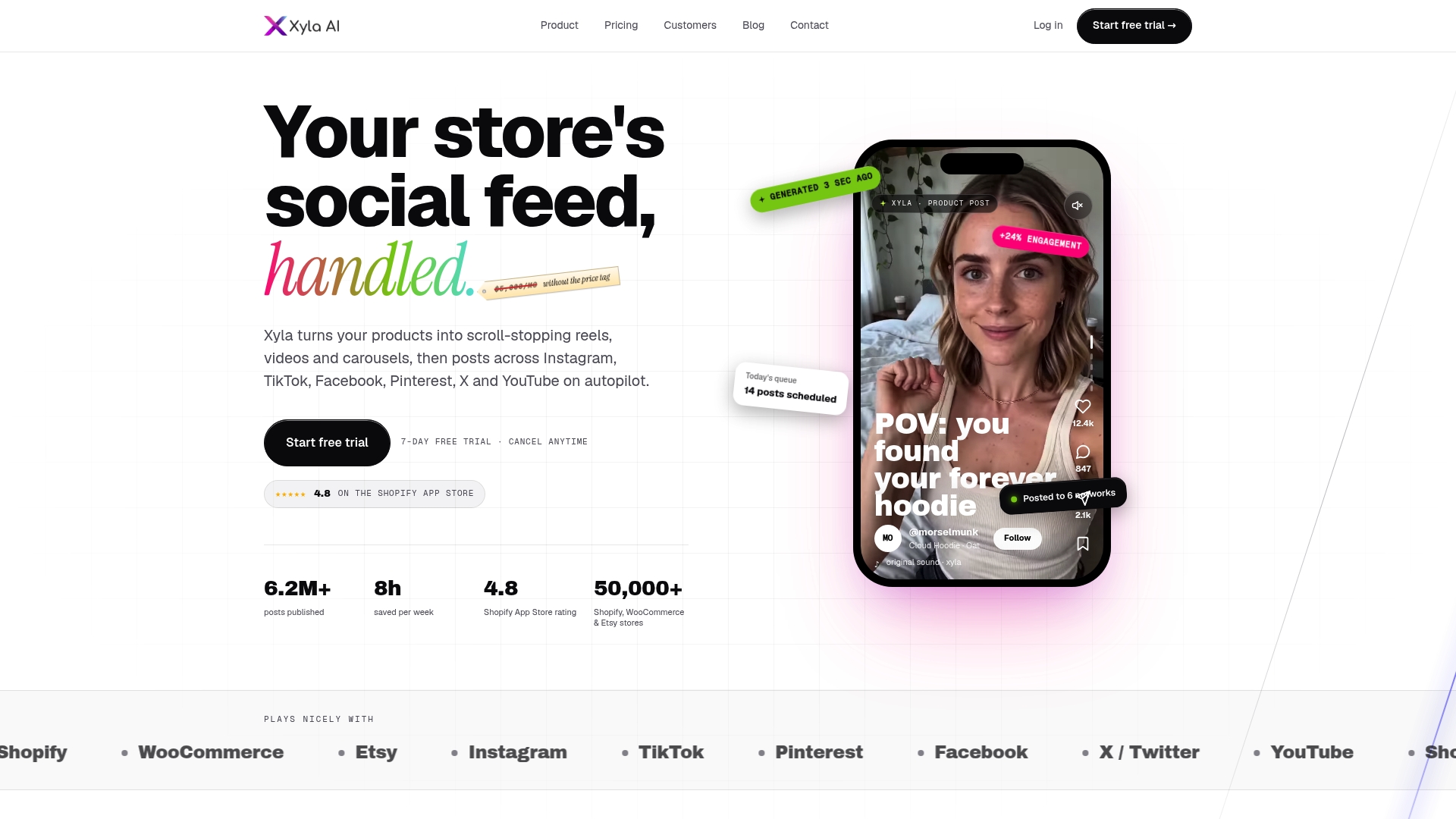
Xyla connects to Shopify, WooCommerce and Etsy, turns your product listings into reels, videos and carousels, and schedules posts across TikTok, Instagram, Facebook and other networks. Plans start with Growth from $29 per month, with Pro at $39 per month and Enterprise at $60 per month, and annual billing from $209 per year for Growth. Details and current plan features are on the Xyla pricing page.
Shopify stores can see the platform-specific plans on the Shopify page, and Etsy sellers on the Etsy page.
FAQ
Do I need a big following to sell on TikTok Shop?
No. Product discovery on TikTok is driven largely by how well each video holds attention, not by follower count. A new account with strong product demos can reach new buyers, and creators can extend your reach further through affiliate links.
How many videos should I post?
One European seller guide recommends 4 to 6 videos per week per product, plus 1 to 4 hour livestreams to convert viewers. If that is more than you can film, batch your shooting and use automation to turn product data into additional video variations.
What commission should I offer creators?
Research from a European ecommerce guide puts typical affiliate commissions at 10% to 20% of each sale. Set yours from your own margin after fees and shipping, then raise it for the top few creators who consistently sell.
Can I connect my Shopify store to TikTok Shop?
Yes. Shopify’s TikTok sales channel lets you verify your shop information, upload documents and sync your catalog, inventory, fulfillment and orders. Check Shopify’s help page for the current steps in your country.
How do I know if my strategy is working?
Look at contribution margin, three-second retention, creator performance, returns and shipping health together. Do not rely on last-click attribution alone, since it can undercount what TikTok contributes.
Sources
- Shopify: What Is TikTok Shop? How TikTok Shopping Works for Sellers
- Shopify Help Center: Setting up TikTok Shop
- TikTok Shop available countries 2026
- Ecommerce Germany: How to Sell on TikTok Shop
- Ecommerce Germany: TikTok Ecommerce Strategy framework
- Content marketing for ecommerce


