

Lock Offers 10 to 12 Weeks Out: Seasonal Campaign Planning for SMBs
Seasonal campaign planning means locking your seasonal window, your offer, and your production lead times early enough that creative testing happens before the crowd shows up, not during it. The single best first move is choosing one seasonal moment your brand can own and setting the offer decision date today. From there, everything else, your timeline, your asset kit, your channel mix, your KPIs, gets built backward from launch.
TL;DR:
- Starting with your own sales data and search trends helps identify the actual windows with active buyer intent, not just retail calendar dates.
- Lock the offer and finalize creative assets 10 to 12 weeks before launch, with testing reserved for weeks 2 to 3 prior to going live.
- Focus on a single, clear KPI tier—awareness, conversion, or retention—and tailor your creative and budget accordingly for that goal.
- Build a comprehensive asset kit with evergreen content and interchangeable end-cards, assigning clear ownership to avoid last-minute production delays.
- Continuously monitor competitor activity and market shifts during your final testing phase to adjust offers, messaging, and channel spend proactively.
Table of Contents
- How Do You Choose the Right Seasonal Campaign Opportunity?
- Setting Goals and KPIs: Awareness, Conversion, and Retention Tiers
- How Far in Advance Should You Plan Seasonal Assets?
- What Belongs in a Seasonal Campaign Asset Kit?
- Creative Strategy: Breaking the Seasonal Sameness Problem
- Channel Mix and Distribution Checklist for Launch Week
- Testing and In-Season Optimization: What to Measure and When
- Budgeting for Profit Weeks vs. Market-Capture Weeks
- Post-Campaign Debrief: Turning This Season’s Work Into Next Year’s Head Start
- Managing Risk and Building a Contingency Plan
- Audience Segmentation and Personalization for Seasonal Offers
- Watching Competitors and Market Shifts During Seasonal Windows
- Author’s Perspective: Practical Trade-Offs I Prioritize
- Automate the Production Bottleneck With Xyla AI
- Sources
- FAQ
How Do You Choose the Right Seasonal Campaign Opportunity?
Most brands default to whatever’s on the retail calendar, Black Friday, Mother’s Day, back to school, without checking whether that window actually converts for their catalog. That’s backward. Start with your own sales history.
Pull the last two years of order data by week and overlay it with Google Trends search interest for your core product terms. If your CRM shows a spike in repeat purchases three weeks before a holiday, that’s your real window, not the date printed on a marketing calendar. US Mother’s Day spending is a well-documented seasonal spike, and back to school produces predictable, large seasonal spend for relevant retailers, but neither matters for you unless your own SKUs show the same lift.
Once you have candidate windows, run them through a short checklist before committing production budget:
- Intent spike: Does search or CRM data show buyers actively looking during this window?
- Product relevance: Does at least one hero SKU or bundle make sense as a gift, upgrade, or seasonal need?
- Margin: Can you discount or bundle here without eroding profit past your floor?
- Brand fit: Does the tone of this moment match how your brand actually talks to customers?
- Repeatability: Can you run this again next year and improve on it, or is it a one-off?
If your category doesn’t have an obvious seasonal moment, invent one. Retailers do this constantly with “customer appreciation weeks” or product-specific launch anniversaries. HubSpot’s seasonal campaign framework treats opportunity selection as step one for a reason: everything downstream, budget, creative, timeline, depends on picking a window worth the effort.
Setting Goals and KPIs: Awareness, Conversion, and Retention Tiers
Not every seasonal campaign should optimize for the same outcome, and treating a brand-building window like a direct-response push (or vice versa) wastes budget. Split your KPIs into three tiers and decide upfront which one this specific campaign prioritizes.
Level 1, awareness, matters most when you’re entering a new seasonal moment or launching a new product line into an existing one. Track reach, video completion rate, and branded search lift. Don’t expect this tier to carry your ROAS.
Level 2, conversion, is what most promo weeks actually chase: conversion rate, cost per acquisition, and revenue per session during the live promotional window. This is where most of your paid budget should point during peak days.
Level 3, retention, is the tier brands skip and shouldn’t. A 60-day repeat purchase rate after a seasonal promotion tells you whether you acquired loyal customers or one-time discount hunters. If retention craters after a seasonal push, your offer structure probably needs rethinking, not your creative.
Turn each tier into a SMART target instead of a vague hope.
Pro Tip: Pick your dominant KPI tier before you brief creative. A video built to maximize reach looks nothing like one built to close a sale in three seconds, and asking one asset to do both usually means it does neither well.
How Far in Advance Should You Plan Seasonal Assets?
Late seasonal campaigns fail for a predictable reason: teams start production when the offer should already be locked. Different assets need wildly different runways, and skipping backward planning is the single most common cause of last-minute creative scrambles.
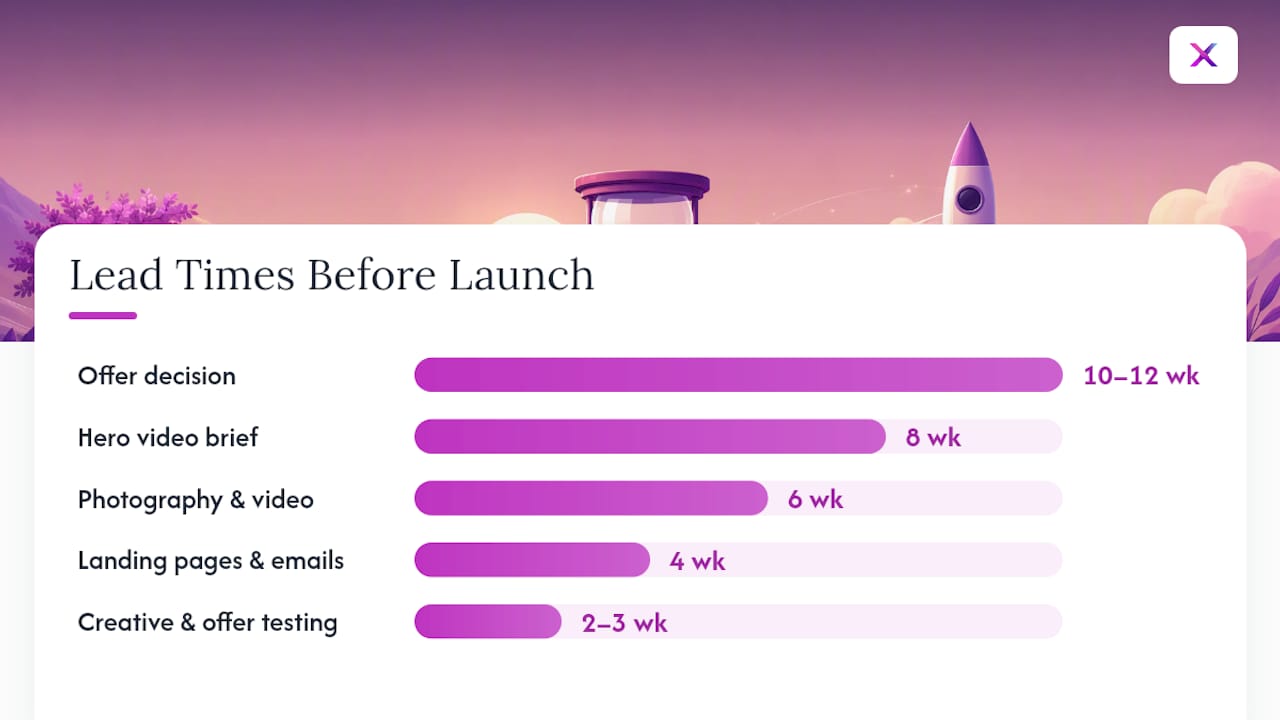
Versely’s production-runway research recommends locking the offer 10 to 12 weeks out, starting hero video concepting at 8 weeks, and reserving 2 to 3 weeks purely for testing before you scale spend. Apex Brands’ DTC playbook lands in similar territory, recommending a full 12-week Q4 build cycle specifically to leave room for testing before CPMs spike closer to the holiday.
Build your calendar backward from launch day using this sequence:
- Set launch day and count backward from there for every other date.
- Lock the offer 10 to 12 weeks before launch, including pricing, bundles, and discount depth.
- Brief hero creative at week 8, giving your team or agency the single idea the whole campaign anchors to.
- Shoot or generate photography and video by week 6, leaving buffer for reshoots.
- Build landing pages and email templates by week 4, so they’re ready for the testing phase.
- Run creative and offer tests during weeks 3 to 2, using small budget to identify winning hooks.
- Reserve a buffer week before launch for fixes, approvals, and last-minute compliance checks.
Starting late doesn’t just mean rushed creative, it means skipping the testing window entirely, which forces you to launch your best guess instead of your validated winner. If you’re already behind, compress by cutting variations rather than cutting testing time altogether. A smaller test with real data beats a full asset kit built on assumptions.
What Belongs in a Seasonal Campaign Asset Kit?
A seasonal asset kit isn’t one hero video and a handful of product shots. It’s a structured set of formats sized for how each channel actually consumes content, with clear ownership so nothing stalls waiting on approval.
A workable minimum kit for a mid-size seasonal push looks like this:
- Hero video, one core concept, produced in 2 to 3 variations (different hooks or openings) at 16:9 and 9:16.
- Cutdowns, 4 to 6 short versions (6 to 15 seconds) pulled from the hero shoot for Reels, TikTok, and Stories.
- Stills, 8 to 12 product and lifestyle photos covering hero SKUs, sized for feed, carousel, and Pinterest.
- Offer cards, 3 to 5 static graphics carrying the specific discount, bundle, or urgency message.
- Email headers and banners, 2 to 3 variants matching the campaign’s visual system.
The smartest production shortcut is keeping the body of your creative evergreen and pushing anything time-sensitive, discount percentages, “ends Sunday” urgency, into interchangeable end-cards and captions. That way a single hero shoot can serve multiple offers or even next year’s campaign with just the end-card swapped.
Assign ownership before production starts, not during it. A simple three-role matrix works for most SMB teams: one person briefs (defines the concept and offer details), one approves (final sign-off on messaging and legal claims), and one exports (formats and delivers assets to each channel). Xyla AI’s content calendar is a practical place to house this handoff, since it keeps brief, asset, and publish date attached to the same record.
Creative Strategy: Breaking the Seasonal Sameness Problem
Every competitor runs the same red-and-green palette in December and the same “everything must go” copy in July. That sameness, what one analysis calls attention monoculture, is exactly why generic seasonal creative underperforms even when the offer is strong. Sagum’s seasonal framework argues that seasonality functions like a temporary micro-market, crowded, noisy, and short-lived, which means pattern-breaking openings and proof-first creative (a real customer result or product demo before the pitch) consistently outperform generic seasonal templates.
Creative half-life, how long an ad keeps performing before fatigue sets in, shortens noticeably during peak seasonal windows because everyone’s audience sees more ads, more often. Plan your refresh cadence accordingly: prepare more variations than you’d need in a normal month, and apply a 72-hour decision rule to each one. If a variation isn’t showing signs of life within 72 hours, scale it, iterate the hook, or kill it. Waiting a full week to make that call during a two-week promo burns a third of your window on a loser.
Pro Tip: Build your creative brief around one idea, not five. A single, sharp concept executed in several formats beats five half-formed ideas competing for the same budget.
Channel Mix and Distribution Checklist for Launch Week
Choosing channels for a seasonal push comes down to three factors: where your audience already spends attention, where past campaigns actually converted, and where margin supports the spend. A channel that drove reach last quarter isn’t automatically the right one for a seasonal promo if its cost per result climbs during peak weeks.
Once channels are chosen, the operational discipline matters more than the platform choice itself:
- Queue evergreen and offer assets at least a week ahead so launch day isn’t a scramble.
- Reserve reactive slots, roughly 20% of your content calendar, for real-time responses to what’s performing.
- Hold daily check-ins during launch week with whoever owns paid spend, creative, and customer service, since seasonal spikes often surface fulfillment or stock issues fast.
- Track channel-specific creative half-life separately, since a TikTok cutdown fatigues faster than a Pinterest still.
Two channel trends are worth building into your 2026 planning. Marketers report plans to increase CTV and streaming ad usage in 2026, and the same research points to AI playing a larger role in both production and holiday search behavior. That shift makes owned channels, your email list and your own social following, more valuable during peak weeks, since paid inventory gets more competitive and expensive as more brands chase the same eyeballs. Xyla AI’s guide on choosing the best time to post is a useful reference when you’re deciding exactly when to queue owned-channel content during a crowded week.
Testing and In-Season Optimization: What to Measure and When
Most seasonal campaigns test too little, too late, or not at all, launching the first draft of creative straight into peak spend. Test hooks, formats, and offer framing during your 2 to 3 week pre-launch window using small, controlled budget before you scale anything.
A workable testing sequence looks like this:
- Test 3 to 5 hooks against the same offer to find which opening earns attention fastest.
- Test format (video vs. static vs. carousel) once you know your winning hook.
- Test offer framing (percentage off vs. dollar amount vs. bundle) with your best-performing creative.
- Scale the combined winner once you have a statistically meaningful sample, typically several hundred conversions per variant, not a few dozen.
During the live campaign, running two forecasts instead of one prevents you from misreading noisy seasonal data: a cash-efficiency forecast (protect margin, hold ROAS targets steady) and a market-capture forecast (accept lower short-term ROAS to grab share while demand is highest). Decide which forecast governs each week of your campaign before launch, not while staring at a dashboard mid-week.
Reporting cadence should match the stakes. Daily reports during peak days should flag spend pacing, creative fatigue signals, and stock levels. Weekly reports should compare performance against both forecasts and decide whether to shift budget, refresh creative, or hold steady.
Budgeting for Profit Weeks vs. Market-Capture Weeks
Confusing a profit week with a capture week is one of the fastest ways to burn seasonal budget without a clear return. Decide, before you spend a dollar, which mode this specific week of your campaign is operating in.
Cash-efficiency budgeting targets steady or improving ROAS and works best in the early or tail parts of a seasonal window, when competition for ad space is lower. Market-capture budgeting accepts a lower short-term ROAS in exchange for grabbing share during peak demand days, when acquiring a customer now, even at higher cost, pays off through lifetime value.
To estimate required spend for either mode, three inputs do most of the work:
- Expected CPA based on recent campaign data or category benchmarks.
- Margin per order, since capture-mode spend only makes sense if the eventual lifetime value clears your cost.
- Projected uplift, how much higher demand you expect versus a normal week, based on last year’s data or category trends.
Set guardrails before shifting budget mid-season: a maximum daily increase (say, no more than 25% day over day) and a floor ROAS below which spend pauses for review, regardless of how tempting the traffic looks.
Post-Campaign Debrief: Turning This Season’s Work Into Next Year’s Head Start
The campaigns that improve year over year all share one habit: a real debrief within a week of wrap, not a vague “that went well” conversation three months later.
Run a one-page debrief covering four fields:
- What ran: the final asset list, channels, and budget by week.
- What won: which hooks, formats, and offers outperformed, with the actual numbers attached.
- What to change: specific fixes for timeline, creative, or targeting, not general impressions.
- Reusable assets: which hero footage, stills, or templates can survive into next year with just an offer swap.
Reusability depends on discipline during production, not luck after the fact. Avoid dated footage (visible calendars, specific pricing baked into video) and keep offer messaging isolated in end-cards, exactly the approach that let the hero shoot double as evergreen inventory. Feed every debrief finding into next year’s asset matrix so the lead times in your production checklist shrink each cycle instead of resetting to zero.
Managing Risk and Building a Contingency Plan
Seasonal campaigns carry risks that steady-state marketing doesn’t: compressed timelines mean less room to recover from a bad creative bet, and demand spikes can outrun your fulfillment capacity before you notice.
Build contingency planning into the calendar, not as an afterthought. Set a stock threshold that automatically pauses paid promotion on a SKU before you oversell it, and confirm with fulfillment or suppliers ahead of launch that lead times can support your projected uplift. If a hero creative underperforms in testing, have a backup concept ready rather than scrambling to brief one during launch week.
Platform risk deserves its own line item. If an algorithm change or ad account issue disrupts your primary channel mid-campaign, owned channels, email and your own social following, become the fallback that keeps revenue moving while paid recovers. Price and offer risk matters too: model what happens if a competitor undercuts your discount mid-season, and decide in advance whether you’ll match, hold, or add value instead of dropping price further.
Finally, build in a communication plan for internal stakeholders. A short daily update during peak days (spend pacing, stock status, top-performing creative) keeps leadership from making reactive decisions based on incomplete information.
Audience Segmentation and Personalization for Seasonal Offers
Blasting the same seasonal offer to your entire list wastes the most valuable asset most SMBs have: first-party purchase history. Segment before you send anything.
Start with three practical splits: past purchasers of the relevant category (who get an upgrade or replenishment message), past browsers who didn’t convert (who get a stronger incentive or social proof), and your full list (who get the general campaign announcement). Each segment deserves different creative emphasis, not just a different subject line.

Personalization at the SMB level doesn’t require enterprise martech. Dynamic product blocks in email that show a customer’s previously viewed items, or simple audience exclusions in paid social so recent buyers don’t see a discount on something they just bought at full price, cover most of the practical gains. The goal is relevance, not complexity: a segment that gets a message clearly built for their situation converts better than one getting a generic blast, even with a weaker offer.
Watching Competitors and Market Shifts During Seasonal Windows
Seasonal periods compress competitive activity into a short window, which means the landscape you scouted in the planning phase can shift by the time you launch. Check competitor offers, messaging, and channel presence again during your final testing week, not just during initial planning.
Track three things specifically: whether competitors have shifted their discount depth (a sign the category is getting more promotional than usual), whether new entrants are targeting the same seasonal moment, and whether channel costs are climbing faster than expected, a signal that more of your category is competing for the same inventory. Marketers already anticipate a heavier tilt toward CTV and AI-driven production for 2026, which means categories slow to adopt those channels may see less competition there, at least temporarily.
Broader spending trends still matter more than any single competitor’s move. Category-level data, like the well-documented spending patterns around Mother’s Day and back-to-school season, tells you whether the whole pie is growing or whether you’re fighting competitors for a flat market.
Author’s Perspective: Practical Trade-Offs I Prioritize
When time or budget runs short, protect the offer decision date and the testing window before anything else. A campaign with mediocre creative but real pre-launch testing beats a beautifully produced campaign that skipped it. I’d rather cut variation count than cut the 72-hour decision discipline, because the discipline is what prevents budget bleeding into a losing creative for a full week.
— Toby
Automate the Production Bottleneck With Xyla AI
Every lead-time chart in this guide assumes someone has to build the hero video, the cutdowns, the stills, and the offer cards on schedule, and for most SMB teams, that production load is the actual bottleneck, not the strategy. Xyla AI converts your existing product listings into reels, carousels, and video variations automatically, then customizes and autoposts them across Instagram, TikTok, Facebook, and other networks, cutting the manual work that typically eats around eight hours a week for store owners.
For e-commerce sellers, that means an asset kit, hero variations, cutdowns, offer cards, can be generated from product photos in your catalog, then queued to publish automatically during launch week instead of requiring manual uploads at peak times. If you’re planning your next seasonal push and want the production side handled while you focus on offer and creative strategy, start with Xyla AI’s guide on automating your social media marketing step by step and see how a free trial fits into your next backward-planning calendar.
Sources
- HubSpot — How to plan a seasonal marketing campaign: A 5-step strategy
- Sagum — Seasonal campaign planning that wins
- Versely — Seasonal digital marketing campaign planning
FAQ
What Is an Example of a Seasonal Campaign?
A back-to-school promotion built around a bundle discount, timed to launch six weeks before the school year starts, is a classic example. Another is a Mother’s Day gifting push that anchors creative to a single hero product and runs for two to three weeks around the holiday.
What Is a Seasonal Marketing Strategy?
A seasonal marketing strategy is a plan that times offers, creative, and channel spend to a specific recurring demand window, such as a holiday or back-to-school period, rather than running the same messaging year round. It typically includes a defined lead time, a dedicated asset kit, and KPIs tailored to that window.
What Are the Basic Steps for Planning a Seasonal Advertising Campaign?
A practical sequence covers choosing the seasonal opportunity, setting goals and KPIs, building a backward timeline with lead times, producing an asset kit, testing before scale, and running a post-campaign debrief. This mirrors the five-step framework HubSpot outlines for seasonal planning, extended with the testing and debrief stages that protect long-term performance.
What Is a Seasonal Promotion?
A seasonal promotion is a time-limited offer, a discount, bundle, or gift with purchase, tied to a specific calendar window when buyer intent for a category naturally rises. It differs from an evergreen promotion because the urgency and messaging are built around that specific window closing.
How Far Ahead Should I Start Planning a Seasonal Campaign?
Start locking your offer 10 to 12 weeks before launch, and begin hero creative concepting around 8 weeks out, leaving 2 to 3 weeks for testing before you scale spend — for practical guidance on organizing a content calendar and aligning assets to campaign milestones, see How to plan a content calendar for marketing success. Tools like Xyla AI’s content calendar can help keep that backward schedule visible across a team.


