

Reels for Ecommerce: Convert Sales and Save 8 Hours a Week

Yes, Reels are worth building into your ecommerce marketing, but only if you treat each one as a sales tool, not a vanity metric. The single tactical priority is discipline: one product, one buyer outcome, per Reel. This guide walks through the formats that convert, a repeatable production workflow, distribution tactics that turn views into checkouts, and the metrics that tell you what to scale.
TL;DR:
- Reels should focus on one product and one buyer outcome to maximize conversion rather than pursuing vanity metrics.
- Starting with product demos, UGC reviews, unboxings, how-to videos, or collection showcases aligns content with common customer hesitations.
- A structured workflow, including preproduction planning and adding clear CTAs, improves Reel effectiveness, with filming hooks last for better sales impact.
- Optimizing for mobile, adding captions, testing trending audio, and properly tagging products can significantly boost engagement and conversions.
- Using AI tools to generate, schedule, and publish Reels can save store owners around eight hours weekly, especially for larger catalogs.
Table of Contents
- Why Instagram Reels matter for ecommerce discovery
- High-impact Reel types and when to use each
- Step-by-step workflow for a converting product Reel
- Optimization and best practices that lift performance
- Turning Reel views into paying customers
- Measure and iterate: what to track and test
- How AI tools keep Reel production consistent at scale
- What realistic Reels results actually look like
- Producing Reels without adding a marketing hire
- Selected resources for going deeper
- Sources
- FAQ
Why Instagram Reels matter for ecommerce discovery
Reels and Stories do different jobs in your funnel, and mixing them up wastes both. Reels are surfaced through Explore, which means they reach people who have never heard of your store, while Stories mostly reach the followers you already have. That makes Reels your top-of-funnel discovery engine and Stories your nurturing and qualifying layer, guiding warm traffic toward a purchase.
- Reels are discoverable through Explore and help grow an audience, while Stories nurture and qualify that audience.
- New viewers who find you through a Reel typically land on your profile before they ever see your product page.
- Short-form video is increasingly favored in feed algorithms, which tends to give Reels more reach than static posts.
Once someone follows you from a Reel, Stories become the tool that walks them through your catalog, restocks, and limited drops until they buy.
High-impact Reel types and when to use each
Not every product benefits from the same format. Matching the Reel type to the buyer outcome you’re chasing keeps production focused and makes results easier to read.
- Product demo: Best when the buyer’s hesitation is about how a product actually works. Show it in use, in real time, with minimal editing tricks.
- UGC or customer review: Best for trust and social proof, especially for newer brands without a reputation yet. A real customer talking about a real result carries more weight than polished brand copy.
- Unboxing and try-on: Best for launches and tactile categories like apparel, beauty, or anything where texture and fit matter. Viewers want to see the reveal moment.
- How-to or use-case: Best for education, and one of the more effective ways to cut down on returns caused by misuse or unmet expectations.
- Montage or collection showcase: Best when you want to move multiple SKUs at once, such as a seasonal lineup or a bundle promotion.
These categories show up repeatedly in ecommerce-focused Reels strategy guides because they map directly to specific stages of buyer hesitation: not understanding the product, not trusting the brand, or not knowing how to use it once it arrives.
Step-by-step workflow for a converting product Reel
Skipping straight to filming is the most common way ecommerce teams waste a Reel. A tight process, even a fifteen-minute one, produces better results than winging it.
- Preproduction: Pick one product and one buyer outcome, such as “show that this backpack fits a 15-inch laptop.”
- Write the hook: Draft a line or visual moment for the first three seconds that states the product, problem, or result up front.
- Build a shot list: Plan three or four short shots, prioritizing the product in actual use over static beauty shots.
- Frame for mobile: Shoot vertical, keep the product centered, and avoid busy backgrounds that compete for attention.
- Capture context shots: Grab a few extra angles or lifestyle shots while you’re set up, useful later for a montage Reel.
- Add captions: Overlay readable on-screen text for viewers watching muted, which is most of them.
- Choose audio: Pick a track that matches the pacing of your cuts, whether trending sound or a short voiceover.
- Overlay one CTA: State a single next step, such as “tap to shop” or “link in bio,” and resist the urge to add a second one.
- Tag the product: Add product tags before publishing so viewers can act without leaving the app.
- Publish and review: Post at a consistent time, then check early performance within the first few hours.
Pro Tip: Film your hook shot last, after you’ve already run through the demo once. You’ll instinctively know which three seconds actually sell the product.
Authenticity does not mean sloppy footage. The strongest ecommerce Reels stay clear about the product and its use while keeping human, native pacing: overly polished ads can feel distant, while unclear amateur clips create doubt instead of trust.
Optimization and best practices that lift performance
Small production choices separate a Reel that gets skipped from one that gets watched to the end and acted on.
- Keep the hook inside the first three seconds and make sure the product or result is visually obvious, not implied.
- Use readable captions sized for a small screen, since most viewers watch with sound off.
- Test trending audio against original voiceover on similar products to see which pulls better watch time for your audience.
- Add product tags on every Reel where it’s supported, and use Collabs to extend reach when a customer or partner creates content about you.
- Prepare your best-performing organic Reels as ad creative once they show strong watch-through, since native-feeling content tends to outperform obviously produced ads in feed.
Pro Tip: Rotate two hook variations on the same product before you settle on a winning template. The hook usually matters more than the rest of the edit combined.
Turning Reel views into paying customers
A Reel that gets views but no sales usually has a distribution problem, not a content problem. Closing that gap means reducing every extra step between watching and buying.
- Set up Instagram Shopping and tag products directly in Reels wherever the feature is available to you.
- Use Reels for discovery, then rely on Stories with stickers or links to qualify that traffic before it reaches a product page.
- Convert or embed your best Reels into shoppable videos on product pages so shoppers can watch and add to cart without leaving your site.
- Once a Reel proves itself organically, repurpose it as paid creative rather than starting a new ad from scratch.
Shoppable video works because it removes the platform-hopping that kills conversion: a viewer who has to leave Instagram, find your site, then find the product is a viewer you’re likely to lose along the way.
Measure and iterate: what to track and test
Track a small set of KPIs consistently rather than chasing every metric Instagram surfaces. Reach and saves tell you about discovery and resonance, profile visits and clicks to product tell you about intent, and add-to-cart and conversion tell you whether the Reel actually sells.
- Reach and saves signal whether the content resonates enough to spread or get revisited.
- Profile visits and clicks to product show whether the CTA and product tag are doing their job.
- Add-to-cart and conversion rate are the real test of whether the Reel matches what the product page delivers.
High clicks but low conversion usually points to a mismatch between what the Reel promises and what the product page shows, not a flaw in the Reel itself.
Run small, single-variable experiments: two different hooks on the same footage, two CTA wordings, or trending audio against a voiceover. Consistent measurement and testing is one of the more reliable levers for improving marketing ROI over time, according to analytics-focused marketing research.
How AI tools keep Reel production consistent at scale
The bottleneck for most ecommerce teams isn’t ideas, it’s volume: producing enough Reels, consistently, without burning out a small team. AI tools now handle a meaningful share of that load.
- Generating UGC-style clips directly from product photos and descriptions, without a camera crew or a customer on hand.
- Batch-producing several Reels at once from a product catalog, tuned to the right aspect ratio and pacing.
- Writing captions and on-brand copy automatically, then scheduling posts across networks.
Platforms built for this, such as those that turn product catalogs into short-form video, can produce native-feeling clips at a pace no manual workflow matches. The trade-off is that automation should still pass through a human check before publishing, since accuracy about the product and a believable, authentic feel matter more than raw output. A reasonable approach is to let AI handle first drafts and batch variations, then reserve real customer UGC for your highest-consideration products. Xyla’s AI UGC video tools are built around that same split between speed and human oversight.
What realistic Reels results actually look like

Reels rarely show a repeatable sales pattern in the first few weeks. Give a format at least a month of consistent posting before judging it, since early Reels mostly teach you what your audience responds to.
If a product category simply doesn’t lend itself to short video, or your audience skews toward channels like email or search, it’s fair to deprioritize Reels rather than force them. For most stores, a mix of frequent Reels for discovery, Stories for nurturing, and a smaller paid budget behind proven winners outperforms betting everything on one channel.
— Toby
Producing Reels without adding a marketing hire
Most store owners don’t have a spare eight hours a week for filming, editing, captioning, and scheduling Reels on top of running the business. Some AI-powered platforms turn existing product listings into AI-generated, UGC-style Reels, videos, and carousels, then format and publish them across Instagram, TikTok, and Facebook automatically.
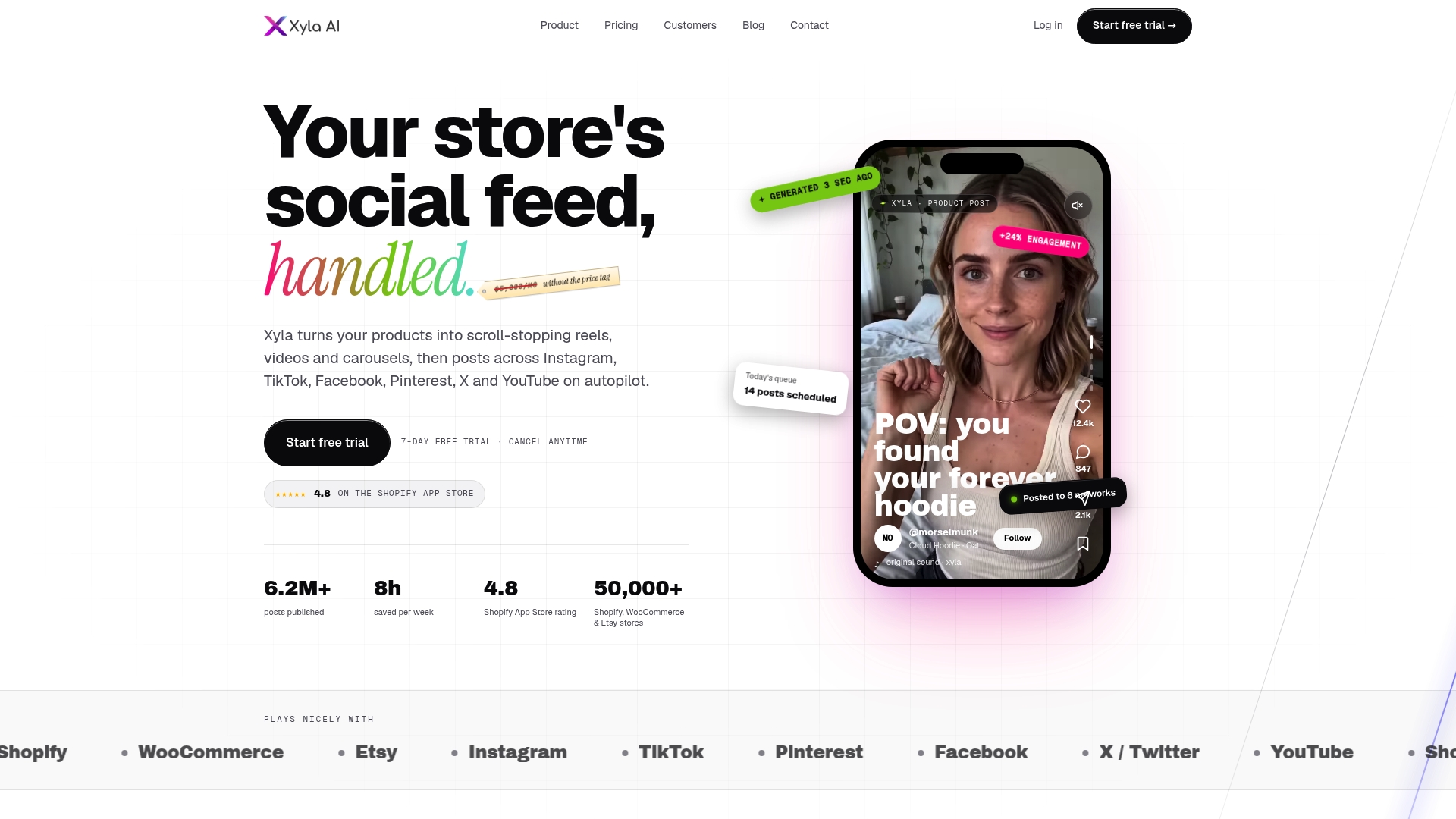
- Generates UGC-style Reels directly from product photos and descriptions, no filming required.
- Schedules and cross-posts content automatically once connected to a store.
- Integrates with popular ecommerce catalogs, including product tagging support.
- Includes AI content generation in plans without separate charges per generation.
Store owners typically save around eight hours a week that would otherwise go into manual content production.
Plan tier Monthly price Best for Growth starting at a low monthly price Stores starting to automate Reels and posting Pro mid-level monthly price Stores wanting more frequent AI-generated content Enterprise higher monthly price Larger catalogs needing full automationIf you run a Shopify store, the Shopify integration page walks through connecting your catalog directly. Full plan details, including annual pricing, are on the Xyla pricing page.
Selected resources for going deeper

For platform-specific tagging and feature details, Shopify’s own guide to using Reels for marketing is a solid reference point. To understand shoppable video mechanics beyond Instagram, the breakdown of Reels-driven store sales covers how embedded video reduces drop-off. Store owners looking to automate the production side can start with Xyla’s Shopify connection guide.
Sources
- How To Use Instagram Reels For Growth and Engagement
- Using Instagram Reels to Increase Online Store Sales With Shoppable Videos
- How to sell with Instagram Reels and Stories
- AI Video for eCommerce | Product Videos at Scale | Fliki
FAQ
What type of reels are trending right now?
Product demos, UGC-style reviews, unboxings, how-to clips, and launch teasers consistently perform well for ecommerce brands. These formats work because they map directly to specific buyer hesitations, like not understanding a product or not trusting a new brand.
Do you get paid for 1,000 views on Instagram reels?
Instagram does not pay ecommerce accounts per view the way a creator fund might. For store owners, the value of views comes from driving traffic, clicks, and sales rather than direct payout from the platform.
What are the top 5 e-commerce platforms?
Shopify, WooCommerce, and Etsy are among the most widely used ecommerce platforms, alongside other options store owners choose based on catalog size and business type. The right platform depends on your product category, budget, and how much control you need over store design.
What are some good Reel ideas for a small business?
Strong starting points include a single-product demo, a customer unboxing, a quick how-to for using the product, and a montage showcasing a few bestsellers together. Keeping each Reel focused on one product and one outcome makes it easier to tell what’s actually working.


