

Earn 4% Back: Promote Etsy on Instagram for Solo Sellers

The three moves that actually drive Etsy clicks from Instagram are: a business profile with a clean bio and one link, a Share & Save trackable link posted in Stories and captions instead of a plain listing URL, and a Reels-first content mix that trades product photos for short process videos. Set the profile up once, grab your trackable link from Shop Manager, and post your first Reel today.
TL;DR:
- Using a trackable Share & Save link in Instagram Stories or bio can earn sellers 4% back on qualifying orders within 30 days, boosting profits.
- Switching to a Business or Creator account unlocks insights like link clicks and follower demographics, essential for measuring ad performance.
- Reels focused on process, unboxing, or behind-the-scenes content drive the most discovery, especially when posted consistently two to three times weekly.
- Batch-producing content and automating posting with AI tools can save time and maintain a steady presence without sacrificing authenticity.
- Engaging with followers through comments, DMs, and user-generated content builds trust and increases the likelihood of converting followers into buyers.
Table of Contents
- How Do You Set Up Instagram for Etsy Sales?
- How Do You Use Etsy’s Share & Save Links on Instagram?
- Which Instagram Formats Actually Sell Etsy Products?
- What’s a Realistic Weekly Posting Schedule?
- How Do You Turn Followers Into Customers?
- What Should Your Captions and Hashtags Say?
- How Do You Know If Your Instagram Strategy Is Working?
- What Mistakes Are Costing Etsy Sellers Sales?
- Can Automation Keep This Consistent Without Losing Your Voice?
- Why Consistency Beats Perfection for Makers
- Automate the Content, Keep the Voice
- Where to Learn More Directly From Etsy
- Sources
- FAQ
How Do You Set Up Instagram for Etsy Sales?
A personal Instagram account can’t show analytics, add a contact button, or run ads, so the first real step is switching to a Business or Creator account under Settings. That single change unlocks profile visit counts, link click data, and audience demographics, all of which you’ll need later to figure out what’s actually working.
Your bio has about 150 characters to do three jobs: say who you are, say what you make, and tell people what to do next. A formula that works consistently: “[What you make] for [who it’s for] → shop below.” Skip the inspirational quote. Skip “welcome to my page.” Nobody clicks a bio because it’s charming; they click because it tells them exactly what they’ll find.
For the link itself, Instagram now lets you add several links directly in your bio without a third-party tool, which is worth doing if you sell more than one product line or want to point traffic to a seasonal collection alongside your main shop. Native multi-link support means most solo sellers don’t need a link aggregator at all.
Before you paste anything into that bio slot, though, grab the right kind of link:
- Switch to Business or Creator in account settings and enable Insights.
- Write a bio that names your product and your customer in the first line.
- Add a Share & Save link (covered next) instead of your shop’s plain URL.
- Turn on the contact button only if you actually check those messages daily.
How Do You Use Etsy’s Share & Save Links on Instagram?
Etsy’s Share & Save program refunds you 4% of the eligible order total when a buyer places an order within 30 days of clicking a trackable link you shared, according to Etsy’s own program guide. That’s a partial transaction fee refund, not a discount to the buyer, and it only applies to links generated through the program.
Share & Save in one line: post the right link, and Etsy hands back 4% of the sale if it closes within 30 days of the click.
To find your link, go to Shop Manager, open the listing you want to promote, and use the Share button to copy the trackable URL. That link goes in your bio, in a Story link sticker, or in the swipe up if your account has it. It does not work if you paste it into an Etsy message or bury it in a listing description, since those placements don’t qualify for attribution.
Common mistakes to avoid:
- Copying the plain browser URL instead of the Share button’s tracked version.
- Posting the link inside a caption on a platform that doesn’t render it clickable (Instagram captions aren’t tappable links, so this only works in bio or Stories).
- Assuming a custom domain redirect will preserve tracking; it often strips the parameters that make Share & Save work.
Which Instagram Formats Actually Sell Etsy Products?
Reels currently get pushed harder by Instagram’s algorithm than any other format, and Craftybase’s 2026 promotion guide confirms Reels remain the dominant discovery tool for small shop owners. Stories, meanwhile, are where the actual clicking happens, since they support direct link stickers. Feed posts and carousels do neither job especially well. Their strength is credibility. A tidy grid of process shots and finished pieces convinces someone who already found you through a Reel that you’re a real, consistent business.
Here are five Reel recipes that consistently pull views without needing a script:
- The process clip. Fifteen to twenty-five seconds of hands actually making the thing, cut on the beat of a trending audio track.
- The unboxing. Show your packaging from the customer’s point of view, tissue paper and all, ending on the finished product.
- The before-and-after. A messy workspace or raw material transformed into the final product in one loopable cut.
- The “how I fix a mistake” clip. Sellers underestimate how much trust a visible flaw and repair builds.
- The restock countdown. A quick 7 to 10 second teaser of inventory landing on shelves, useful right before a drop.
Keep clips between 7 and 30 seconds and cut the ending so it loops back into the first frame. Loopable Reels get replayed, and replays count toward reach.
Pro Tip: Film five short clips in one sitting. You can turn one packaging session into a process Reel, a Story sequence, and a carousel without touching your workspace twice.

For Stories, use the link sticker on every single one that mentions a product, and try a poll sticker (“Which color should I restock?”) once a week. It’s a low effort way to get direct feedback on what to make next, and it drives Story views up because people like tapping polls. For feed posts, favor carousels that show a product in three contexts, in use, in packaging, and styled, over a single flat product shot, following visual storytelling tips to boost your brand’s impact. Etsy’s own Seller Handbook points sellers toward exactly this mix: Reels, Stories, and consistent visuals working together rather than any one format carrying the whole strategy.
What’s a Realistic Weekly Posting Schedule?
Aim for 2 to 3 Reels, 1 to 2 feed posts, and a Story most days. That’s the cadence Craftybase recommends for solo sellers, and it’s sustainable in a way that daily Reels rarely are once order fulfillment picks up.
Batch your production instead of creating content daily:
- Plan (15 minutes): List which products need content this week and what story each one tells.
- Shoot (60 to 90 minutes): Film all clips for the week in one session, using natural light near a window if possible.
- Edit (45 minutes): Cut clips into Reel length, add captions, and save Story-sized crops of the same footage.
- Schedule (20 minutes): Queue everything so Stories go out daily even on days you’re packing orders.
One shoot session, reused three ways, beats three separate shoots for three separate posts. That’s the entire trick to keeping this up past week four.
How Do You Turn Followers Into Customers?
Comments and DMs are where trust actually gets built, and trust is what closes an Etsy sale from someone who’s never bought handmade goods online before.
Ask happy customers for permission to repost their photos with a simple message: “Would you mind if I shared this on my Instagram? I’ll tag you and give full credit.” Most say yes, and user-generated content reads as more credible than your own product shots because it shows the item in someone’s actual life.
Set aside 15 to 20 minutes daily for replying to comments, answering DMs, and interacting with hashtags in your niche. This isn’t busywork. It’s the reason the algorithm shows your content to more people the following week.
- Repost UGC with credit and a direct thank-you tag.
- Reply to every comment within a few hours, even a single word.
- Reach out to one complementary (not competing) maker each month for a joint Reel or Story swap.
Pro Tip: A small collaboration with a maker in an adjacent niche, candles and soap, jewelry and leather goods, often converts better than a big influencer post, because both audiences are already primed to buy handmade.
What Should Your Captions and Hashtags Say?
A caption that converts follows a simple shape: hook, story or benefit, direct call to action, hashtags. The hook is one line that stops the scroll. The story explains why the product matters or how it’s made. The CTA tells people exactly where to click.
- Feed post CTA: “Link in bio, or DM me for a custom order.”
- Reel CTA: “Tap the link in my bio for this one, it restocks Friday.”
- Story CTA: Use the sticker itself; skip the redundant text overlay.
For hashtags, use 5 to 10 tags rather than the maximum Instagram allows. Mix two or three broad ones (“handmadejewelry”) with the rest specific to your niche (“beadedearringssmallshop”). Broad tags get you volume; narrow ones get you the right people.
How Do You Know If Your Instagram Strategy Is Working?
Track four numbers weekly: profile visits, link clicks, Story sticker taps, and Reel plays, all available once your account is set to Business or Creator. Cross-reference those against Etsy’s own Shop Stats to see which week’s traffic bump actually turned into orders.
Run one A/B test at a time. Try two different CTA phrasings across similar Reels for two weeks, then compare click rates. Or swap your Reel’s cover thumbnail between a product shot and a face shot and see which one holds attention longer.
- Weekly check: profile visits, link clicks, sticker taps, Reel plays.
- Monthly check: cross-reference Instagram Insights against Etsy Shop Stats for actual conversions.
- Test one variable at a time (CTA text or thumbnail), never both at once.
Instagram’s wide reach across nearly every adult age group means the traffic potential is there. The gap is almost always in tracking, not audience size.
What Mistakes Are Costing Etsy Sellers Sales?
- Posting a plain shop URL instead of a Share & Save link. Fix: replace it this week and start earning the 4% refund on qualifying orders.
- Only posting finished product photos. Fix: add one process or packaging Reel this week to show the making, not just the result.
- Ignoring Stories entirely. Fix: post one Story a day for seven days, even something as small as a “packing orders today” clip.
- Posting in bursts, then going silent for two weeks. Fix: batch a week’s content in one sitting so consistency doesn’t depend on daily motivation.
Can Automation Keep This Consistent Without Losing Your Voice?
Turning one product listing into a Reel, a caption, and a Story crop takes real time when you’re doing it by hand every week. That’s exactly the gap tools like Xyla AI’s Etsy integration are built to close, converting listing photos into short-form video and carousel content and queuing it across the week automatically.
Automation handles the repetitive part: turning product photos into Reel-ready clips, writing a first draft caption, and scheduling posts at the times your audience is actually online. It should not handle your DMs, your comment replies, or your final caption edit. Keep those human, since that’s where trust actually gets built with buyers.
- Use automation for volume: converting listings into Reels and carousels on a schedule.
- Keep a five-minute human review step before anything posts, checking the caption’s tone and CTA.
- Reply to comments and DMs yourself; that’s not a task worth automating away.
There’s no fully automatic pipeline that turns an Etsy catalog into tagged Instagram Shopping posts for every seller. Most shops still rely on manual catalog syncs or third-party tools to enable product tagging, so build your workflow around content creation and scheduling, and treat native Shopping tags as a bonus, not the core plan.
Why Consistency Beats Perfection for Makers
Most Etsy sellers quit Instagram not because the platform doesn’t work, but because they aim for a posting frequency they can’t sustain past their own busy season. A modest, repeatable cadence, three Reels and daily Stories, beats an ambitious schedule abandoned after three weeks.
Chase link clicks and Share & Save conversions, not follower counts or likes. A shop with 800 followers and a tight, trackable posting habit will usually outsell one with 8,000 followers and no link strategy at all.
— Toby
Automate the Content, Keep the Voice
Xyla AI is the alternative to hiring a part-time content assistant for your Etsy shop. Instead of spending your evenings converting listing photos into Reels one at a time, Xyla turns your existing catalog into ready-to-post Reels, carousels, and captions, then schedules them automatically across Instagram at the times your audience is actually browsing.
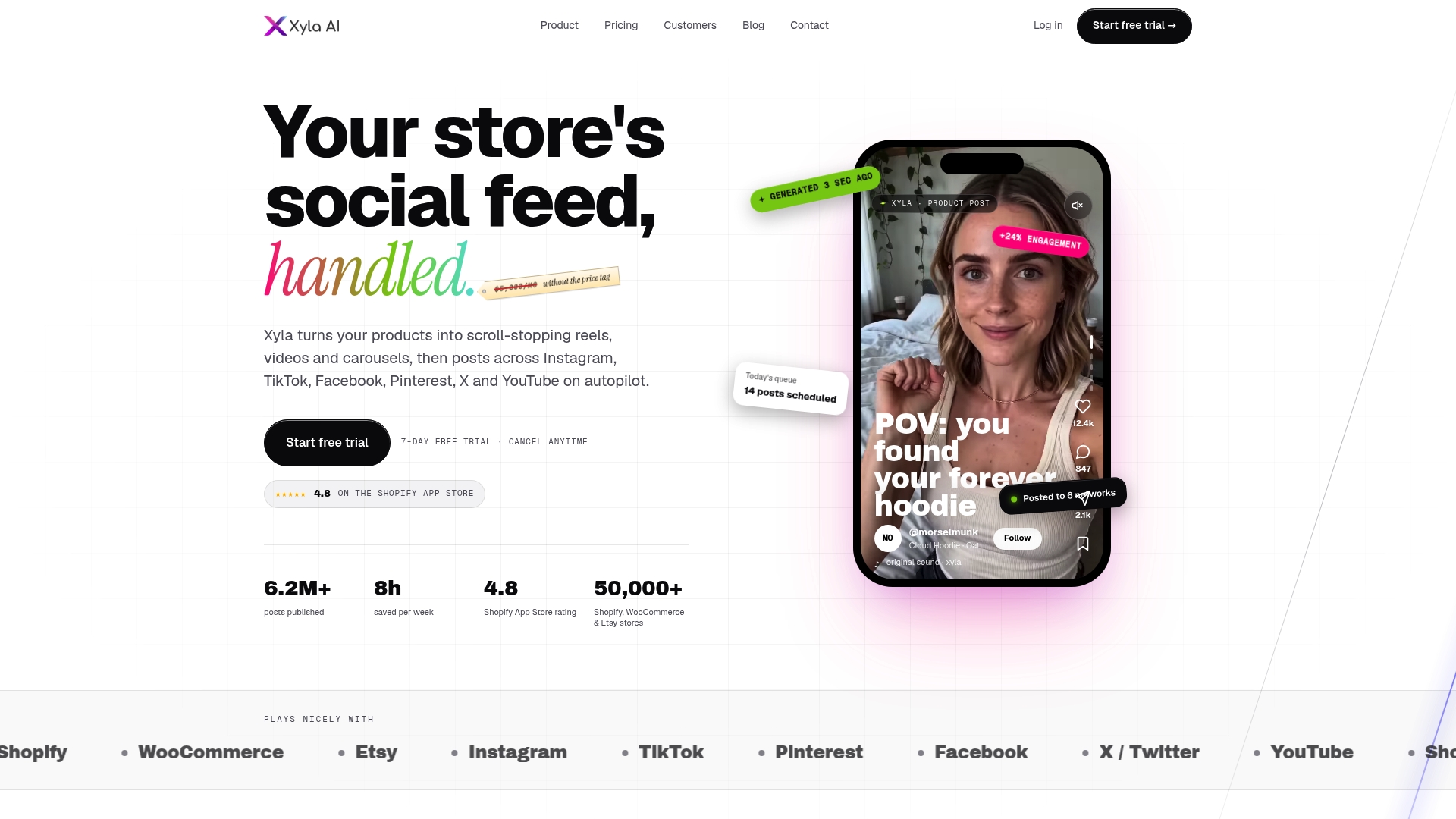
It’s built specifically around the workflow this article just laid out: listings become video and carousel content, that content gets a posting schedule instead of a to-do list, and you keep your time for the parts that need a human, replying to DMs, packing orders, and reviewing captions before they go live. The Etsy plans start at $29 a month for the Maker tier, with Shop and Studio tiers available as your catalog and posting volume grow, and every tier includes AI content generation without separate per-post credit charges. If you want the full breakdown of plan features and pricing, the pricing page lays out all three tiers side by side. Start with a short trial on one week’s worth of listings and see how much of Tuesday night you get back.
Where to Learn More Directly From Etsy
- Etsy Seller Handbook: How to Market Your Business With Instagram
- Etsy Help: Share & Save Program details
- Etsy Seller Handbook: consistent branding guidance
- Craftybase: How to promote your Etsy shop on Instagram in 2026
- LitCommerce: How to link Etsy to Instagram
Sources
- How to Save on Etsy Fees with the Share & Save Program – Etsy Help
- How to Market Your Business With Instagram — Etsy Seller Handbook
- Instagram: share of users by age group — Statista
- How to promote your Etsy shop on Instagram in 2026 | Craftybase
FAQ
Can You Make $10,000 a Month on Etsy?
Some sellers do reach that level, but it typically requires a catalog of proven bestsellers, consistent external traffic (Instagram included), and pricing that accounts for materials, time, and Etsy fees. It’s realistic as a growth goal, not a guaranteed starting point, and most shops build toward it over many months of consistent posting and product testing.
Why Are Sellers Leaving Etsy?
Common complaints include rising transaction fees, increased competition from mass-produced listings, and the feeling that on-platform search alone no longer delivers enough traffic. That’s exactly why driving external traffic from Instagram, paired with Share & Save’s 4% fee refund, has become a bigger part of many sellers’ strategy rather than relying on Etsy search alone.
Is It Better to Sell on Instagram or Etsy?
They serve different jobs rather than competing directly. Etsy handles secure checkout, buyer protection, and search discovery within its marketplace, while Instagram handles the discovery and trust-building that gets a stranger to click through in the first place. Most successful handmade sellers use both together instead of choosing one.
How Much Does Etsy Take From a $1,000 Sale?
Etsy’s standard fees include a transaction fee, a payment processing fee, and a small listing fee per item, which together typically take a meaningful cut before you factor in any offsite ads. Using a Share & Save trackable link on qualifying orders refunds 4% of the eligible order value, which offsets part of that cut when a sale closes within the program’s 30-day attribution window.


