

Sellers: 4 Copy-Paste Product Caption Prompts That Convert

The prompt structure that works for product captions follows a simple order: Hook, Value, Proof, Call to Action, written so the hook lands early in the caption before any “more” truncation cuts it off. Below, you’ll find reusable templates built on that structure, platform-specific tweaks, before-and-after examples, and a testing loop to refine what you generate. Every prompt is ready to copy into whatever AI tool you already use.
TL;DR:
- Effective captions should start with a punchy hook within the first 125 characters to prevent truncation on social feeds.
- Including concrete proof points, such as material details or test results, increases credibility and encourages engagement.
- Clearly separating visible content from backend search terms improves listing compliance and searchability across platforms.
- Disclosures for sponsored or AI-generated content must appear within the first three lines to meet legal and platform transparency rules.
- Automating caption creation with a defined structure saves time and maintains consistency when posting multiple products across social channels.
Table of Contents
- Core caption prompt frameworks and formulas
- Ready-to-use prompts you can copy and paste
- Adjusting prompts for Instagram, TikTok, Amazon, and eBay
- Before-and-after caption examples that show what’s changing
- Testing and refining your AI-generated captions
- Staying compliant with disclosure rules on sponsored captions
- How Xyla fits into this workflow
- What I’d tell a seller starting from scratch
- Automating this at scale with Xyla
- FAQ
- Sources
Core caption prompt frameworks and formulas
Most weak AI captions come from vague prompts: “write a caption for this product.” The fix is giving the model a formula to fill, not just a description to riff on.
The four-part structure recommended in a practitioner caption blueprint breaks down like this:
- Hook: one line, often a question or bold claim, placed before the truncation point.
- Value: what the product does for the reader, in plain terms.
- Proof: a detail that makes the value believable (material, review count, a specific use case).
- CTA: a direct next step (shop, save, comment, tap the link).
That same source found this ordering helps engagement because proof and CTA land after the point where a feed caption gets cut off by “more,” so the hook has to do the work of stopping the scroll on its own.
Here are four formulas built on that skeleton:
- Short social caption: Hook (5 to 8 words) + Value (one sentence) + CTA (3 to 5 words). Target 125 to 150 characters total for Instagram and TikTok feeds.
- Product listing caption: Value-led opening (what it solves) + two or three Proof details (materials, sizing, certifications) + CTA. Target 300 to 600 characters for a marketplace description.
- UGC-style caption: Hook as a relatable complaint or moment + Value as a quick fix + Proof as a personal-sounding detail + casual CTA.
- Promo caption: Hook naming the offer + Value (why now) + Proof (quantity, deadline, or eligibility) + urgent CTA.
When you write the prompt, specify the persona explicitly: “Write as a friendly, slightly playful small-business owner” produces different sentence rhythm than “Write as a premium skincare brand.” Tone words like warm, no-nonsense, or witty change word choice more than most sellers expect, as explained in detail in How to Humanize AI Text with Instructions.
Keyword placement matters too. Put your primary keyword phrase in the Value or Proof slot, never forced into the Hook, where it tends to kill the punch of the line. A prompt instruction like “work the phrase ‘organic cotton baby blanket’ naturally into the value sentence” keeps the keyword present without making the caption read like a search query.
Pro Tip: Ask the model for three hook variations in the same prompt, then pick the one that reads out loud without stumbling.
Ready-to-use prompts you can copy and paste
These are built on the Hook, Value, Proof, CTA formula from above. Swap the bracketed details for your product, then adjust tone to match your brand.
Short social captions (Instagram, TikTok):
- “Write an Instagram caption for [product name], a [one-line description]. Hook in the first 8 words, then one value sentence, then a 4-word CTA. Keep the total under 150 characters.”
- “Write a TikTok caption to pair with a video showing [what happens in the video]. Open with the exact words shown on screen in the first frame, then add one proof detail and a soft CTA like ‘link in bio.’”
- “Write 3 short caption variants for [product], each with a different hook style: a question, a bold claim, and a relatable complaint. Keep each under 125 characters.”
Marketplace listing captions (Amazon, eBay):
- “Write a product listing caption for [product] that opens with the main value in the first sentence, follows with 3 proof points (materials, dimensions, certifications), and ends with a clear use case. Do not include a call to action. Output a separate list of backend search terms that do not repeat words from the visible caption.”
- “Write an eBay listing description for a used [item] in [condition]. Lead with condition and authenticity details, then value, then a one-line CTA to message with questions.”
Promotional prompts:
- “Write a holiday promo caption for [product] announcing a [discount or offer]. Hook names the occasion, value explains why it’s a good fit as a gift, proof states the deadline or quantity, CTA drives to the sale page.”
- “Write a restock announcement caption for [product] that previously sold out. Hook acknowledges the wait, value reminds readers why it sold out, CTA tells them to grab it before it happens again.”
- “Write an influencer brief paragraph (not a caption) instructing a creator to feature [product] with a casual, UGC-style tone, including one disclosure line and one proof detail about the product’s main benefit.”
Controlling verbosity and persona:
- “Limit the response to 2 sentences maximum. No emojis unless specified.”
- “Write in the voice of a [persona, e.g., ‘outdoorsy, no-fluff’] brand. Avoid exclamation points and avoid the word ‘amazing.’”
Pro Tip: Add “no em dashes, no generic marketing adjectives like ‘amazing’ or ‘perfect’” directly into your system prompt. It cuts a lot of the robotic flavor out before you even see the draft.
For more ideas on turning these into full post cadences rather than one-off captions, our ecommerce social media tips piece covers the broader posting rhythm that captions fit into.
Adjusting prompts for Instagram, TikTok, Amazon, and eBay
A caption that works on Instagram often fails on Amazon, and not because the writing is worse. Each platform truncates, indexes, and polices content differently, so your prompt needs platform-specific instructions baked in.
- Instagram and TikTok: Feed captions get cut off after roughly the first two lines, so the hook has to carry the whole weight in the first 125 characters. For video content, instruct the model to “mirror the first words spoken or shown on screen,” since a caption that echoes the video’s opening line keeps attention through the autoplay moment.
- Amazon: Visible listing copy and backend search terms are two different fields with two different purposes, according to Amazon’s own seller guidance. Keep the customer-facing caption readable and benefit-led, and push keyword variants into a separate backend terms field instead of stuffing them into the description.
- eBay: Buyers read listings looking for condition and authenticity reassurance, so prompts should ask for a line on item condition and seller-protection language (return policy, authenticity guarantee) near the top, not buried at the end.
- Marketplaces generally: Avoid superlative claims the AI tends to default to (“best,” “guaranteed,” “proven”) unless you can actually back them, since marketplace policy teams flag unsupported claims more often than platforms realize.
A practical fix across all four: keep one master prompt template, then add a one-line platform instruction at the top, such as “Optimize for Amazon: separate visible copy from backend terms” or “Optimize for TikTok: sync hook to first video frame.”
Before-and-after caption examples that show what’s changing
Seeing the formula applied makes it easier to spot in your own drafts.
- Candle brand. Before: “Our candles are made with soy wax and smell great.” After: “Tired of candles that lose their scent by week two? Our soy-wax blend holds fragrance for 60+ hours of burn time. Shop the fall collection.” The hook became a question, and the vague “smell great” turned into a specific proof point.
- Phone case. Before: “Durable case for your phone.” After: “Dropped your phone one too many times? This case passed a 6-foot drop test and still looks brand new. Grab yours before the holiday restock sells out.” Value and proof both got concrete, and a CTA with urgency replaced the flat statement.
- Skincare serum. Before: “Great for hydration and glowing skin.” After: “Dry patches by 2pm? This serum uses hyaluronic acid to keep skin hydrated through a full workday. Try it risk-free with our 30-day return window.” The proof line now gives a reason to believe, not just a claim.
The hook-to-frame match matters most on video. A practitioner blueprint on caption structure notes that aligning the caption’s opening line with a reel’s on-screen text helps hold attention through the autoplay window, which is why the “after” versions above would pair with video openings that say the same words out loud.
Testing and refining your AI-generated captions
Treat captions like any other conversion asset: generate variants, test them, keep what works.
- Generate 3 caption variants from one prompt, keeping the hook constant but changing the proof element in each.
- Post each variant to a small audience segment or boost each briefly, then track click-through rate and add-to-cart actions rather than likes alone.
- Keep the winning proof angle, then test 2 new CTA phrasings against it.
- Repeat monthly as your product mix or seasonal angle shifts.
Two prompt settings change output more than sellers expect. Temperature controls how predictable versus creative the wording is: lower settings produce safer, more literal copy, higher settings produce looser, more playful phrasing. A system persona prompt (“You are a direct, no-fluff outdoor gear brand”) locks in voice across every caption you generate afterward, so you’re not re-explaining tone each time.
Before publishing, run a quick quality check: does the caption make any claim you can’t support, does it repeat a word awkwardly, does it sound like no human would say it out loud.
Pro Tip: Keep a running doc of winning hooks by category. Patterns show up fast once you’ve tested a dozen or so.

Staying compliant with disclosure rules on sponsored captions
If a caption involves a paid partnership, free product, or affiliate link, the disclosure needs to sit inside the first three lines of the caption, not buried in a hashtag cluster at the bottom. Updated 2026 guidance on social commerce regulation confirms that disclosures placed after three lines of text are treated as non-compliant, and that clear, conspicuous disclosure is now required on every post, not just the obviously promotional ones.
Compliant phrasing is simple: “Ad: I received this product free” or “Paid partnership with [brand]” works, as long as it’s visible before the reader has to tap “more.” FTC-focused creator guidance specifically warns against burying “#ad” among a dozen other hashtags, since that doesn’t count as clear or conspicuous.
Build this directly into your prompt: “Include a one-line disclosure in the first 3 lines: ‘Ad: I received this product free.’ If the caption is AI-generated and used for sponsored content, also note ‘AI-generated caption’ where required.”
- Use platform-native disclosure fields where they exist. TikTok Shop added machine-readable partnership tags in 2026 specifically to help sellers and creators flag sponsored content for audits, according to the same social commerce guide.
How Xyla fits into this workflow
We built Xyla around this exact prompt logic, applied automatically at scale. The platform pulls product data from e-commerce catalogs, generates caption variants using the Hook, Value, Proof, CTA structure, pairs them with auto-generated reels or carousels, and schedules the set across major social networks. Users of this workflow report significant time savings previously spent on manual posting and caption writing.
Manual prompting still makes sense when you’re testing a brand-new angle or writing for a single hero product launch. Automation earns its place once you’re producing captions for a full catalog on a weekly cadence, which is where most of the time actually gets lost.
What I’d tell a seller starting from scratch
I’ve written and rewritten enough product captions to know the formula matters more than the tool you use to generate the draft. Treat the first output as a starting point, not a finished caption.
- Do give the model a persona and a formula, not just a product description.
- Do test variants against real clicks, not against your own gut feeling.
- Don’t let a caption make a claim your product page can’t back up.
Run a dozen tests before you trust any single hook style as “your voice.” Patterns take a little volume to show up.
— Toby
Automating this at scale with Xyla
Once your caption formula is dialed in, the repetitive part, writing fresh captions for every new product and every platform, is exactly what we built Xyla to take off your plate. We turn your product catalog into caption-matched reels, carousels, and video content automatically, then schedule everything across your social channels so the Hook, Value, Proof, CTA structure gets applied consistently without you rewriting it product by product.
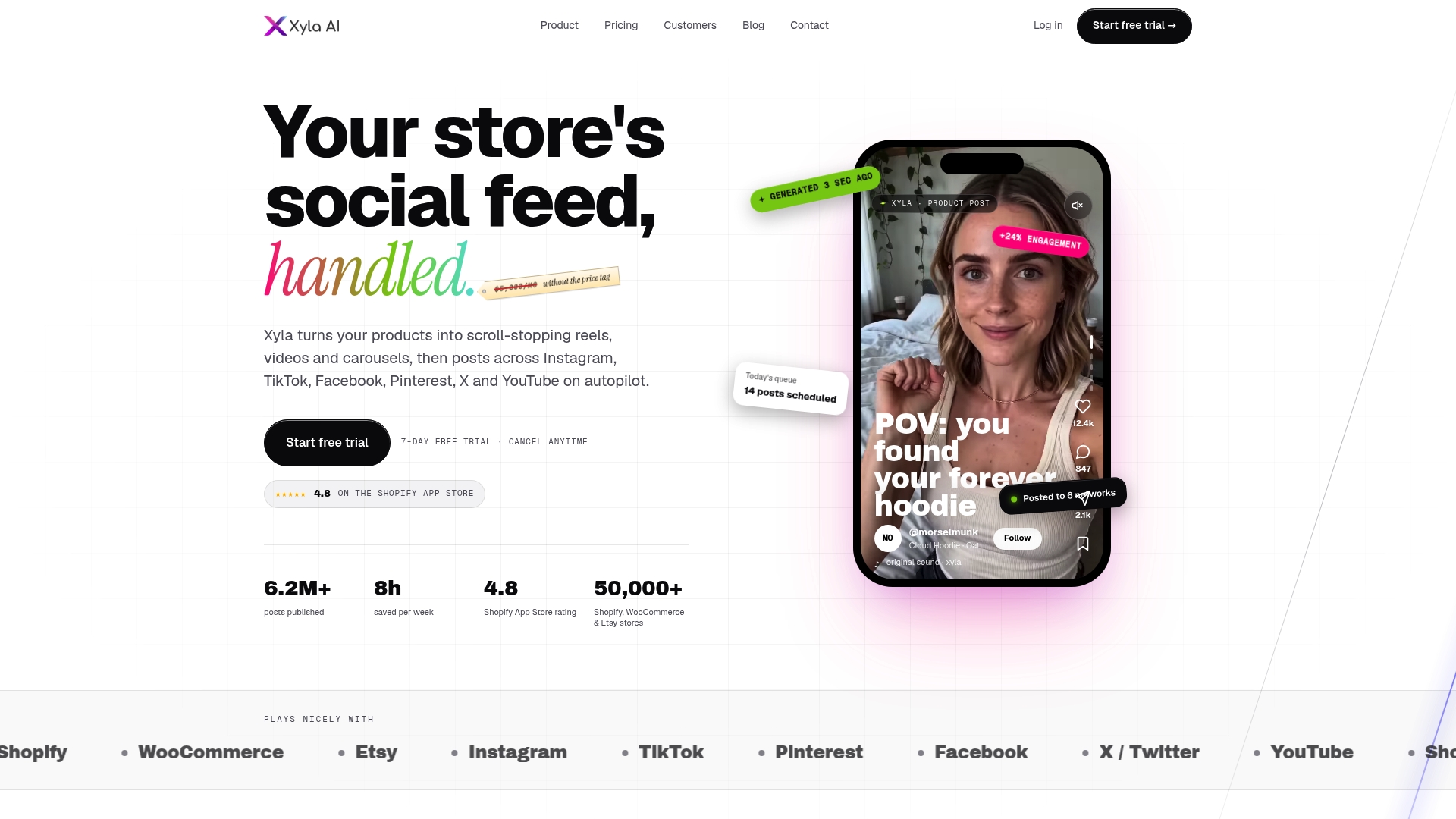
Our pricing plans start at $29 a month, and if you run a Shopify store specifically, our Shopify integration page walks through how catalog sync works before you commit.
FAQ
What is the best prompt structure for product captions?
The most reliable structure is Hook, Value, Proof, Call to Action, with the hook placed in the first 125 characters to beat feed truncation. This ordering, recommended in a practitioner caption blueprint, keeps the strongest line visible before a reader has to tap “more.”
How do I stop AI captions from sounding robotic?
Give the model a specific persona and tone in the prompt, such as “write as a direct, slightly playful small-business owner,” and explicitly ban generic words like “amazing” or “perfect.” Testing a few hook variants and reading them out loud catches most of the remaining stiffness.
Do I need to disclose AI-generated or sponsored captions?
Yes, if the caption involves a paid partnership or free product, disclosure needs to appear within the first three lines, since 2026 social commerce guidance treats later placement as non-compliant. Phrasing like “Ad: I received this product free” placed up front satisfies both platform and FTC-style expectations.
Should I use the same caption on Instagram and Amazon?
No, each platform has different constraints: Instagram and TikTok reward a punchy hook before truncation, while Amazon separates visible listing copy from backend search terms according to Amazon’s seller guidance. Writing one master prompt with a platform-specific instruction line keeps the formula consistent while meeting each platform’s rules.
Can automation tools like Xyla generate these captions for me?
Yes, automation tools can generate caption variants from product catalogs using the Hook, Value, Proof, CTA structure, then pair them with video or carousel content and schedule posts automatically, fitting sellers posting across a full catalog regularly rather than writing one caption at a time.
Sources
- How to Navigate Social Commerce Regulation in 2026: A Complete Seller Guide
- Amazon Seller Central help: Listing content and policies
- Four-Part caption blueprint (practitioner whitepaper)
- Understanding FTC sponsored content disclosures


