

Turn Meme Marketing Into Sales for Ecommerce: Rights, Research, and AI

Meme marketing is worth doing for ecommerce brands, but only under two conditions: the creator’s voice stays intact and every piece of content has clear commercial rights attached. Done right, memes feed top-of-funnel reach that lowers retargeting costs later. Skip either condition and you get either a flop or a legal problem, sometimes both.
TL;DR:
- Memes should only be used for ecommerce marketing if the creator’s voice remains authentic and all content has clear commercial rights.
- Timing is crucial, as memes perform best during their warm phase when they are trending but not yet overused, significantly impacting engagement and purchase intent.
- Brands must secure explicit, written licenses for using memes commercially and avoid relying on fair use, which is unreliable for paid content.
- Automated workflows and AI tools can help scale meme production, ensuring timely content creation with proper rights management.
- Measuring the effectiveness of meme campaigns involves tracking comments, shares, branded search lift, and retargeting metrics, not just vanity engagement figures.
Table of Contents
- What meme marketing is and how it differs from branded creative
- Why memes work for ecommerce: evidence and platform mechanics
- Tactical playbook: sourcing, briefing, producing, and posting memes for ecommerce
- Legal and rights checklist for commercial meme use
- Measuring meme performance and connecting memes to sales
- Examples and micro case studies: how brands turned memes into commercial outcomes
- Operationalizing meme marketing at scale with AI-assisted workflows
- A conservative starter plan for ecommerce brands
- How Xyla helps ecommerce teams scale meme-style social content
- Sources
- FAQ
What meme marketing is and how it differs from branded creative
Meme marketing means using culturally recognizable formats, image macros, sound memes, or remixable video templates, to promote a product or brand inside a joke the audience already understands. It borrows the shape of something already circulating instead of building a polished concept from scratch.
That’s the core difference from a standard brand ad. A produced commercial aims for control: a fixed script, a locked cut, one message delivered the same way every time. A meme is built to be broken. It works because it looks unfinished enough to remix, low-fi enough to feel like it came from a person rather than a marketing department, and current enough to reference something the viewer already saw that day.
A few structural traits set memes apart from other branded content:
- They are shareable by design, meaning the format survives even when the specific joke gets swapped out.
- They reward being remixed rather than copied exactly, which is how a single format spawns hundreds of variants.
- They read as low production value on purpose, since anything too polished breaks the illusion that it came from a peer rather than a brand.
Memes almost always sit at the top of the funnel. They are an awareness and consideration tool, not a direct-response format, so expecting immediate checkout conversions from a meme post sets the wrong bar. The realistic payoff shows up downstream: in branded search, in cheaper retargeting, in a warmer audience for the ads that follow.
Why memes work for ecommerce: evidence and platform mechanics
The case for meme marketing isn’t just anecdotal anymore. A large-sample academic study analyzing roughly 900,000 posts and 4,000 participants found that meme content increases engagement and purchase intention, but only when it’s used during a meme’s “warm” phase, after it’s caught on but before it’s exhausted. Deploy the same joke too early and the audience doesn’t get it yet; deploy it too late and it reads as stale, which actually hurts brand perception rather than helping it.
A large-sample study of 900,000 posts and 4,000 participants found meme content improves likes, click-through rate, and conversion metrics when posted during a meme’s warm lifecycle phase. That timing window is the single biggest lever a brand controls in meme marketing, more than production quality or budget.
A separate Elsevier study using media richness theory models the mechanism more directly: it links meme marketing to measurable purchase intention on ecommerce platforms specifically, not just general brand awareness. That distinction matters for store owners who need to justify the tactic against revenue-focused channels.
Platform mechanics compound the effect. Algorithms tend to boost content that’s already generating comments and shares, which means a meme that catches early momentum gets pushed further without extra spend. Remix culture does the rest: once a format is popular, creators start making their own versions, and each variant is a fresh distribution event the brand didn’t have to pay for.
The limit is the lifecycle itself. A meme has an introduction phase, a warm maturity phase, and a decline phase, and the research is clear that only the middle phase reliably produces engagement and purchase-intent gains. Product fit matters too: a format built for irony doesn’t always sit well next to a premium price tag.

Tactical playbook: sourcing, briefing, producing, and posting memes for ecommerce
Turning a meme into a commerce asset is a workflow, not a single decision. Here’s how to run it end to end.
- Monitor trend signals daily. Watch trending sounds and formats on TikTok and Instagram Reels, subreddit activity in your product category, and what creators in your niche are already remixing, since a format spreading through your specific audience is a stronger signal than a generic trending page.
- Judge the lifecycle stage before committing. A format still gaining steam is worth testing fast; one that’s already been done by five brands in your feed is likely past its warm phase and heading toward decline.
- Write a creator brief with four fixed elements: the product payoff moment, the call to action, the rights being granted, and which edits are and aren’t allowed.
- Keep the product payoff late and light. The joke should land first, and the product should appear at the punchline rather than the opening frame, since leading with the product kills the humor and the format both.
- Test three quick formats in parallel: a UGC-style talking clip, a static product-overlay meme using an existing image macro, and a sound-remix video synced to a trending audio.
- Preserve a few uncontrolled variables. Let small things like camera shake or an off-script line survive editing, since a meme that’s too smoothed over reads as corporate and stops feeling shareable.
- Batch produce variants once a format proves out, generating multiple product or angle versions from the same template rather than starting over each time.
- Schedule by platform cadence, since a format that’s fresh on TikTok in the morning can already feel dated on Instagram by evening.
Trend sources worth checking on a recurring basis include TikTok’s Discover page, X/Twitter trending topics, niche Facebook groups tied to your product category, and comment sections on competitor posts, where audiences often signal what they wish a brand would make fun of.
Pro Tip: Brief creators on the joke’s mechanics, not just the product message, since a creator who understands why something is funny will protect that timing far better than a script that spells out every beat.
Scaling comes down to two things: templated overlays that handle the repeatable parts (logo placement, CTA text, link-in-bio prompts) and a small human review step that checks each variant still feels like a person made it. Once a format works, most ecommerce teams can produce five to ten variants from a single creative concept without starting from zero each time, adjusting the product shown, the caption, or the sound.

Legal and rights checklist for commercial meme use
The single biggest blind spot in meme marketing is treating “fair use” as a shield. It isn’t one, at least not reliably. A UGC rights and licensing guide aimed at brands and creators is direct about this: commercial use of memes and user-generated content requires explicit written licenses, and fair use is rarely a defense that holds up once money is involved.
Using memes commercially without a written license exposes a brand to copyright and right-of-publicity claims that fair use will not reliably resolve. That single fact should shape every meme workflow a store runs.
A practical minimum checklist before a meme goes live in paid media:
- Get a written license from the original creator if you’re repurposing their content commercially, not just a verbal or DM agreement.
- Avoid reusing memes featuring recognizable private individuals, since right-of-publicity claims apply even when the content is already circulating publicly.
- Follow FTC disclosure basics for any paid creator relationship, including clear labeling when a creator is compensated to appear in or produce content for your brand.
- Keep a timestamped record of when rights were granted and what they cover, so there’s a paper trail if a dispute comes up later.
- Store consent documentation somewhere your team can retrieve quickly, not scattered across email threads.
The operational fix is simpler than it sounds: capture rights the moment a creator agrees to work with you, and make sure that agreement explicitly names “paid media” and “derivative works” as covered uses. A verbal yes to post something organically does not automatically extend to boosting it as an ad.
Measuring meme performance and connecting memes to sales
Meme performance metrics split into two tiers: engagement signals that hint at buying intent, and business metrics that confirm it. Treating them as interchangeable is where most attribution goes wrong.
- Comments asking direct product questions (“where’s this from,” “how much,” “does it come in other colors”) signal far higher purchase intent than a passive like or view.
- Saves and shares indicate a viewer plans to return to the content or pass it along, both stronger intent signals than raw reach.
- Branded search lift in the days following a meme post is one of the clearest markers that awareness is converting into consideration.
- Assisted conversions in analytics tools show whether people who saw the meme later completed a purchase through another channel.
- CPA movement in retargeting cohorts built from meme engagers, if those cohorts convert cheaper than cold traffic, the meme did real commercial work even though it never asked for a sale directly.
Attribution here works best with a mix of methods rather than one dashboard number. UTM-tagged links on any meme post that includes a link give a baseline click trail. Holdout experiments, showing the meme to one audience segment and withholding it from a matched segment, isolate incremental lift more honestly than before-and-after comparisons. Incrementality testing at a larger scale can confirm whether the lift holds up beyond a single post.
The most durable output of a meme campaign is often the retargeting pool it builds. Everyone who engaged with a meme, whether they clicked through or not, becomes a warmer audience for the performance ads that follow, which is where a lot of the real revenue impact of meme marketing eventually shows up.
Examples and micro case studies: how brands turned memes into commercial outcomes
- McDonald’s CEO viral moment. A candid, slightly awkward video involving McDonald’s CEO went viral in March 2026, and it was followed by a measurable sales bump and a broader halo effect as other brands jumped into the conversation in real time. Takeaways: speed beats polish when a moment is breaking, playful low-production content can outperform a scripted campaign, and rapid participation from adjacent brands can extend a single moment’s commercial life well beyond its first news cycle.
- Levi’s and the World Cup “covered logo” moment. Unable to use official World Cup branding, Levi’s leaned into a restriction, turning covered or obscured logos into a meme-ready visual joke that spread precisely because it acknowledged the limitation instead of hiding it. Takeaways: a legal or brand restriction can become the joke itself rather than a dead end, and audiences respond to brands that seem in on the constraint rather than fighting it.
- KFC Arabia’s “Missing Chedrawi Cheese.” This serialized, social-first campaign used AI-assisted storytelling to turn a supply issue into an ongoing narrative, generating multi-million views and heavy audience participation without relying on paid seeding to get there. Takeaways: a single post rarely sustains attention the way a serialized story can, AI-assisted production let the team iterate variants quickly as the story evolved, and turning a real operational issue into transparent content built more engagement than hiding it would have.
KFC Arabia’s campaign reached multi-million view counts organically, showing that fast iteration and serialized storytelling can outperform one-off polished posts. The pattern across all three examples is the same: speed, willingness to use a real constraint as material, and letting the audience participate rather than just watch.
Operationalizing meme marketing at scale with AI-assisted workflows
Running this well at volume means treating it as a repeatable pipeline rather than a one-off creative sprint: detect a trend, brief a creator or generate a variant, capture rights immediately, produce product-specific versions, then schedule and monitor results.
AI tools now handle a meaningful chunk of that pipeline. AI-generated UGC-style video can turn a product listing into a short clip that matches a trending format’s pacing and structure without needing a new shoot for every variant, and the goal is producing enough versions to test quickly, not replacing the human joke with something generic.
A governance checklist keeps this from becoming a legal liability at scale:
- Log the source and license terms for every meme template or UGC clip used, not just the final asset.
- Tag each piece of content with rights metadata (organic-only versus paid-eligible) before it enters the scheduling queue.
- Require a human approval step before anything with a real person’s likeness goes into paid media.
- Keep a rights audit trail that’s searchable, not just archived.
The automation step by step matters as much as the creative step. A format that works but can’t be scheduled consistently across Instagram, TikTok, and Facebook loses most of its lifecycle value.
A conservative starter plan for ecommerce brands
Meme marketing rewards ecommerce brands that treat it as a listening exercise first and a production exercise second. Most failures come from brands skipping straight to output without understanding why a format is funny to begin with, which is also usually where the rights get sloppy.
A three-step starter plan: listen to what’s already trending in your specific niche for at least a week before posting anything, pilot with two or three creators who already speak the internet’s language rather than briefing your internal team to write jokes, then measure engagement quality (not just volume) before deciding whether to scale the format or drop it.
— Toby
How Xyla helps ecommerce teams scale meme-style social content
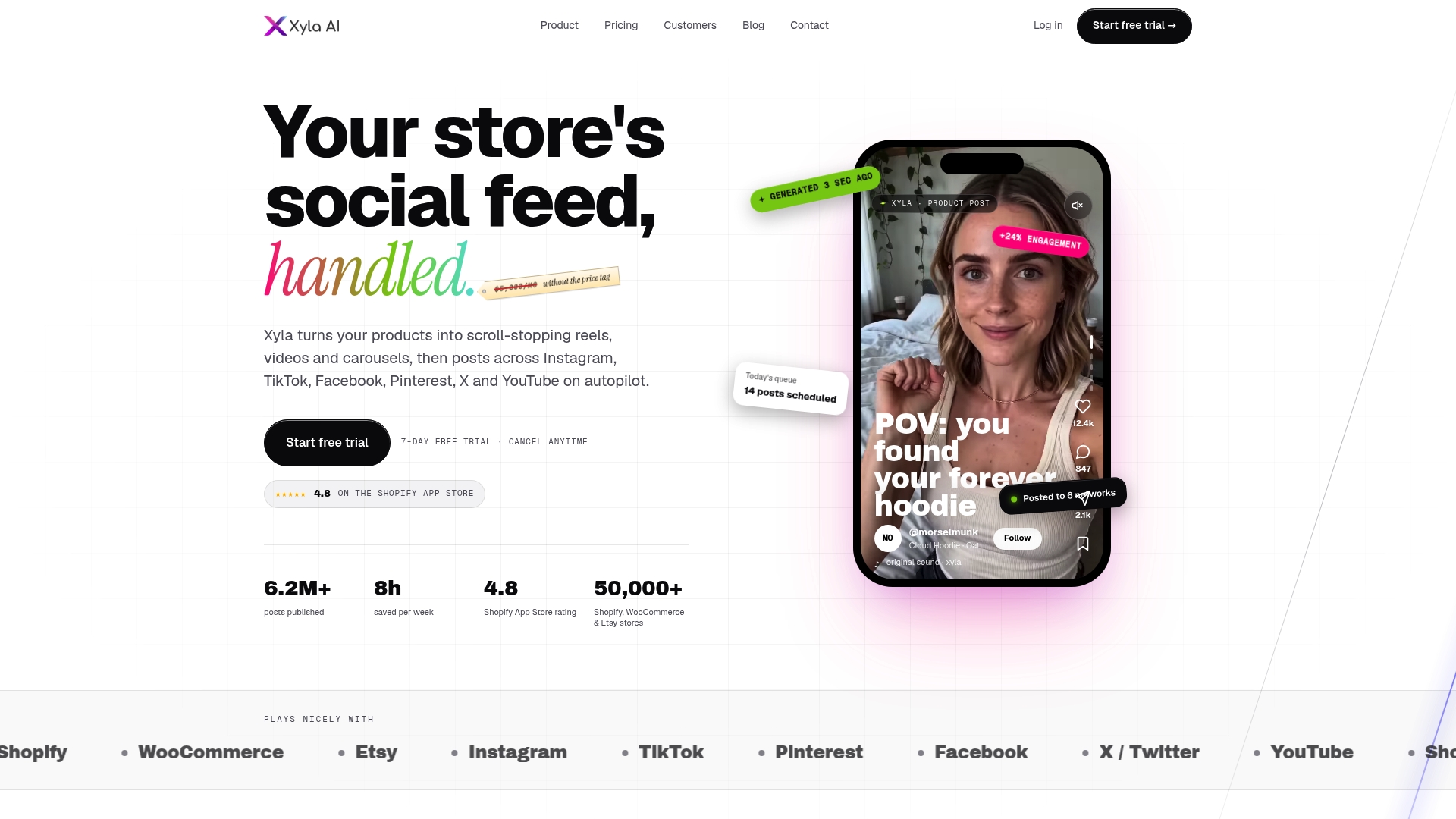
Most store owners don’t have the bandwidth to monitor trends daily, brief creators, and manage a rights spreadsheet on top of running a shop. An AI tool can turn product listings into ready-to-post visual content, including UGC-style clips, without the extra production cycle each meme format usually demands.
What that looks like in practice:
- Fast content generation: The tool converts existing product photos into reels, carousels, and short videos styled to match current formats, so testing a trending format doesn’t require a new shoot.
- Rights and metadata handling: Each generated asset ties back to product data, avoiding licensing gray zones that come with repurposing someone else’s viral clip.
- Automated scheduling: Posts can be scheduled to go out across major social networks at set times, helping ensure a format’s warm window doesn’t pass while waiting to publish.
A typical use case: a trending sound or visual joke appears in your niche, and instead of building a custom video from scratch, Xyla generates a product-led variant in that style within the same day, while the format is still current. Plans start at $29 a month on the Growth plan, with Shopify-specific and Etsy-specific pricing available on their respective Shopify and Etsy pages.
Sources
- From owning to connecting: understanding and leveraging the effect
- Turning laughs into buys: The influence of meme marketing on consumer purchase intentions in e-commerce using media richness theory
- McDonald’s CEO’s awkward burger video goes viral — and boosts sales
- KFC Arabia: The Missing Chedrawi Cheese
FAQ
What is meme marketing?
Meme marketing is the practice of using existing cultural formats, image macros, remixable video templates, or trending sounds, to promote a brand or product inside a joke the audience already recognizes. It typically works as a top-of-funnel tactic that builds awareness and feeds cheaper retargeting later, rather than driving direct conversions on its own.
Which brands are known for using meme marketing?
Several brands have built recognizable moments this way, including McDonald’s, whose CEO’s viral video was followed by a measurable sales bump, and KFC Arabia, whose serialized “Missing Chedrawi Cheese” campaign generated multi-million views. Levi’s also turned a World Cup branding restriction into a widely shared meme moment.
Do people make money with memes?
Some creators earn income through brand partnerships, sponsored posts, or licensing their content for commercial use, but this depends on securing proper written agreements rather than relying on organic virality alone. Brands, meanwhile, generate value from memes indirectly, through cheaper retargeting and branded search lift rather than direct meme sales.
What is cringe marketing?
Cringe marketing describes brand content that’s intentionally awkward or off-trend in a way that reads as self-aware rather than embarrassing, often used to signal that a brand doesn’t take itself too seriously. It works when audiences sense the awkwardness is deliberate, and it backfires when it reads as a brand genuinely misunderstanding the format it’s using.
How do I know if a meme format is still worth using?
A format is worth using while it’s in its warm phase, gaining traction but not yet oversaturated, since research shows engagement and purchase intent drop once a format moves into decline. If a format has already appeared across several accounts in your feed, it’s likely past the window where it still helps.


