

Two Hour Batches Meet Variant Pipeline: Ecommerce Content Batching

Content batching works for ecommerce because it trades daily scramble for planned production, and stores that adopt it post more consistently while spending less time doing it. Consistent presence matters because social discovery is fragmented across Instagram, Facebook, and TikTok, so brands that show up reliably capture more of that attention. What follows is a four-phase workflow, schedule options for different team sizes, and the metrics that tell you it’s working.
TL;DR:
- Batching content allows ecommerce brands to produce a full month of posts in focused sessions, reducing daily decision fatigue and increasing consistency.
- Creating multiple platform-specific variants from a single asset maximizes efficiency and helps target different discovery channels like TikTok, Instagram, and Facebook.
- Using templates, automation tools, and AI generators can streamline production and scheduling, but starting small and tracking key metrics like click-through rate is essential for growth.
- Batch schedules vary from one monthly sprint for solo owners to weekly cycles for agencies, always emphasizing separate tasks for capture, editing, and scheduling.
- A one-SKU micro-batch lasting just two hours can validate batching efforts before scaling, avoiding common pitfalls like repurposing the same crop across platforms.
Table of Contents
- What content batching means for ecommerce brands
- The four-phase content batching workflow
- Batching schedules for solo owners, small teams, and agencies
- Tools, templates, and shortcuts that make batching repeatable
- The variant pipeline: turning one asset into many
- Measuring whether your batching is actually working
- Start small: a two-hour micro-batch and the mistakes to avoid
- How AI-assisted workflows shorten the batching cycle
- What matters most once you actually start batching
- Try Xyla to accelerate your first few batches
- Sources
- FAQ
What content batching means for ecommerce brands
Content batching means producing a group of posts, videos, or captions in one focused session instead of creating each piece the day it goes live. For ecommerce, that shift matters more than it does for other businesses because product catalogs change constantly, seasonal promotions stack up fast, and shoppers discover items across several platforms at once rather than on one channel.
Retailers face a fragmented discovery landscape: Constructor’s research on ecommerce discovery found that Instagram, Facebook, and TikTok all function as meaningful entry points for shoppers, and brands need presence in each place rather than betting on a single channel.
Batching also removes the daily context switch of jumping between “what should I post today” and actually running the store. Instead of scattered decisions, a single planning session can set:
- A month of themes tied to launches, restocks, or promotions.
- Shot lists for the next batch of product photography.
- Caption angles that can be reused across several SKUs.
Many shoppers aged 18 to 29 report discovering products directly through TikTok, according to Constructor’s 2025 report, which makes consistent posting on that platform a discovery lever, not just a branding exercise.
The four-phase content batching workflow
A batching cycle breaks cleanly into four phases, and running them in order is what keeps the whole system from collapsing into ad hoc posting again.
- Strategy and ideation. Set your themes for the cycle, pull SKU triggers such as new arrivals or low stock, and draft caption hooks before you shoot anything.
- Production. Shoot product photos and short videos in one session, using a repeatable capture checklist so lighting, angles, and backgrounds stay consistent across SKUs.
- Atomize and edit. Take each core asset and cut it into variants: crops for different aspect ratios, alternate opening frames, caption swaps, and different calls to action.
- Scheduling and distribution. Slot finished assets into a calendar, respecting each platform’s posting rhythm and format rules, then queue them for automatic release.
Shopify’s guidance on combining SEO and social media reinforces the value of the atomize phase specifically: long-form content, like a blog post or product page, can be broken into several short social assets rather than treated as a one-time publish, as explained in Why SEO Matters for Ecommerce Growth Worldwide.
Pro Tip: Batch by job, not by post. Do all your cropping in one sitting, all your captioning in another. Task-switching between creative and copy work is what eats the time batching is supposed to save.
Batching schedules for solo owners, small teams, and agencies
The right cadence depends on how many hands are on the work, but the underlying principle stays the same: separate capture from editing from scheduling.
- Solo founders: a single monthly sprint day works well. Spend the morning (roughly three hours) shooting five to eight products, the early afternoon (two hours) cutting variants, and the last hour loading everything into a scheduler.
- Small teams (two to four people): split into a two-day cycle. Day one is dedicated to production only. Day two is editing, captioning, and scheduling, often split between two people working in parallel.
- Agencies or teams with dedicated roles: run an ongoing weekly cadence where a photographer or videographer batches capture, an editor handles the variant pipeline, and a scheduler or account manager owns the calendar and freelancer handoffs.
Group work by function across all three models: capture together, cut together, caption together, and queue together. Mixing those jobs inside a single sitting is the most common reason batching sessions run long.
Tools, templates, and shortcuts that make batching repeatable
A batching system only holds up if the tools and templates around it are simple enough to reuse every cycle. Four categories cover most of what an ecommerce store needs:
- Capture and editing apps for shooting and trimming product photos and video.
- Asset managers to store raw footage and finished posts so nothing gets reshot by accident.
- Social schedulers that queue content across platforms so nobody is posting manually at 9 AM.
- AI-assisted generators that turn existing product photos into new video or image variants without a reshoot.
Build a few standing templates before your first batch: a caption bank organized by product category, a swipe file of proven hook lines, saved crop presets for each platform’s aspect ratio, and a repurposing checklist you run every asset through. Choosing tools comes down to two questions: how many people will touch the workflow, and how much of the editing you want handled automatically versus by hand. A solo owner usually wants more automation; a team with a dedicated editor can lean on simpler, cheaper tools since a person is doing the atomizing.
The variant pipeline: turning one asset into many
The variant pipeline treats a single high-quality product asset as raw material rather than a finished post. Instead of shooting new content for every platform, you systematically produce several variants from the same core video or photo set, which is what keeps a small team from burning out on constant reshoots.
- Start with one strong asset, usually a short product video or a clean photo set.
- Create platform crops: a vertical cut for Reels and TikTok, a square crop for feed posts, a wide crop for YouTube.
- Swap the opening line so each version leads with a different hook, price point, or use case.
- Write several caption variants targeting different angles: a feature callout, a customer pain point, a seasonal tie-in.
- Change the call to action between versions, alternating “shop now,” “link in bio,” and a question that invites comments.
A single product video can realistically become one Reel, three short clips, four static image posts, and five caption variants, all from one shoot. DHL’s research on social commerce notes that platforms play different roles, with TikTok and Facebook driving more in-app purchase behavior while YouTube skews toward inspiration, so tailoring each variant to its platform’s role matters more than reusing one version everywhere.
Pro Tip: Keep a running document of which hook and CTA combinations performed best last cycle. That list becomes your starting point for the next batch instead of a blank page.

Measuring whether your batching is actually working
Batching only earns its place in your workflow if it moves numbers you can see. Track these consistently across cycles:
- Reach and impressions, to confirm your posting cadence is expanding visibility.
- Engagement rate, which flags whether the content itself is resonating, separate from volume.
- Click-through rate to product pages, the clearest link between a post and store traffic.
- Assisted conversions, since most social-driven purchases don’t happen inside the app itself.
That last point matters: Clutch’s research on shoppable content found that while most shoppers see products on social media, only a minority buy directly inside the app, yet 78% say brand posts still influence their purchase decisions. Batching’s real payoff often shows up in assisted conversions, not one-click sales.
Run small experiments inside your batches: test two hook lines or two thumbnail styles on otherwise identical posts. Because batching produces more posts per cycle, you generate enough data points faster to see which version actually performs better, rather than guessing off a single post.
Start small: a two-hour micro-batch and the mistakes to avoid
You don’t need a full production day to test whether batching fits your store. Try one SKU first.
- Minutes 0 to 30: pick one product and write three caption angles and one hook line.
- Minutes 30 to 60: shoot or select five to eight photos and one short video clip.
- Minutes 60 to 90: cut two platform crops and pair them with two caption variants each.
- Minutes 90 to 120: schedule all four posts across the next two weeks.
The most common mistake is trying to batch every product at once on the first attempt, which usually means nothing gets finished. A close second is posting the same crop and caption everywhere instead of tailoring for each platform’s format. The third is skipping measurement entirely, so there’s no way to tell if the extra planning time paid off. Fix all three by starting with one SKU, using templates rather than freehand edits, and tracking a single KPI, like click-through rate to the product page, before adding more.
How AI-assisted workflows shorten the batching cycle
AI tools can take over the slowest part of the variant pipeline: turning one product listing into several platform-ready posts without a reshoot. An AI tool works this way for ecommerce platforms, converting existing product listings into reels, carousels, and images and posting them automatically, which can save store owners significant time.
- Start with a small, defined SKU set rather than your whole catalog.
- Set brand tone and visual guardrails before letting the system generate content.
- Keep a manual review step in the first few cycles to catch anything off-brand.
- Expand the SKU set once the output consistently matches your voice.
Piloting on a narrow slice of your catalog limits risk while you confirm the generated content holds up against what you’d produce by hand.
What matters most once you actually start batching
Consistency beats intensity: a modest cadence you can sustain every month outperforms one huge batch you never repeat. Protect brand voice inside every template so speed doesn’t flatten your captions into something generic, and track one KPI from the start rather than trying to watch five at once. Automate the repetitive steps first, cropping and scheduling, and keep judgment calls, like which hook actually sounds like your brand, in human hands a little longer.
— Toby
Try Xyla to accelerate your first few batches
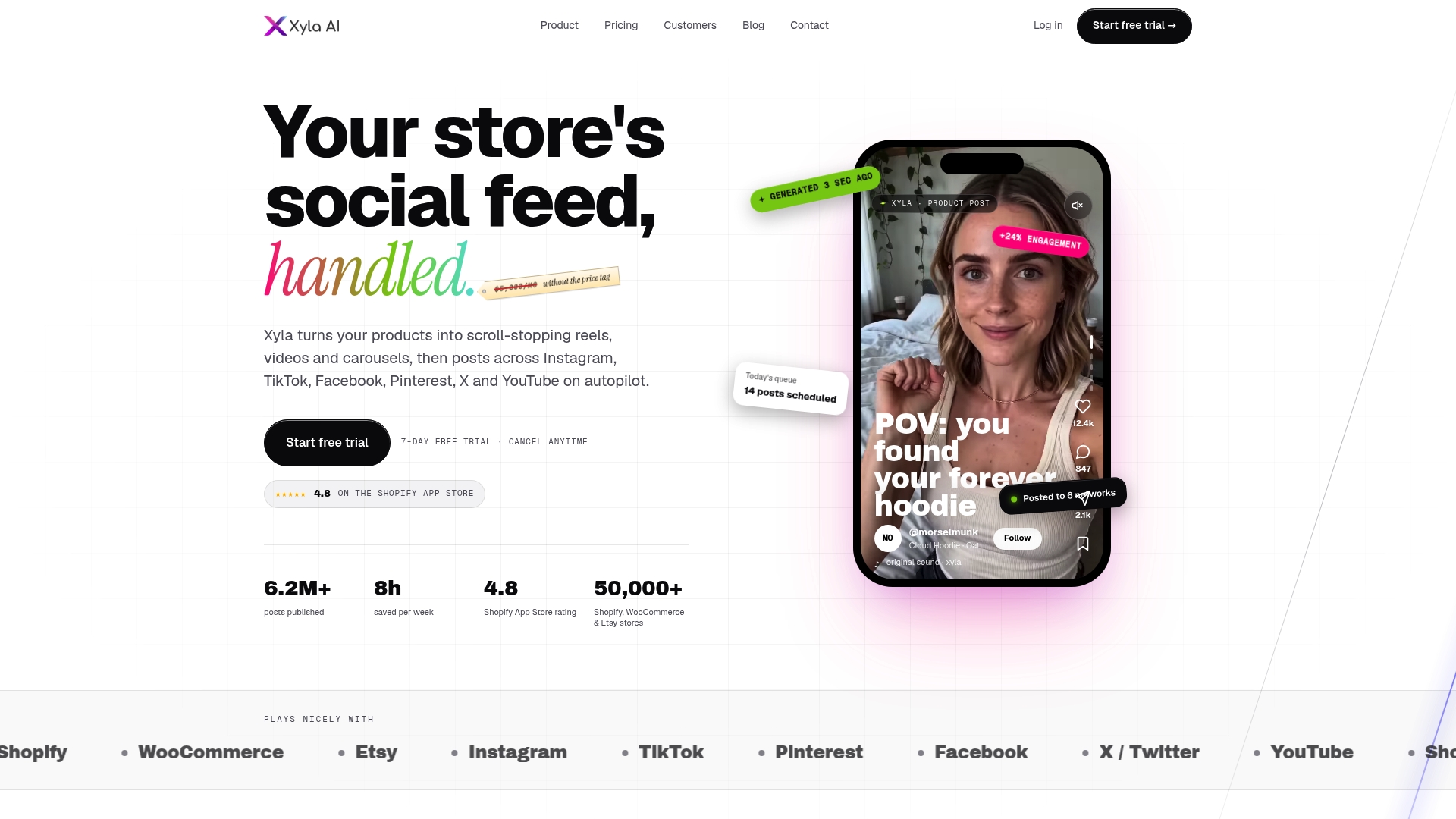
Xyla AI turns product listings from Shopify, WooCommerce, and Etsy stores into reels, carousels, and platform-ready posts, then schedules and publishes them automatically, so the atomize and distribution phases of batching happen without a manual editing queue.
- Run a one-SKU pilot for a month and compare time spent against your usual posting routine.
- Track reach and click-through to that product’s page against the prior month.
- Expand to more SKUs once the generated content matches your brand voice.
Plans start with Growth at $29 a month, and you can compare Growth, Pro, and Enterprise tiers, or the Shopify-specific and Etsy-specific plans, on the Xyla pricing page before committing to a full catalog rollout.
Sources
- The State of Ecommerce (2025) - Constructor
- Scroll to sale: shoppable content data (2025) - Clutch
- 2025 social commerce trends - DHL
FAQ
What does “content batching” mean?
Content batching means creating a group of posts, photos, or videos in one dedicated session rather than producing each piece the day it’s published. For ecommerce stores, it usually covers a whole content cycle, like a month, at once.
What is the 5-3-2 rule for social media posts?
The 5-3-2 rule is a informal content-mix guideline suggesting that out of every ten posts, five should share other people’s or industry content, three should share your own original content, and two should be personal or off-topic posts. Definitions of the exact split vary by source, so treat it as a starting ratio rather than a fixed rule.
What is the 3-2-1 rule on Instagram?
The 3-2-1 rule is a batching-adjacent guideline suggesting you produce three pieces of core content, two shorter repurposed clips, and one piece of supporting or behind-the-scenes content from a single shoot. It’s used informally by creators to structure a batch session rather than as an official Instagram policy.
What are the five C’s of content marketing?
Definitions of the five C’s vary across sources, but a common version includes clarity, consistency, credibility, creativity, and connection with your audience. There’s no single official framework, so treat it as a checklist of qualities rather than a fixed rule.
How often should an ecommerce store batch content?
Most solo owners do well with one focused batching day per month, while small teams often run a two-day cycle every two to four weeks. The right frequency depends on how fast your catalog changes and how many promotions you run each season.


