

Scale Compliant AI Generated UGC for Ecommerce in One Week

For ecommerce stores, “ugc for ecommerce” now often means AI-generated, product-derived social content built to look and feel like organic customer posts. It works when paired with human review and correct disclosure. This is not real customer submissions. It is synthetic content built from your product listings, and used right, it scales brand-aligned social faster than any team of freelancers. Xyla AI is one platform built specifically to automate that workflow for Shopify, WooCommerce, and Etsy stores.
TL;DR:
- AI-generated UGC creates scalable, fast social content from product data, but requires careful disclosure and human review to avoid misleading consumers.
- Disclosing AI-created content reduces perceived authenticity, especially for utilitarian products, and must be clearly labeled early in the post.
- Automation saves significant time by producing multiple format variants from a single listing, freeing resources for customer engagement and brand voice refinement.
- A balanced workflow includes classifying templates, filtering claims through human checkpoints, and adhering to platform-specific disclosure rules for compliance.
- Proper format and natural language in scripts, along with timely disclosures, help maintain organic feel while meeting legal and platform transparency requirements.
Table of Contents
- What Is AI-Generated UGC for Ecommerce?
- What Automation Actually Delivers for Store Owners
- The Detection-Disclosure Paradox and Other Risks
- How to Build a Compliant AI-UGC Workflow
- Content Templates That Actually Read as Organic
- What to Measure and What to Check Before Publishing
- Balancing Scale and Authenticity
- Turn Your Product Catalog Into Social Content With Xyla AI
- Sources
- FAQ
What Is AI-Generated UGC for Ecommerce?
AI-generated UGC for ecommerce takes your existing product data (photos, titles, descriptions, pricing) and turns it into content that mimics the look of a real customer video or post. A tool reads the listing, generates a script or caption, and produces a reel, carousel, or short video styled to feel candid rather than corporate. No customer ever touches the camera.
This matters because the term “UGC” traditionally means content made by actual buyers: unboxing videos, honest reviews, photos submitted through hashtag campaigns. AI-generated UGC borrows that visual language, handheld framing, casual voiceover, natural lighting, without the sourcing problem. There’s no waiting on customers to post, no incentive program, no relationship to manage.
The tradeoff is straightforward:
- Real UGC wins on authenticity and trust but is slow, unpredictable, and hard to scale on demand.
- AI-generated UGC wins on speed, consistency, and volume, but requires disclosure and careful claim review to avoid misleading buyers.
- Most stores get the best results running both: soliciting real customer content when possible, filling gaps with AI-generated posts for new products or slow periods.
Picking one over the other usually comes down to how fast you need content and how much control you need over the message.
What Automation Actually Delivers for Store Owners
The case for AI-generated UGC is mostly about time and testing capacity, not magic engagement gains. A store that used to produce three or four social posts a week manually can generate dozens of format variants (square, vertical, carousel, 15 second and 30 second cuts) from the same product listing in the time it took to shoot one video.
Automation of social media content creation can save store owners a significant amount of time each week that would otherwise go into filming, editing, and manually posting content across networks.
That freed time typically goes toward the things AI still can’t do well: responding to comments, negotiating with real creators, or refining brand voice.
Where automation performs best and worst:
- Strong fit: product demos, feature callouts, restock announcements, seasonal promotions, price-drop alerts.
- Weak fit: emotional storytelling, founder narratives, community moments that depend on a real human voice and lived experience.
- A/B testing: generating five hook variations for the same product costs almost nothing in time, which is where automation pays off most directly.
The pattern holds across the industry: generative AI is increasingly used to scale ecommerce video production, with case studies pointing to faster output and higher testing volume once human oversight is built into the loop.
The Detection-Disclosure Paradox and Other Risks
Here’s the uncomfortable finding buried in the research: people are bad at spotting AI-generated content, but telling them anyway can hurt how the content performs. In controlled experiments, human detection accuracy for AI-generated ads sat around 53%, barely better than a coin flip. Yet disclosing that a post was AI-made repeatedly lowered perceived authenticity and trust scores in the same research. That’s the paradox: silence is deceptive, but honesty carries a measurable cost.
The cost isn’t uniform. A 2026 Frontiers in Computer Science study found AI disclosure hurt perceived aesthetic appeal and social presence most for utilitarian products, while effects on actual purchase intention were mixed and sometimes positive. Category matters more than most marketers assume.
Regulatory rules aren’t optional extras layered on top of that finding:
- FTC guidance treats synthetic personas and AI-generated testimonials as endorsers. Disclosure has to sit clearly and conspicuously near the claim being made, not buried in a bio or a hashtag graveyard.
- TikTok Shop specifically bans fabricated customer testimonials and misleading product displays, and requires toggles or labels for realistic AI-generated content.
- Meta, YouTube, and TikTok broadly require disclosure when content could be mistaken for real footage; stylized or clearly synthetic content usually gets a pass.
- Hallucination risk is real: AI models can invent product claims, wrong dimensions, or made-up ingredient lists that never appeared in your listing.
Pro Tip: Run every AI-generated script through a claim filter before it ever reaches a review queue. If the script states a fact not in your product listing, kill it before a human even sees it.
How to Build a Compliant AI-UGC Workflow
A workable system runs on four steps, repeated on a schedule instead of reinvented every week.
- Classify your templates first. Sort formats into “realistic” (looks like real customer footage) and “stylized” (clearly animated, graphic, or branded). Realistic templates carry a higher disclosure bar and belong mostly on platforms where labeling tools exist.
- Generate from product data, then filter claims. Feed the tool your listing details and a brand-voice prompt. Every draft should get an automatic pass that flags any claim not directly traceable to your product description.
- Route everything through a human checkpoint. Someone checks for hallucinated facts, off-brand tone, and anything that reads as a fabricated testimonial before it queues for publishing. Human-in-the-loop hybrid workflows are the practical default recommended across academic and practitioner sources for exactly this reason.
- Run a publish-time checklist. Confirm platform disclosure toggles are on, on-screen labeling appears within the first three seconds for realistic content, and caption text carrying the disclosure sits before the “more” cutoff, not hidden below it.
A few automation habits make this sustainable instead of exhausting:
- Batch-generate a week’s worth of drafts in one sitting rather than one post at a time.
- Use an approval queue so nothing auto-publishes without a human sign-off.
- Set a cadence rule (say, three AI-generated posts to one real customer feature) so your feed never reads as fully synthetic.
- Where platform policy allows it, test disclosure timing on emotionally driven posts rather than defaulting to the strictest placement everywhere.
Xyla AI’s step-by-step automation guide walks through setting up scheduling and approval gates inside an actual platform if you want a reference for how this looks in practice.
Content Templates That Actually Read as Organic
The format matters as much as the disclosure. A script that sounds like a press release will read as fake no matter how the video is labeled.
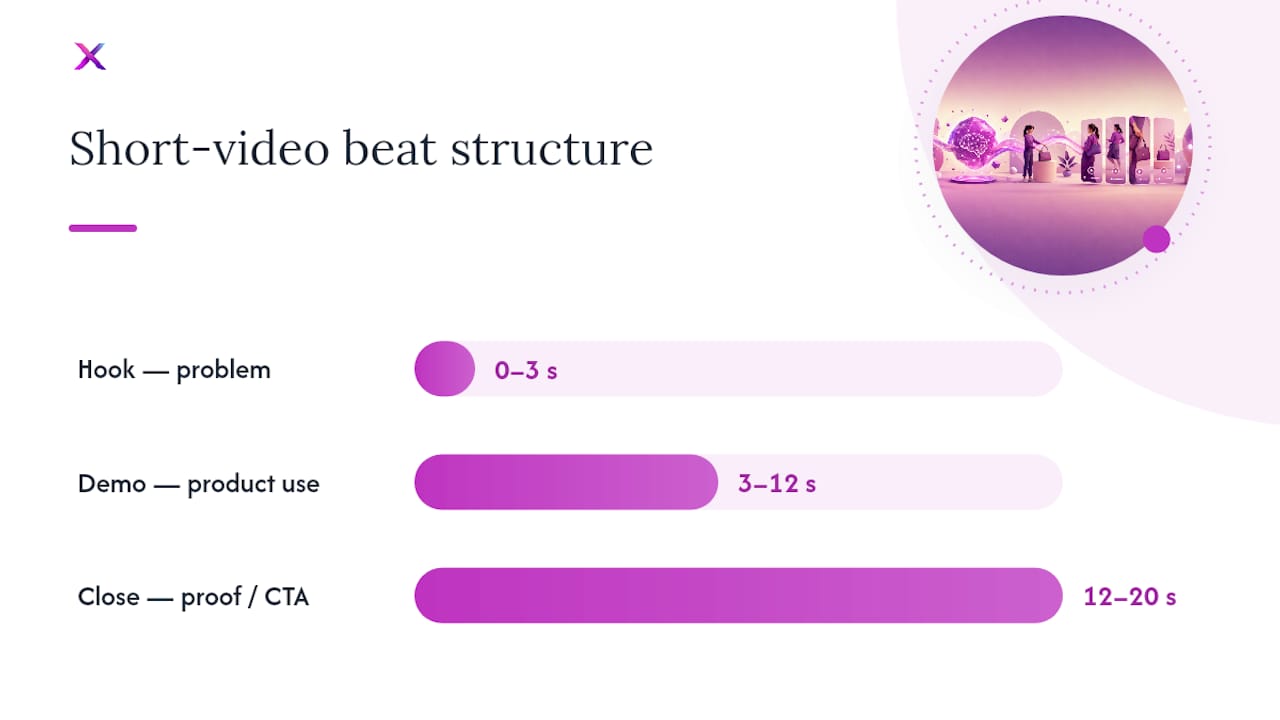
For TikTok and Reels, a template that consistently performs breaks into three beats: a 0 to 3 second hook (a question or a problem, not a product name), a 3 to 12 second demo showing the product in use, and a 12 to 20 second close with a casual proof point or call to action. Natural, slightly imperfect camera framing sells the illusion better than a polished pan.
For Instagram carousels, the first frame does the work of a thumbnail, so it needs to look like a real photo, not a rendered ad. Keep captions short and conversational; a caption that reads like ad copy undercuts the whole format. Never let a caption imply a real customer wrote it.
A few format rules worth locking in:
- Use text overlay for factual claims (price, materials, sizing) since it’s easier to fact-check and edit than voiceover.
- Reserve AI voiceover for tone and mood, not specific product claims.
- Avoid synthetic “customer” testimonials entirely. Brand-voiced narration describing the product is safer and complies more easily with platform and FTC rules than a fabricated person endorsing it.
What to Measure and What to Check Before Publishing
Five numbers tell you whether this is working: engagement rate, click-through rate, conversion lift, cost per piece of content, and hours saved per week compared with your old manual process.
Worth testing directly rather than assuming: disclosed versus delayed disclosure on AI-enhanced posts where platform rules permit timing flexibility, stylized versus photorealistic templates on the same product, and human-edited versus fully automated variants run side by side. The Frontiers findings on category effects suggest utilitarian products may need different disclosure handling than hedonic ones, so don’t assume one rule fits your whole catalog.
Before anything goes live, run it against a short checklist:
Check What to confirm Disclosure timing Label appears in the first few seconds for realistic content Caption placement Disclosure text sits before the “more” cutoff Platform toggle AI-content setting enabled per platform’s requirement Testimonial check No fabricated customer quotes or synthetic endorsers Provenance metadata C2PA content credentials preserved on export where supportedBalancing Scale and Authenticity
The honest answer is that fully automated feeds and fully human feeds both fail in predictable ways. All-AI feeds start to feel hollow after a few weeks; all-manual feeds burn out whoever’s filming. Human-in-the-loop review isn’t a compliance checkbox. It’s the thing that keeps AI output from drifting into claims your product can’t back up.

If you’re skeptical, don’t commit your whole calendar on day one. Run a one-week pilot: five to ten posts, one platform, one compliance checklist. Measure engagement and conversion against your normal baseline before scaling further.
Store owners juggling product sourcing, fulfillment, and customer service rarely have bandwidth left for daily content production, and that gap is exactly where this technology earns its place.
— Toby
Turn Your Product Catalog Into Social Content With Xyla AI
Xyla AI is the direct route to everything this article just walked through: template classification, human review queues, and platform-specific publishing rules built into one workflow instead of five separate tools. It converts Shopify, WooCommerce, and Etsy listings into reels, carousels, and short videos, then schedules and auto-publishes them across Instagram, TikTok, Facebook, Pinterest, X, and YouTube with brand-aligned copy generated alongside each asset.
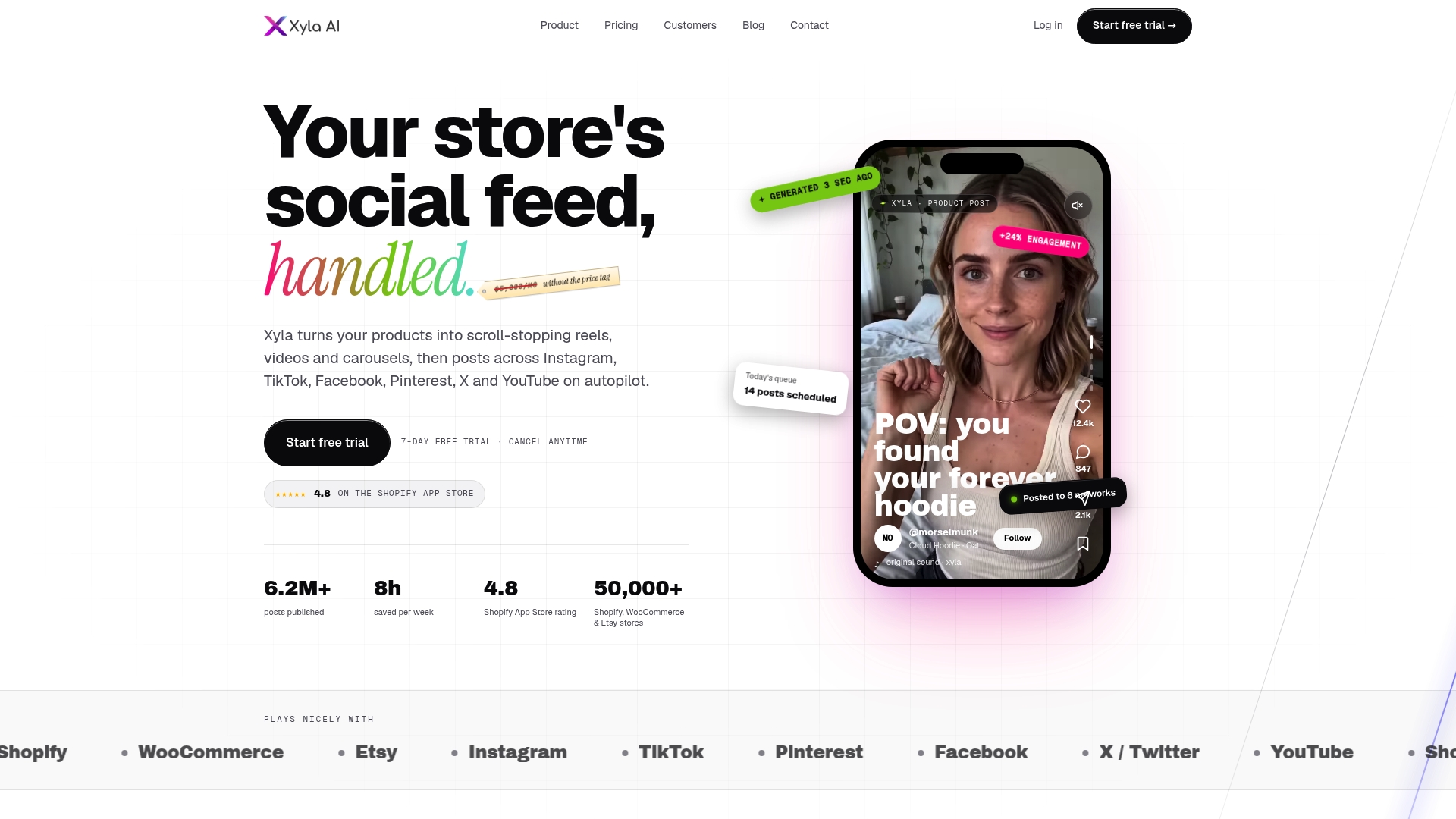
The platform maps directly onto the workflow above. A template library handles the classify-and-generate steps, an approval queue covers the human checkpoint, and platform toggles handle the publish-time compliance check without you touching each network separately. Pricing starts with the Growth plan at $29 per month, with Pro at $39 and Enterprise at $60 per month on the main pricing page. Etsy sellers get dedicated Maker, Shop, and Studio plans at the Etsy-specific page, and Shopify stores have their own Starter and Scale tiers on the Shopify integration page. Start a trial and run your one-week pilot against your current feed before committing further.
Sources
- Transparent technology: evaluating the impact of AI-generated ad disclosures (Manchester research)
- Frontiers in Computer Science (2026) study on AI disclosure effects
- IAB updates industry framework for consistent AI transparency & disclosure in advertising
- AI UGC disclosure and the FTC (Social Operator practical guide)
- TikTok Shop and AI-generated content rules (Polici guide)
FAQ
Is AI-Generated UGC the Same as Real Customer Content?
No. AI-generated UGC for ecommerce is synthetic content built from your product listings to look like organic customer posts, while real UGC comes from actual buyers or creators. Platform and FTC rules treat the two very differently for disclosure purposes.
Do I Have to Disclose AI-Generated Content on Social Media?
Yes, when the content is realistic enough to be mistaken for real footage or includes a synthetic testimonial. FTC guidance treats AI-generated endorsers the same as human ones, and platforms like TikTok Shop require labeling for realistic AI content.
Does Disclosing AI Content Hurt Engagement?
It can. Research found disclosure often lowers perceived authenticity and trust, and effects vary by product category, with utilitarian products seeing a bigger hit to perceived appeal than others. Testing disclosure timing where platforms permit it can help offset the drop.
How Much Time Does AI-Generated Content Actually Save?
Automation of social media content creation can save store owners a significant amount of time each week compared with manually filming, editing, and posting content across networks. That time typically shifts toward customer engagement and creative review instead of production.
What’s the Biggest Mistake Stores Make With AI UGC?
Treating it as fully hands-off. Skipping human review invites hallucinated product claims and fabricated-sounding testimonials, both of which violate FTC guidance and platform rules like TikTok Shop’s ban on fake customer endorsements.


