

Scale Your Twitter Video Strategy for Marketing Teams: Save 8 Hours

Prioritize short, native video with a thumb-stopping visual hook, on-screen captions for sound-off viewing, and a distribution plan that blends organic posting with promoted spend. X’s own creator guidance backs this approach. Native uploads stay under approximately 2 minutes and 20 seconds, and tools like Xyla AI can help teams produce that volume without burning out a one-person marketing department.
TL;DR:
- Creating short native videos under 2 minutes 20 seconds with eye-catching first frames and sound-off captions is crucial to stop thumb-scrolling on mobile feeds.
- Optimizing aspect ratios, compressing files properly, and maintaining consistent frame rates prevent upload failures and ensure smooth playback.
- Using visual surprises or clear promises at the start increases the likelihood viewers will watch the entire clip, especially in short teaser formats.
- Organic posting should be prioritized initially, with boosted promotion reserved for videos that demonstrate strong early engagement signals like high completion rates.
- Automation tools like Xyla AI can save around eight hours weekly by converting product images into multi-aspect videos and scheduling posts automatically.
Table of Contents
- Why Twitter video works for brands
- Native video formats and technical specs you must follow
- Creative hooks and first-frame tactics that stop the scroll
- Production and editing checklist for Twitter videos
- Posting and distribution tactics to amplify video
- Measuring performance: KPIs, benchmarks, and experiment ideas
- Scaling Twitter video with AI and automation
- Best practices for using Twitter Live video
- Case studies of successful Twitter video campaigns
- Tips for leveraging Twitter video ads and promoted video content
- Perspective: brand-building versus performance video on Twitter
- How Xyla helps scale Twitter and X video for e-commerce stores
- FAQ
- Sources
Why Twitter video works for brands
Feeds move fast, and most people scroll through X on a phone, thumb flicking past tweet after tweet in under a second. That rhythm rewards video that makes its point before the viewer decides to keep scrolling. Native uploads also tend to get better placement than linked video, since the platform can autoplay and track them directly rather than sending viewers off-site.
Watch time matters here in a very practical sense: the longer someone stays on a clip, the more signal that sends about relevance, which can influence how often similar content shows up in other feeds. For brands, that translates into a direct line from creative quality to reach.
The business case breaks down into a few outcomes:
- Awareness: short video gets more passive exposure than static images because it holds attention longer per impression.
- Social proof: a video with visible replies, likes, and reposts signals that other people found it worth watching.
- Conversion support: product demos and customer-style clips reduce the guesswork buyers do before clicking through.
Most video viewing on X happens on mobile, according to Adobe’s analysis of platform content strategy, which means every creative decision, from font size to pacing, should be tested on a phone screen first, not a desktop monitor.
Native video formats and technical specs you must follow
Getting the technical details wrong is the fastest way to waste a good concept. X accepts MP4 or MOV files, with MOV typically limited to mobile uploads, and caps native video at roughly 2 minutes 20 seconds, according to Lifewire’s breakdown of X’s video requirements. Beyond length, the platform enforces its own file size, resolution, and frame rate limits, and uploads that exceed them simply fail.
A few practical points to check before you export:
- Aspect ratio: square (1:1) or vertical (9:16) tends to perform well in-feed, since it fills more of the screen on mobile without requiring a tap to expand.
- Multi-video tweets: posting more than one video in a single tweet reduces the size each one can occupy, so test how your creative reads at a smaller frame.
- File prep: compress before uploading rather than relying on the platform to do it, since oversized files are a common cause of failed uploads.
- Frame rate: keep it consistent with your source footage. Mismatched frame rates during export are a frequent, avoidable cause of choppy playback.
When in doubt, re-export at a lower bitrate using the H.264 codec. It is the most common fix for upload rejections and it rarely costs much visible quality on a phone screen.
Creative hooks and first-frame tactics that stop the scroll
The first one to three seconds decide whether anyone sees the rest of your video. Since most clips autoplay muted, your opening frame has to work as a thumbnail and your first beat has to work without sound.
A few hook types consistently earn attention:
- Visual surprise: an unexpected image or motion that breaks the pattern of a normal feed scroll.
- A clear promise: text or imagery that states the payoff immediately (“3 ways to,” “before and after”).
- A curiosity gap: showing part of an outcome without revealing how it happened.
- Immediate value: leading with the single most useful piece of information instead of building up to it.
Platform research on what makes video “thumb-stopping” points to the same pattern: short runtime, a strong opening, and creative built for sound-off viewing from the first frame. Teaser clips of 6 to 15 seconds work well as standalone posts, while 15 to 30 second explainers suit product walkthroughs. A longer idea can also be split: post a teaser, then link a thread or follow-up video for viewers who want more depth. For more hook examples drawn from ad creative, the video ad hooks breakdown from Palmador is worth a look.
Pro Tip: Design your first frame as if it were a static thumbnail. If it does not make sense frozen, it will not stop a scroll.
Production and editing checklist for Twitter videos
Treat every video as a short script with three beats: open, hook, payoff. A 15 second clip might spend two seconds on the open, five on the hook, and the rest delivering the payoff. A 60-second explainer can afford a slower build, but the hook still needs to land in the first few seconds.
Before export, run through this sequence:
- Draft the shot list around the three beats, not around available footage.
- Add captions burned into the video, since autoplay is muted by default.
- Keep text inside safe zones so it is not cropped by different aspect ratios.
- Check contrast: light text needs a dark background or a subtle shadow to stay legible on busy footage.
- Export at a bitrate that balances file size against visible quality on mobile.
A few things are easy to skip and costly to miss:
- Alt text on the video thumbnail improves accessibility and helps screen reader users understand the content.
- Caption accuracy matters more than caption style. A misspelled word undercuts credibility fast.
- A final playback check on an actual phone, not just a desktop preview, catches cropping and legibility issues before they go live.
Pro Tip: Build a reusable template for captions and opening frames. It keeps every video on-brand and cuts editing time on the next one.
Posting and distribution tactics to amplify video
Organic posting works best for testing a concept cheaply and seeing what resonates before committing budget. Once a video shows early traction, that is the moment to consider boosting it rather than starting a paid campaign cold.
A few distribution habits extend a video’s reach:
- Pin a strong-performing video to your profile so new visitors see your best work first.
- Reply to your own tweet with a follow-up clip or thread to keep the conversation, and the algorithm’s attention, going.
- Post during the hours your specific audience is active, which usually means testing a few windows rather than copying a generic schedule.
- Use one or two relevant hashtags, not a long string, since overloading a caption with tags can read as spam and crowd out the message.
Threads built around a video, where you add context or a behind-the-scenes note underneath the clip, tend to extend watch time because viewers stick around to read the follow-up.
Measuring performance: KPIs, benchmarks, and experiment ideas
Track completion rate and average watch time as your primary signals, since they tell you whether the creative itself is working, separate from how many people simply saw it scroll by. Impressions and unique views matter for reach, but they do not tell you if anyone cared.
Useful metrics to watch together:
- Completion rate: the share of viewers who watch to the end, a strong signal of hook and pacing quality.
- Average watch time: how long people stay, useful for comparing different edits of the same concept.
- Click-through rate: how often a video drives people to a link or profile.
- Engagement rate: replies, reposts, and likes relative to impressions, a rough proxy for how much the content resonated.
Video views on X have grown substantially over time, and most of that growth is on mobile, per Adobe’s review of platform video trends, which is one more reason to benchmark everything against a phone-sized screen rather than desktop playback.
Run simple A/B tests: same script, two different opening frames, or same hook, two different lengths. Track which version performs better on completion rate before scaling the format. For attribution, use UTM-tagged links in your bio or replies so downstream conversions can be traced back to a specific video.
Scaling Twitter video with AI and automation
Once a format works, the bottleneck usually becomes production capacity, not ideas. Automation helps most with repetitive work: repurposing one asset into multiple aspect ratios, generating captions, and scheduling posts at the times your data says perform best.
A practical workflow looks like this:
- Pull product photos or footage from your existing catalog.
- Apply a consistent template for captions and opening frames.
- Auto-render multiple versions sized for feed and expanded view.
- Schedule publishing around your tested posting windows.
- Review performance and feed the results back into the next batch.
The guardrail that matters most is keeping a human review step before anything goes live, so templates stay on-brand even as volume increases. Tools built for this kind of workflow, including Xyla’s step-by-step automation guide, are built around this batch-to-schedule pattern.
Best practices for using Twitter Live video
Live video rewards a different kind of planning than pre-recorded clips. Since viewers join mid-stream, the first thing they see needs to orient them immediately: what is happening, and why should they stay. A simple on-screen title or a host who states the topic in the opening seconds solves most of this.
Promote the stream in advance with a short teaser clip, since live video has no second chance at a first impression once it starts. A pinned tweet announcing the start time, paired with a countdown post an hour before, gives your existing audience a reason to show up rather than discover the stream after it ends.
During the stream, actively prompt replies and questions rather than waiting for them. Live audiences on any platform tend to engage more when there is a clear invitation, a direct question, a poll, or a request for comments.
After the stream ends, the recording becomes a long-form asset. Clip the strongest two or three minutes into standalone native uploads, since most of your live audience was smaller than your total follower base, and a well-edited highlight reaches people who never saw the live broadcast.
Technical reliability matters more for live than recorded video. Test your connection and audio setup before going live, since a stream that buffers or drops audio loses viewers permanently rather than letting them catch up later.

Case studies of successful Twitter video campaigns
Patterns across successful video campaigns on the platform tend to share the same ingredients: a short runtime, a visual hook that works without sound, and a follow-up plan that extends the content’s life beyond the first post. Brands that treat a single video as the start of a thread, rather than a one-off post, consistently get more total watch time out of the same production effort.
Campaigns built around teaser-to-long-form sequencing, posting a 10 to 15 second cut first and linking a deeper explainer or thread underneath, tend to outperform a single long upload because the teaser does the work of earning attention before asking for a bigger time commitment.
Another recurring pattern involves timing content around live events or product launches, where a short video posted at the right moment can ride an existing wave of attention rather than competing for a cold audience’s time. Brands that plan their video calendar around known launch dates, rather than posting reactively, get more consistent reach because the audience is already primed to pay attention.
The common thread across effective campaigns is less about any single viral moment and more about a repeatable system: a consistent visual style, a predictable posting cadence, and a willingness to repost or recut a strong performer into new formats rather than letting it disappear after 24 hours.

Tips for leveraging Twitter video ads and promoted video content
Promoted video works best as an amplifier for something that already shows organic traction, not as a substitute for testing. Launch a video organically first, watch completion rate and engagement over the first day, and only put budget behind the clips that already prove the hook works.
A few things to keep in mind when setting up a promoted campaign:
- Reuse your best-performing organic creative rather than producing separate ad-only content, since you already have evidence it holds attention.
- Keep captions and hooks identical to the organic version so the paid placement feels native rather than like a traditional ad.
- Target narrowly at first, then widen once you have enough engagement data to know which audience segment responds best.
- Watch frequency, since showing the same promoted video too often to the same audience causes fatigue and falling engagement over the campaign’s life.
Eligibility and payout structures around platform creator programs have shifted recently. X announced an Original Content Rewards Program to replace its prior creator revenue-sharing setup, with new impression thresholds and a Premium subscription requirement for participation. Brands relying on creator partnerships for video distribution should confirm current eligibility rules before building a campaign around revenue-sharing incentives, since the terms changed as recently as August 2026.
Perspective: brand-building versus performance video on Twitter
Chasing viral hooks every week burns out small teams and rarely compounds. A better split: most of your output should build consistent brand recognition through steady, simple video, with a smaller share reserved for sharper, performance-driven pushes tied to launches or offers. If you only have time for one video this week, make it the one that teaches or entertains, not the one trying to sell.
— Toby
How Xyla helps scale Twitter and X video for e-commerce stores
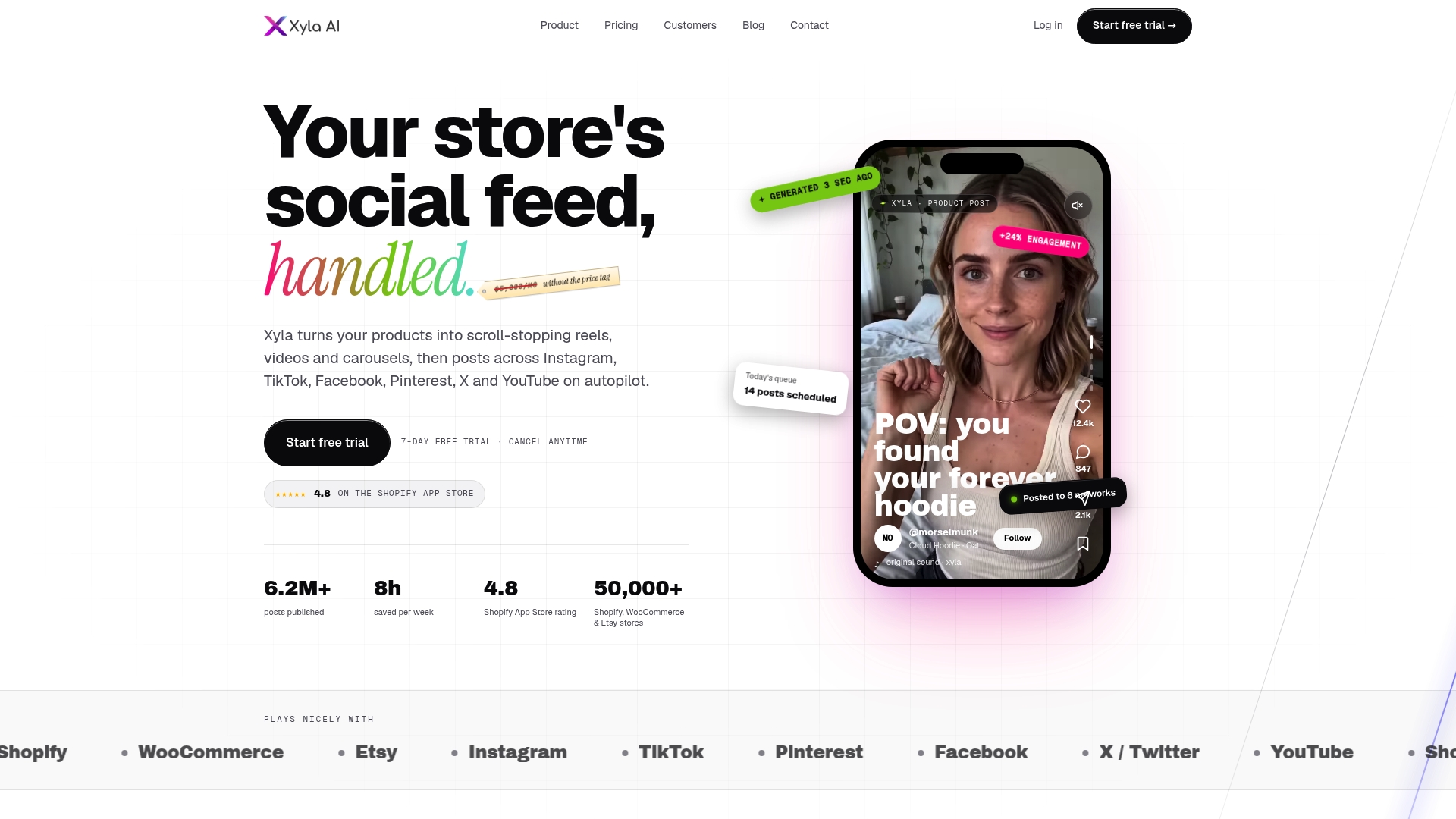
Running a consistent video schedule across X, Instagram, and TikTok is hard when you are also running a store. Xyla AI turns product listings into UGC-style video content automatically, exporting versions sized for feed and expanded view so the same asset works across platforms without a separate edit for each one. The platform schedules and publishes on its own, which is where most of the time savings come from.
- Automated creation: product photos become ready-to-post video without a manual edit for each piece.
- Multi-aspect exports: one source asset gets resized for different feed placements automatically.
- Scheduled publishing: content goes out at set times without someone manually posting each day.
Estimates from such tools suggest the time saved can be around eight hours a week for store owners who switch from manual posting to automated production. Compare plans on the Xyla pricing page to see which tier fits your posting volume, or start a trial to see the workflow on your own product catalog.
FAQ
What is the 4-1-1 rule on Twitter?
The 4-1-1 rule is a content-mix guideline suggesting that for every one promotional post, you should share four pieces of relevant content from others and one piece of your own non-promotional content. It is meant to keep a feed from feeling like a constant sales pitch, which tends to reduce engagement over time.
How much does Twitter pay for 1,000,000 views?
Payouts depend on the specific creator program a user is enrolled in, and X recently changed its structure by launching an Original Content Rewards Program to replace the prior revenue-sharing model. Eligibility now depends on factors including a Premium subscription and meeting defined impression thresholds, so there is no single flat rate per view.
What is the 5-5-5 social media strategy?
Definitions of the 5-5-5 approach vary across marketing sources, but a common version suggests spending five minutes engaging with other accounts, five minutes replying to comments, and five minutes creating or scheduling content each day. It is best treated as a loose daily habit framework rather than a fixed platform rule.
What are some effective marketing strategies for Twitter?
Short native video with a strong first-frame hook, captions for sound-off viewing, and a mix of organic testing followed by promoted spend on proven clips tends to perform well. Posting consistently, replying to your own threads to extend watch time, and reviewing completion rate before scaling a format round out a practical approach.
What is the maximum length for a native video on Twitter?
Native video uploads on X are capped at roughly 2 minutes 20 seconds, according to Lifewire’s guide to posting video on X. Shorter clips, generally under 30 seconds, tend to hold attention better in a fast-moving feed.
Sources
The following sources back the technical specs, platform research, and program details referenced above. Check them directly for the most current rules before planning a large campaign, since platform policies and reward programs change periodically.
- X is ending its ‘creator revenue sharing’ program and launching an ‘original content rewards program.’
- How to Post a Video on X (formerly Twitter)
- How to create video that captivates on Twitter
- How to incorporate video into your X content strategy


