

3 Signals That Decide Instagram Reach in 2026 for Marketers
Instagram’s 2026 systems prioritize three signals above everything else: watch time, likes per reach, and sends per reach, with a new originality rule stripping recommendation eligibility from accounts that mostly repost. Reels, Feed, Stories, and Explore each weigh those signals differently, so a repost-heavy account now loses reach across all four surfaces at once, not just one. The rest of this guide breaks down exactly how each surface scores content, what changed this year, and how to measure the signals that actually move your numbers.
TL;DR:
- Reposting content without meaningful transformation now risks being ineligible for reach across all surfaces, including photos and carousels.
- Private shares, such as sends per reach, are the most critical signal, outweighing likes, comments, or follower counts.
- Content optimized for Reels should focus on retention and avoid watermarked clips; carousels must provide clear value and prompts to save or share.
- Hashtag caps are limited to five per post, with captions and keywords now playing a bigger role in discoverability than hashtags.
- Building a systematic, original content process using AI to transform assets is essential for long-term growth and compliance in 2026.
Table of Contents
- Key Takeaways: A Quick Action Checklist for 2026
- How Instagram’s Algorithms Work in 2026, Surface by Surface
- Confirmed 2026 Changes and What They Actually Mean for You
- The 2026 Format Playbook: Reels, Carousels, Stories, and Captions
- How to Scale Original Content With AI Without Losing “Meaningful Transformation”
- Measuring the Signals Instagram Actually Uses
- Common Mistakes and a 30-Day Recovery Plan
- The Role of Comments, Saves, and Shares in 2026
- How Timing and Posting Frequency Affect Reach in 2026
- How AI and Machine Learning Personalize Recommendations
- Regional and Demographic Differences in Algorithm Behavior
- Adapting Your Long-Term Strategy as the Algorithm Keeps Shifting
- Why Systems Beat Vanity Metrics: An Editorial Take
- Turn Your Product Catalog Into Original, Platform-Native Content
- Sources
Key Takeaways: A Quick Action Checklist for 2026
Before you read another paragraph about ranking theory, do this. These four moves take under three days combined and will tell you more about your current standing than any algorithm explainer.
- Audit your last 30 posts. Flag anything reposted from another account, a UGC creator, or a stock library without added narration, branding, or commentary. Instagram’s April 30, 2026 originality expansion now applies this scrutiny to photos and carousels, not just Reels.
- Build Reels around a three-second hook, then check retention drop-off in Insights. If half your audience leaves before second four, the hook is the problem, not the topic.
- Design carousels for saves. A slide-one promise (“swipe for the sizing chart”) gives people a reason to stay and tap through.
- Cap hashtags at five and move your real keywords into the caption itself, since Instagram now treats captions as searchable text.
- Run a one-week test. Post your usual mix, then pull sends per reach and watch time by format at the end of the week. That single data pull will tell you more than a month of guessing.
None of this requires new software or a bigger budget. It requires fifteen minutes with your own Insights tab, which is more than most accounts ever spend on it.
How Instagram’s Algorithms Work in 2026, Surface by Surface
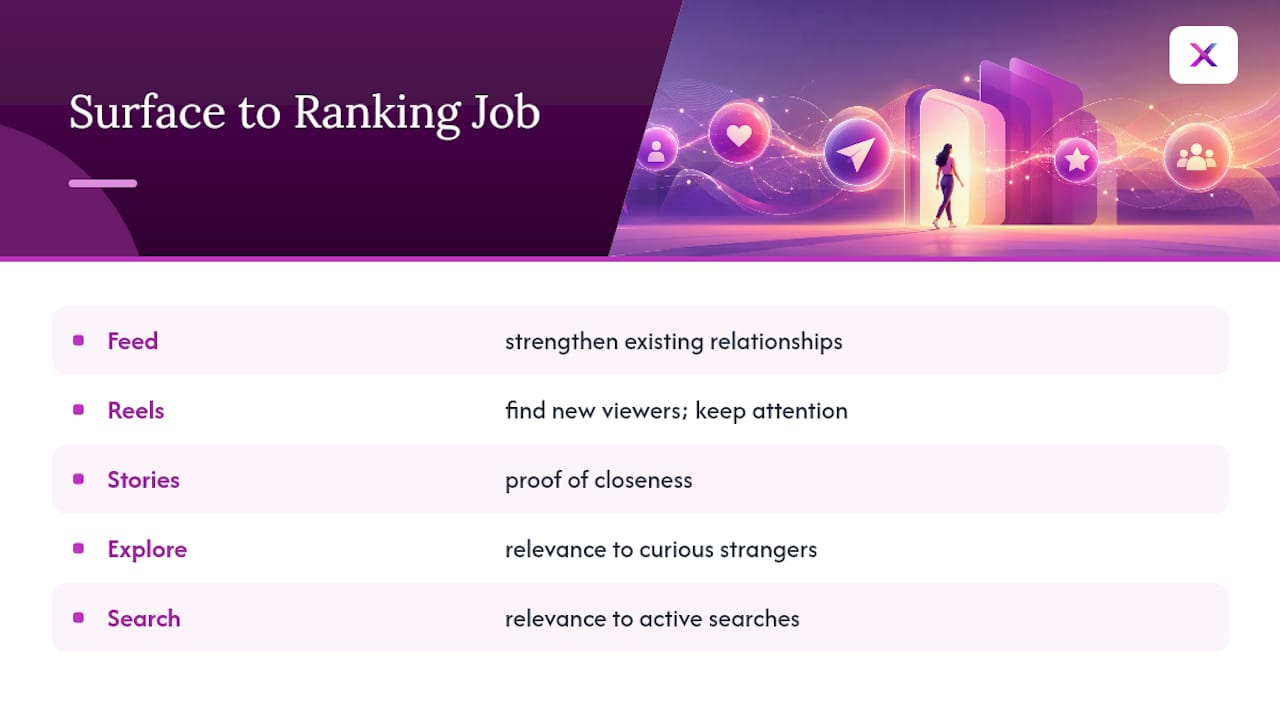
There is no single Instagram algorithm, and treating it like one is the most common strategic mistake marketers make. Instagram runs separate ranking systems for Feed, Reels, Stories, Explore, and Search, and each one optimizes for a different job. Feed wants to strengthen relationships you already have. Reels wants to find you new viewers who will stick around. Stories wants proof of closeness. Explore and Search want relevance to what a stranger is actively curious about right now.
That distinction changes how you should plan content. A post built to deepen loyalty with existing followers (a behind-the-scenes carousel, a customer shoutout) is not built the same way as a post meant to win a cold viewer’s attention in the Reels tab. Confusing the two goals is why so many accounts post consistently and still watch reach flatline.
The signals that matter most, per surface
Instagram has been unusually direct about this. Adam Mosseri has publicly named watch time, likes per reach, and sends per reach as the three signals with the heaviest influence on distribution, and these are treated as the primary on-the-record signals rather than industry guesswork.
- Reels: watch time and completion rate carry the most weight, followed closely by sends per reach.
- Feed: relationship history (how often you two interact), likes per reach, and saves dominate.
- Stories: recency and closeness signals lead, meaning replies, DMs, and poll taps from the same people repeatedly.
- Explore: topical interest matching plus early popularity velocity in the first hour or two after posting.
- Search: keyword relevance in captions and alt text, since Instagram increasingly treats Search like a lightweight version of a web search engine.
The signals themselves are ratios, not raw counts, and that distinction matters more than most creators realize. Likes per reach measures what percentage of the people who saw your post actually liked it, not how many likes you collected in absolute terms. Sends per reach does the same thing for private shares. A post that reaches 500 accounts and gets 40 sends is outperforming a post that reaches 50,000 accounts and gets 40 sends, even though the raw numbers look identical. Account-level priors also compound over time: an account with a consistent history of strong ratios gets more initial distribution on every new post, which is why abandoning a repost-heavy strategy takes a few weeks to show results rather than a few days.
Surface Heaviest signals Primary user intent Feed Relationship history, likes per reach, saves Reconnect with people you follow Reels Watch time, completion rate, sends per reach Discover new creators and topics Stories Recency, closeness, reply/DM history Maintain existing relationships Explore Topical interest, early popularity velocity Browse based on curiosity Search Caption/alt text keyword relevance Find something specificUnderstanding which surface a given post is actually optimized for changes how you write the caption, choose the format, and even decide whether to post at all that day.
Confirmed 2026 Changes and What They Actually Mean for You
Three confirmed shifts define this year, and all three affect discovery eligibility directly.
The biggest one: on April 30, 2026, Instagram expanded its originality restriction beyond Reels to include photos and carousels. Accounts that primarily repost content from other creators, without meaningfully transforming it, now risk losing recommendation eligibility across every surface, not a warning on a single post. “Meaningful transformation” generally means added narration, branded overlays, new commentary, or a genuinely different edit, not a watermark swap or a slightly cropped repost.
Second, Instagram rolled out “Your Algorithm,” a set of controls letting people directly adjust what kind of content gets recommended to them. This shifts real influence over recommendations into the viewer’s hands rather than leaving it entirely to inferred behavior, which means content that earns explicit interest signals (follows, “see more like this” taps) now compounds its advantage faster than before.
Third, the hashtag cap dropped to five per post, confirmed back in December 2025, alongside official guidance that hashtags do not meaningfully boost reach on their own. Captions and on-screen keywords now carry more of the discovery weight that hashtags used to claim.
A quick myth check, since bad information spreads fast in this space:
- There is no published, official weighting formula for any ranking signal. Anyone quoting exact percentages is guessing.
- “Shadowban” is a loosely used term that gets misapplied to normal reach fluctuation; Instagram’s actual mechanism is eligibility for recommendation, not a secret blacklist.
- Most “algorithm update” claims circulating in marketing forums are reverse-engineered speculation. Cross-check against official trackers that only log confirmed changes before you rebuild a strategy around a rumor.
The 2026 Format Playbook: Reels, Carousels, Stories, and Captions
Tactics only work when they’re tied to what each surface actually measures. Here’s the breakdown by format.
- Reels: build for retention, not just a hook. Test three different opening frames for the same clip and compare drop-off in the first three seconds using Insights. Avoid posting watermarked content pulled from TikTok. Instagram’s systems can detect it, and it reads as unoriginal under the April 2026 rule. Match audio pacing and cut frequency to how long you actually need to deliver the payoff, not to whatever trend audio is loudest that week.
- Carousels: sequence for a reason to keep swiping. Slide one should make a specific promise (“the three mistakes,” “before and after”), and each following slide should deliver one piece of that promise, not repeat the same point in different words. End on a slide that explicitly asks for a save (“screenshot this”) or a share to a friend, since both actions feed the sends-per-reach signal directly.
- Stories: treat them as relationship maintenance, not broadcast. Daily polls, “ask me anything” stickers, and quiz stickers generate reply and tap history that Feed’s relationship signal picks up on. A Story that gets three DM replies from the same follower does more for long-term Feed distribution than a Story that gets 200 silent views.
- Captions and hashtags: write for search, not decoration. Put the actual words someone would type into Search inside the first two lines of your caption. Keep the caption itself genuinely readable so people dwell on it rather than skip past it, since dwell time on the post itself is part of what gets measured. Limit hashtags to five, chosen for topical relevance rather than reach-chasing broad terms.
For weekly cadence, a mix of roughly 60 to 70% Reels for reach, 20 to 30% carousels for depth, and daily Stories for relationship signals lines up with what current engagement benchmarks suggest performs best. Carousels and Reels both consistently outpace static single-image posts on engagement rate, with carousels often winning specifically on saves, according to industry benchmark analysis.
Pro Tip: Before you hit publish, ask one blunt question: would a friend actually forward this to someone? If the honest answer is no, the post probably won’t move sends per reach, no matter how polished it looks.
Run every post through a short pre-publish check: is the hook strong enough to survive the first three seconds, does the carousel earn a swipe past slide one, and is there anything here that reads as a repost rather than something you made.
How to Scale Original Content With AI Without Losing “Meaningful Transformation”
The originality rule doesn’t ban AI. It bans laziness. A photo run through a filter and reposted with the same caption is not transformed. A product photo turned into a Reel with new narration, on-screen text explaining a use case, and branded motion graphics clearly is, and industry commentary increasingly points to AI-assisted transformation as the practical way to stay original at scale rather than a shortcut around it.
A workflow that holds up under scrutiny looks like this:
- Source asset: a product photo, a raw customer video, or an existing catalog image.
- AI conversion: the raw asset becomes a platform-native draft, reformatted as a vertical Reel, a carousel sequence, or a Story frame.
- Human creative pass: someone adds narration, brand voice, on-screen commentary, or a specific hook tied to that week’s promotion.
- Publish and monitor: track sends per reach and watch time on that specific post, then feed what worked back into the next batch.
The risk to avoid is treating step two as the finish line. Automated reposting without a human edit is exactly what the originality rule targets, and it’s worth keeping a simple log of what was changed on each post in case an appeal is ever needed. Xyla AI’s UGC video tooling is built around that second and third step specifically, turning product listings into Reels-ready drafts that still need (and get) a human pass for brand voice. For teams building this out for the first time, a step-by-step AI social workflow is worth reading before you commit to a tool.
Measuring the Signals Instagram Actually Uses
Guessing whether a post “did well” is no longer good enough when the platform tells you exactly which ratios matter. Track these three formulas directly from native Insights:
- Likes per reach = likes ÷ reach. Multiply by 100 for a percentage you can compare across posts of very different sizes.
- Sends per reach = sends ÷ reach × 100. This is arguably the most important number in 2026, since private shares predict future session activity more strongly than public likes.
- Watch time ratio = average watch time ÷ total clip length. A 30-second Reel with an 18-second average watch time gives you a 0.60 ratio, which is the number to track over time, not the raw seconds.
Instagram’s native Insights panel shows reach, saves, and average watch time per post; export these weekly into a spreadsheet if you want trend lines rather than isolated snapshots. Some creators have also started verifying their profiles through Search Console-style integrations for cross-platform performance reporting, which is useful if Instagram traffic feeds into a broader site funnel.
Set a rough threshold for yourself: if sends per reach climbs even a percentage point after a format change, that’s a real signal worth repeating, not noise. Tie these numbers to actual business outcomes like profile visits and link clicks, and use UTM parameters on any link in bio or Story link sticker so you know which posts are actually driving traffic, not just attention.
Common Mistakes and a 30-Day Recovery Plan
The accounts losing reach in 2026 tend to make the same five mistakes: reposting without transformation, buying engagement (which tanks your likes-per-reach ratio the moment the fake accounts unfollow), running an inconsistent content mix, ignoring Stories entirely, and stuffing hashtags instead of writing searchable captions.
If your reach has dropped and you suspect an eligibility issue rather than normal fluctuation, run this over 30 days:
- Week 1: Audit every post from the last 60 days and flag anything unoriginal.
- Week 2: Rework or delete the flagged posts; replace them with transformed versions where possible.
- Week 3: Push original Reels and engagement-first Stories daily to rebuild relationship signals.
- Week 4: Review sends per reach and watch time trends; file an Account Status appeal only if eligibility clearly hasn’t recovered despite the changes.
Expect gradual improvement, not an overnight jump. Account-level priors take a few weeks to rebuild once they’ve been damaged.
The Role of Comments, Saves, and Shares in 2026
Public engagement metrics haven’t disappeared, but their relative weight has shifted hard toward private, high-intent actions. A comment still signals interest, but it’s a weaker predictor of distribution than a save or a send, because comments are cheap and often reflexive, while saving a post or forwarding it to a friend requires the viewer to decide it’s worth revisiting or worth someone else’s time.
Saves function almost like a bookmark signal to the ranking systems. A carousel that gets saved at a high rate relative to its reach tells Instagram people intend to come back to it, which is a strong indicator for Feed and Explore distribution alike. Comments still matter for Stories and Feed’s relationship scoring, particularly when the same accounts comment repeatedly, since that builds the interaction history that closeness signals rely on.
Shares, meanwhile, are the clearest expression of “this is worth someone else’s attention,” and that’s precisely why sends per reach sits at the top of Instagram’s named signal list. A post can have modest public engagement and still perform exceptionally well in distribution if it gets forwarded into DMs at a high rate. The practical implication: stop optimizing captions purely to bait comments (“tag a friend who…”) and start designing content that genuinely earns a private forward, because the two behaviors are scored very differently.
How Timing and Posting Frequency Affect Reach in 2026
Posting time still matters, but less as a rigid “best hour” rule and more as a matter of matching your audience’s actual activity windows. Early popularity velocity, meaning how much engagement a post earns in its first hour or two, feeds directly into Explore distribution, so posting when your specific audience is actually online beats posting at a generic “optimal” time pulled from a blog post written for a different account entirely.
Frequency matters more subtly. Posting Reels several times a week keeps you visible in Explore, since that surface rewards accounts producing a steady stream of fresh, testable content. But frequency without quality control backfires: flooding Feed with mediocre posts dilutes your account-level relationship signals if engagement per post drops as volume rises. A better approach is a fixed weekly rhythm, for example three Reels, one or two carousels, and daily Stories, that you can sustain without cutting corners on the human edit step that keeps content original.
Consistency also compounds with account priors. An account that posts reliably and maintains strong ratios earns more initial distribution on each new upload, essentially a trust discount from the system. That trust erodes gradually if you go silent for weeks, so the real lesson on timing isn’t about chasing a magic hour; it’s about building a cadence your team can actually maintain for months, not just for a launch week.
How AI and Machine Learning Personalize Recommendations
Instagram’s recommendation systems increasingly lean on machine learning models that predict what a specific viewer is likely to engage with, based on their own watch history, save patterns, and the accounts they interact with repeatedly. This is why two people can follow the exact same accounts and see completely different Reels in their Explore tab.
The “Your Algorithm” controls introduced this year are a direct response to that personalization becoming almost too effective. Giving people explicit levers to say “show me less of this” or “show me more like this” means creators now have a partial, indirect way to earn a stronger fit with the audience segments that already respond well to their content. If your Reels consistently earn a “see more like this” tap from a certain demographic, the model reinforces that pairing for future uploads.
Practically, this means broad, generic content aimed at “everyone” tends to underperform content that clearly resonates with a defined niche audience, because the personalization layer rewards a strong, repeatable match over a diluted one. Small e-commerce brands with a distinct visual identity or voice tend to build that pattern-match faster than accounts that shift tone and topic constantly, since the model has less consistent signal to learn from.
Regional and Demographic Differences in Algorithm Behavior
Engagement norms vary meaningfully by region and age group, and Instagram’s ranking systems reflect that rather than applying one universal standard. Younger audiences in markets with high Reels adoption tend to reward faster pacing and trend-responsive audio, while audiences in markets where Instagram functions more like a shopping or discovery tool respond better to carousels with clear product information and text overlays.
Time zones also affect the “early popularity velocity” signal directly, since a post’s first hour of performance is judged against the activity patterns of the audience actually online at that moment, not a global average. A brand with followers split across North America and Europe needs to think about which audience segment it’s actually optimizing a given post for, since posting once for a single time zone can leave half the audience seeing a post after its early momentum window has already closed.
Demographic differences also show up in format preference. Older audience segments on the platform still engage more with Feed and static carousels relative to Reels, compared with younger segments who spend a disproportionate share of their session time in the Reels tab. If your customer base skews older, over-indexing entirely on Reels at the expense of carousels and Feed posts may leave real engagement on the table.
Adapting Your Long-Term Strategy as the Algorithm Keeps Shifting
Chasing every rumored update is a losing game, since most circulating “algorithm change” claims are speculation rather than confirmed platform policy. A better long-term posture is building a content system resilient to shifts in weighting rather than a system optimized perfectly for today’s exact ranking mechanics.
That means investing in a repeatable creative process (consistent branding, a documented format mix, a review step that checks originality) rather than reacting to every new tactic that goes viral in a marketing newsletter. Platform-wide engagement has trended downward as attention becomes more contested, which means the accounts still growing are the ones treating scarcity of attention as the constraint to design around, not chasing raw posting volume. Building measurement habits now, tracking sends per reach and watch time consistently, gives you the data to adapt quickly whenever the next confirmed change actually lands, instead of guessing based on someone else’s forum post.
Why Systems Beat Vanity Metrics: An Editorial Take
Most teams still report likes and follower counts to leadership because those numbers are easy to explain in a meeting. That habit is now actively working against them. Instagram has told marketers directly which numbers matter: watch time, likes per reach, and sends per reach. None of those show up cleanly on a follower-count slide, and none of them reward volume for its own sake.
The teams that will keep growing through 2026 are the ones that build a repeatable creative system, a small group that can consistently produce original, platform-native formats, rather than a rotating cast of freelancers copying whatever performed well for someone else last month. That system needs human judgment at its core, but it doesn’t need to be entirely manual. Automation tools like Xyla AI can handle the repetitive conversion work (turning a product photo into a Reels-ready draft) so a person’s time goes toward the part that actually earns sends: narration, timing, and brand voice. Used that way, automation is a force multiplier for originality, not a replacement for it.
— Toby
Turn Your Product Catalog Into Original, Platform-Native Content
If the originality rule has you worried about keeping up with Reels, carousels, and Stories on top of running your store, Xyla AI handles the heavy lifting without turning into another repost machine. It converts your existing product listings into reels, carousels, and platform-tailored videos automatically, then schedules and publishes them across Instagram, TikTok, and Facebook at the times your audience is actually active.
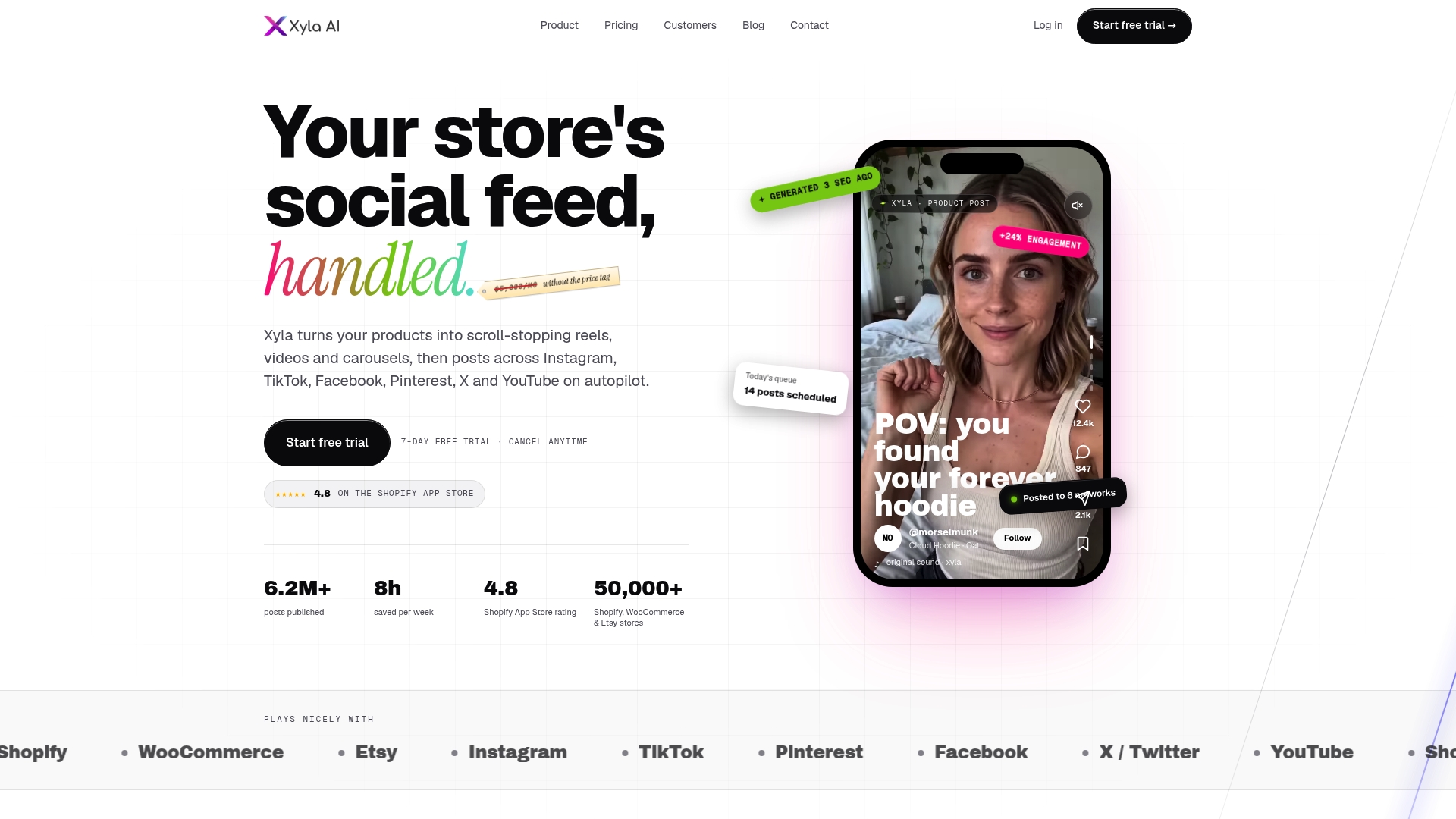
Store owners typically spend close to eight hours a week on social content when they do it manually; Xyla AI cuts that down while still producing content built specifically for each platform’s format, not a single asset stretched across five networks. That distinction matters now more than ever, since generic, unedited repurposing is exactly what the 2026 originality rule penalizes.
You can see the full process, from product photo to published post, on the step-by-step automation walkthrough. If you’re ready to see what your own catalog looks like turned into Reels-ready creative, that page is the place to start.
Sources
- Instagram Algorithm Updates 2026: Confirmed Changes & Tracker
- Instagram’s algorithm clamps down on repurposed, unoriginal photos and posts
- How the Instagram Algorithm Works in 2026: Signals, Surfaces, and What Actually…
- How the Instagram Algorithm Works in 2026 | Web Tonic™


