

5 Etsy Marketing Automation Workflows That Protect Star Seller Status

Automate the repetitive parts of your marketing, social posting, listing refreshes, routine messages, and keep every buyer conversation that matters human. Sellers who split the work this way report steadier traffic from social and search, more hours back for product creation, and none of the robotic feel that costs Star Seller status. The right starting point is one workflow, not ten.
TL;DR:
- Automating social posting and listing SEO refreshes reduces manual workload and helps maintain listing quality, but requires careful oversight to prevent errors.
- Using tools that connect via Etsy’s Open API v3 with OAuth ensures shop data remains secure and compliant with Etsy policies.
- Starting with high-volume, low-risk workflows like automating new listing shares and message triaging provides the best return with minimal initial setup.
- Regularly monitoring key metrics such as response times, review trends, and listing conversion rates helps preserve Star Seller status during automation.
- Catalog-based content tools like Xyla AI automatically generate branded social media posts, saving approximately eight hours weekly while maintaining shop authenticity.
Table of Contents
- What Does Etsy Marketing Automation Actually Cover?
- Which Automation Workflows Should You Set Up First?
- How Do You Vet Automation Tools Safely?
- What Is a Safe Four-Week Rollout Plan?
- How Do You Protect Star Seller Status While Automating?
- How Catalog-Driven AI Keeps Automation From Feeling Generic
- When Should You Automate vs Keep a Process Manual?
- Try Catalog-Driven Automation Built for Etsy Shops
- Where to Read More Before You Automate
- Sources
- FAQ
What Does Etsy Marketing Automation Actually Cover?
Etsy marketing automation means using software to handle repeatable tasks around your shop while you keep the judgment calls. It is not a bot running your business. It is a set of tools that draft, schedule, and flag things for your approval.
The core areas worth automating are social content publishing, listing SEO refreshes, first-line customer messaging, ads monitoring and reconciliation, and inventory or listing sync across channels. AI fits into this by drafting captions, turning product photos into short UGC-style videos, and suggesting tags or titles based on search trends. None of that should skip human review before it goes live.
- Social publishing: auto-generate and schedule posts from new or existing listings.
- Listing SEO: flag underperforming tags or titles for a seller to approve.
- Customer messaging: auto-reply to FAQs, route anything custom to a person.
- Ads and inventory: reconcile ad spend and sync stock levels across sales channels.
One rule matters more than any tool feature: only connect apps that use Etsy’s Open API v3 through OAuth. Etsy’s own guidance encourages automation for streamlining operations, but it draws a hard line on keeping marketing authentic and grounded in real product data rather than generic bulk content.
Which Automation Workflows Should You Set Up First?
Start with the workflows that touch the most orders and carry the least risk of a bad automated decision reaching a customer or a live listing.
- Auto-share new listings across Instagram, Pinterest, and TikTok. Trigger the post the moment a listing goes live, but keep a manual glance at the caption before it publishes so it still sounds like you.
- Weekly listing optimization brief. Pull keyword and traffic data, generate suggested tag and title edits, and require your sign-off before anything changes. Auto-editing live listings without review is how conversion rates quietly tank.
- Auto-reply and triage for messages. Canned answers cover shipping times and sizing questions; anything about a custom order or a complaint escalates straight to you.
- Post-purchase follow-up. Time a cross-sell or review request to fire a few days after delivery confirmation, not the moment the label prints.
- Ad and Offsite Ads reconciliation. Run a daily check that flags misattributed sales, since Offsite Ads attribution errors can quietly inflate the fees you owe if nobody is watching.
Pro Tip: Run workflow one and workflow three for two weeks before touching anything else. That combination alone usually returns the most hours for the least setup effort.
How Do You Vet Automation Tools Safely?
Tools generally fall into five categories: catalog-based social managers that turn listings into posts, AI content creators for images and video, no-code workflow platforms for message routing, listing SEO analyzers, and inbox triage tools. Each solves a narrow problem, so most sellers end up combining two or three rather than relying on one platform for everything.
Before connecting anything to your shop, check for these four things:
- Uses Etsy Open API v3 with OAuth, not a login-and-password connection.
- States exactly which data scopes it accesses, orders, listings, or messages, and nothing beyond that.
- Has reviews you can verify outside the vendor’s own site.
- Offers a free trial or sandbox period before you pay.
Pricing generally runs one of two ways: a flat monthly subscription or a per-generation fee for AI content. Subscription pricing is easier to forecast against ROI once volume grows, while per-generation fees can sneak up on shops posting daily. Whatever the pricing shape, never hand over your Etsy password directly to a tool. Etsy’s API policy explicitly warns against scraping and credential sharing, and either one puts your account at real risk.
What Is a Safe Four-Week Rollout Plan?
Rolling out automation gradually beats flipping five switches at once and hoping nothing breaks.
- Week one: audit. List every recurring marketing and messaging task you do by hand and estimate hours spent on each.
- Week two: connect one tool. Pick the highest-hour task, connect a single API-based tool, and leave everything else manual.
- Week three: pilot one workflow. Run it live but check every output before it ships. Note anything that needed a correction.
- Week four: measure and document. Compare before-and-after numbers, write a short standard operating procedure, then decide whether to add a second workflow.
Track four numbers through the pilot: message response time, listing conversion rate, social referral visits, and hours saved per week. Roughly 81% of shop traffic tends to come from Etsy’s own search and browse, with about 19% from channels sellers control directly, which is exactly why automating your owned social channels carries outsized value against that 19%.
Keep a backup of your original listing text before any tool touches it, require manual approval for title and tag changes, and check your Star Seller dashboard weekly during the pilot, not just at the end of the month.

How Do You Protect Star Seller Status While Automating?
Automation and Star Seller status can coexist, but only if you watch the right numbers. Track initial response time, thread-based response time, review trends, on-time shipping percentage, listing conversion rate, ad return on ad spend, and social click-through rates. A dip in any of these after adding a tool is your signal to roll it back.
Etsy’s Star Seller program weighs message response time, on-time shipping, and review quality heavily, and the program has adjusted its thresholds before, so treat these as moving targets rather than fixed numbers. Keep auto-replies short and clearly human in tone. Nobody wants a canned paragraph when they asked a simple sizing question.
- Confirm your shipping and tracking workflow stays accurate even when messaging is automated.
- Combine automated triage with manual checks on any thread involving a complaint or custom request.
- Reconfirm every few months that your tools still run on Etsy Open API v3 and follow current seller policy, since Etsy prohibits actions that manipulate clicks, carts, or sales data.
How Catalog-Driven AI Keeps Automation From Feeling Generic
The gap between automation that works and automation that flattens a brand usually comes down to where the content originates. Tools that pull directly from your product catalog, photos, descriptions, materials, generate posts that still read as yours. Tools that rely on generic templates produce content that could belong to any shop.
Some tools build content generation from a seller’s actual catalog data rather than templated assets, which helps keep the maker’s story intact across every network where the posts land. That distinction matters more once volume climbs and you’re publishing daily instead of weekly.

When Should You Automate vs Keep a Process Manual?
A rough threshold worth watching: once a shop crosses roughly 80 orders a month, or once a repetitive task eats more than a few hours a week, manual handling starts costing more than the risk of automating it. Below that volume, the setup time often isn’t worth it yet.
The rule that holds regardless of scale: automate structure and execution, never voice and personal touches. Let software handle scheduling, drafting, and triage. Keep the actual words to a customer in a dispute, and the caption on your best-selling piece, in your own hands. Scale automation one workflow at a time, and audit the results every month rather than assuming a tool still performs the way it did on day one.
— Toby
Try Catalog-Driven Automation Built for Etsy Shops
If you’re weighing tools to automate the social side of your shop, Xyla AI is the one built specifically to turn Etsy listings into posts without you touching a template. It pulls directly from your product catalog to generate reels, carousels, and AI UGC-style videos, then schedules and publishes them across Instagram, TikTok, and Facebook automatically.
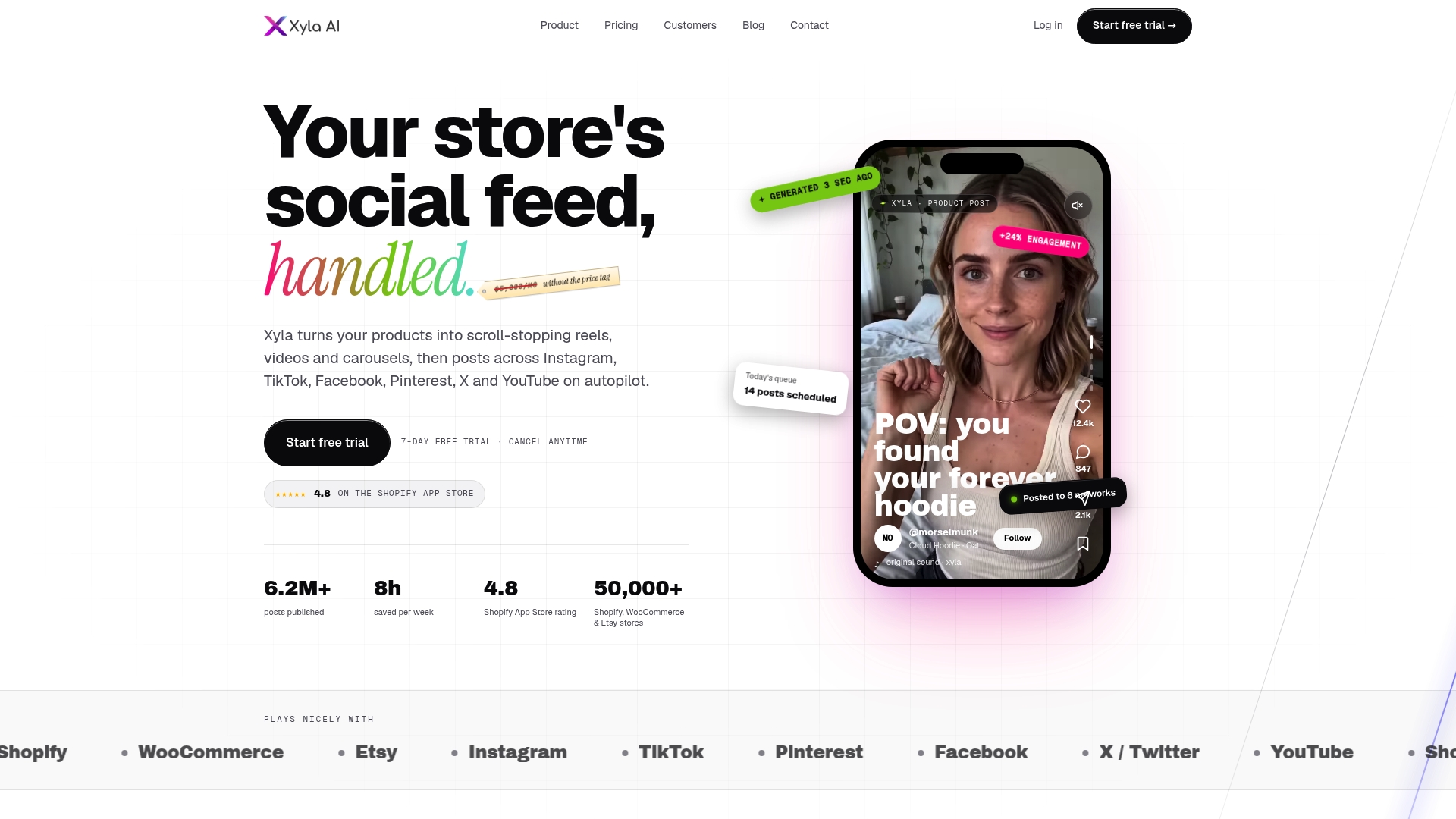
That catalog sync is the piece most generic scheduling tools skip, and it’s why sellers using it report getting back roughly eight hours a week that used to go into manual posting. Xyla AI’s Etsy plans start with the Maker tier at $29 a month, with Shop and Studio tiers available as your posting volume grows. Run a monitored pilot for two weeks, measure it against the response time and referral traffic numbers from your rollout plan, and see whether it earns a permanent spot in your workflow. Start with the Etsy automation tools built for exactly this.
Where to Read More Before You Automate
- Etsy Seller Handbook: guidance on authentic marketing and listings, Etsy’s own stance on keeping automation grounded in real product content.
- Etsy Open API v3 developer documentation, the technical reference for any tool you connect.
- 3 Years of Real Etsy Shop Data (2022-2025), a multi-year case analysis of traffic sources and conversion shifts.
- Top marketing automation tools for SEO success in 2026, broader context on automation and search visibility.
Sources
- Etsy Seller Handbook: guidance on authentic marketing and listings
- 3 Years of Real Etsy Shop Data (2022-2025) – CraftedCharts
- OpenClaw for Etsy Sellers: Star Seller defense and automation patterns
FAQ
Can You Make $10,000 a Month on Etsy?
It’s achievable but uncommon, and it depends heavily on niche, order volume, and pricing rather than any single tactic. Shops that reach that level typically combine strong SEO, consistent social traffic, and enough order volume to justify automating routine tasks like messaging and listing refreshes.
Why Are So Many People Leaving Etsy?
Sellers commonly cite rising fees, increased competition, and frustration with algorithm changes that shift traffic unpredictably. Shops that build owned channels, social, email, through automation tend to feel less exposed when Etsy’s own traffic patterns shift, since they aren’t relying solely on Etsy search.
How Much Does Etsy Take From a $1,000 Sale?
Etsy charges a transaction fee, a payment processing fee, and a listing fee per item, and the exact total varies by seller location and whether Offsite Ads applied to that sale. Check your own Payments dashboard for the precise breakdown, since fee structures differ by country and can change.
What Is Etsy’s Marketing Strategy?
Etsy invests in its own search and Offsite Ads program while encouraging individual sellers to build authentic, product-based marketing rather than generic promotional content. Etsy’s guidance specifically favors automation that supports authenticity over automation that produces bulk, templated posts.
Does Xyla AI Work With Etsy Shops?
Yes, Xyla AI connects to Etsy catalogs and generates social content, including reels, carousels, and AI UGC-style videos, directly from product listings. Etsy plans start at $29 a month for the Maker tier, with pricing details on the Etsy product page.


