

3–5 Attributes to Scale Brand Voice on Social Media for Ecommerce Teams

Brand voice on social media is your brand’s consistent personality expressed through language and behavior across every post, caption, and reply. It builds recognition, trust, and higher engagement when it’s applied the same way everywhere. Skip the theory and do this first: pick 3 to 5 voice adjectives, write ten sample posts and replies against them, and test them on one platform for a week before rolling out further.
TL;DR:
- Consistent brand voice builds recognition, trust, and operational efficiency, but it must be defined, tested, and adapted to each platform’s unique context.
- The voice remains fixed, while tone adjusts for situations involving safety, frustration, or financial concerns to avoid sounding tone deaf.
- Auditing existing social media presence and researching actual audience language helps identify drift and define actionable voice attributes within a concise style chart.
- Automating content creation and scheduling through tools like Xyla AI ensures adherence to the voice guide across platforms, saving roughly eight hours weekly for small teams.
- Regularly monitoring community comments, remixes, and customer service replies reveals real-time shifts in perception, allowing ongoing voice adjustments based on authentic feedback.
Table of Contents
- What Brand Voice Means on Social Media
- Brand Voice vs. Brand Tone: What’s the Real Difference?
- Why Consistent Brand Voice on Social Media Actually Matters
- How Do You Build a Brand Voice for Social Media, Step by Step?
- What Belongs in a Social Media Style Guide?
- Show, Don’t Just Tell: Voice Templates You Can Use Today
- How Do You Measure Whether Brand Voice Is Working?
- How Xyla AI Helps E-Commerce Teams Keep Voice Consistent
- The Part Most Brand Voice Guides Skip
- Try Xyla AI to Put Your Voice Guide Into Practice
- Sources
- FAQ
What Brand Voice Means on Social Media
Brand voice is the specific combination of word choice, sentence rhythm, humor, and reply behavior that makes your brand sound like a person rather than a press release. It’s not a logo or a color palette. It’s what happens when a customer tags you in a comment and you have to decide, in ten seconds, how to respond.
Social media is where this matters most. A systematic review of 49 academic studies found that social platforms are the most studied context for brand personality research, because informal, back-and-forth communication lets brands take on humanlike traits in a way a billboard or a product label never can. That humanlike quality is directly tied to engagement, word-of-mouth, and purchase intent.
Research on the Online Brand Personality Scale breaks that perception into three pillars worth knowing by name:
- Esteem: does the brand seem likable and respected?
- Credibility: does it seem trustworthy and competent?
- Relevance: does it feel connected to what the audience actually cares about?
Platform mechanics shape all three. A brand that only posts polished product shots on Instagram but never replies to comments will read as distant, no matter how good the copy is. A brand that answers every DM within an hour builds credibility that a perfectly worded bio never will.
Brand Voice vs. Brand Tone: What’s the Real Difference?
Voice is who you are. Tone is how that personality adjusts to a moment. Confusing the two is why so many social teams end up sounding inconsistent, or worse, tone deaf during a crisis.
- Voice stays fixed. If your brand voice is “witty, direct, and a little irreverent,” that doesn’t change between Monday’s product launch and Friday’s meme.
- Tone flexes with context. The same witty brand goes quiet and direct when responding to a shipping complaint, and dials the humor back to zero during a product recall.
- The decision rule is simple: ask whether the situation involves someone’s money, safety, or frustration. If yes, tone shifts toward calm and clear. Voice traits like humor or slang get parked until the issue is resolved.
A brand that jokes in a reply to an angry customer isn’t showing personality. It’s showing a gap in training, which is exactly what a style guide exists to close.
Why Consistent Brand Voice on Social Media Actually Matters
Inconsistent voice is expensive in ways that don’t show up on a balance sheet until much later. When one team member sounds corporate and another sounds like a stand-up comedian, customers notice, and trust erodes gradually rather than all at once.
The business case breaks down into three areas:
- Recognition: audiences learn to spot your posts in a crowded feed without seeing the logo, the same way people recognize a friend’s texting style.
- Operational speed: a defined voice cuts back-and-forth revisions because writers already know the rules.
- Crisis resilience: brands with a documented tone playbook respond faster and more coherently when something goes wrong publicly.
Trust is the pillar with the clearest tie to revenue. Statista’s research on purchase decisions confirms that brand trust is a major factor shoppers weigh before buying, and voice consistency is one of the cheapest levers available to build that trust over time. Aligning visual identity with voice across platforms also improves discoverability and operational efficiency, because teams stop reinventing tone decisions post by post.
How Do You Build a Brand Voice for Social Media, Step by Step?
Most brand voice failures aren’t a creativity problem. They’re a process problem: nobody wrote the rules down, so everyone improvised. Here’s the sequence that avoids that.
Step 1: Research your actual audience, not your assumed one
Pull the last 90 days of comments, DMs, and reviews and read them in one sitting. Note recurring phrases customers use to describe your product, the questions they ask most, and the words they use for competitors. If you have Shopify or Etsy order data, cross-reference which customer segments engage most on which platform. A Shopify-specific social strategy needs a different voice calibration than a wholesale B2B feed, even under the same parent brand.

Step 2: Audit what you’re actually sounding like today
Pull 30 to 100 recent posts and replies per platform and code them against basic traits: formal or casual, emoji use, sentence length, first-person or brand-name references. This kind of structured audit surfaces drift you can’t see just by scrolling. It’s common to find that Instagram captions sound playful while customer service replies on the same account sound like a legal disclaimer. That gap is the fragmentation you’re trying to fix.
Step 3: Define 3 to 5 core attributes
Pick adjectives that are specific enough to be actionable. “Friendly” is too vague. “Friendly like a shop owner who remembers your name” gives writers something to aim at. For each attribute, write one line of what it sounds like and one line of what to avoid.
Step 4: Build a compact voice chart
Long style documents get skimmed once and ignored. A tight voice chart with explicit examples performs better in daily production than paragraphs of prose guidelines, because writers can scan it in the time it takes to draft a caption.
Attribute Sounds Like Avoid Direct “This restock sold out in 6 hours last time. Here’s your heads up.” Vague hype with no specifics Warm “Thanks for waiting on this one, we know it’s been a minute.” Corporate apology templates Playful One well-placed emoji or pun per post, not per sentence Forced slang that doesn’t match the productStep 5: Adapt per platform
- Instagram: longer captions work for storytelling, but the first line still needs to earn the tap on “more.”
- TikTok: voice comes through in on-screen text and captions more than polish; imperfection often reads as more credible.
- Facebook: slightly more explanatory tone works because the audience skews toward longer read times.
- LinkedIn: drop most emoji and slang, keep the same core attributes but raise the formality dial.
Step 6: Create reusable templates and pilot before you scale
Draft five to ten caption formulas per platform, then run them on one platform for a week before expanding. This is where a scheduling and content tool earns its keep, since it lets a small team test formulas without manually rebuilding every post.
Pro Tip: Skip the temptation to write your voice chart alone in a conference room. Read your audit findings out loud to someone outside marketing, ideally a customer service rep, and ask if it sounds like the brand they know. They’ll catch mismatches faster than another round of internal review.
What Belongs in a Social Media Style Guide?
A style guide isn’t a branding document that gathers dust. It’s a working reference a new hire should be able to use on day one without asking five questions first.
The essentials, based on widely used style guide frameworks, include:
- Voice attributes with sound-like and avoid-this examples
- Platform-specific formatting rules (caption length, hashtag count, emoji frequency)
- Grammar and punctuation preferences (Oxford comma, capitalization of product names, how numbers are written)
- Approved and banned phrases, including how to handle sensitive topics
- Guardrails for AI-generated captions and user-generated content reposts
Governance matters as much as content. Decide who drafts, who approves, and who has final say during a fast-moving situation, and write that chain down instead of relying on memory.
Governance Role Responsibility Turnaround Content writer Drafts posts and replies against the voice chart Same day Social lead QA checks against style guide before publishing Within 2 hours Brand manager Escalation point for tone judgment calls On call for urgent issuesTraining should happen in the first week of onboarding, not months in. Walk new team members through five real examples of posts that got voice right and five that missed, and have them draft three practice replies before they touch the live account.
Show, Don’t Just Tell: Voice Templates You Can Use Today
Examples beat instructions every time a writer is staring at a blank caption box at 4:45 p.m. These are starting points, not scripts to copy word for word.
Instagram caption formula: Hook line with a specific detail, one line of context, one clear call to action. “Back in stock after 400 people asked. Restocked the color everyone wanted and nothing else. Grab yours before it’s gone again.”
TikTok caption formula: Short, conversational, almost like a text to a friend. “POV: you finally restocked the thing your DMs have been begging for.”
LinkedIn caption formula: Lead with a business insight or number, then connect it to your product. “Small stores lose an average of several hours a week to manual posting. Here’s how we cut that down for one Etsy seller.”
Reply scripts:
- Praise: “This made our whole week. Thank you for saying it out loud.”
- Complaint: “That’s not the experience we want you to have. Send us a DM and we’ll sort it today.”
- Question: “Good question. Short answer: yes, ships within 3 days. Longer answer in your inbox.”
Caption and hashtag conventions matter more than most teams admit, and a dedicated writing style reference keeps a whole team consistent even when three different people are drafting posts in the same week.
How Do You Measure Whether Brand Voice Is Working?
Voice work feels soft until you tie it to numbers a brand manager can defend in a meeting. The right KPIs turn “does this sound like us” into something measurable.
Track these on a recurring basis:
- Engagement rate per platform, segmented by post type, not just averaged across everything
- Sentiment in comments and DMs, coded roughly as positive, neutral, or negative
- Share of voice relative to close competitors in your category
- Reply-to-conversion, meaning how often a customer service reply on social leads to a completed purchase or resolved issue
Run tone tests in small batches rather than committing to a full rebrand. Testing tone variants on small audiences produces usable signal faster than a six-month overhaul, and it limits the damage if a variant flops. Post the same offer with two different voice treatments to comparable audience segments and compare engagement after 48 hours.
Social listening closes the loop. Community comments, remixes, and user-generated content actively shape how your brand personality is perceived, which means voice isn’t fully in your control. Watch for shifts in how customers describe you unprompted. If people start calling you “helpful” more than “funny,” that’s real signal worth adjusting toward, not ignoring.
How Xyla AI Helps E-Commerce Teams Keep Voice Consistent
Maintaining one voice across five platforms is a scheduling and production problem as much as a creative one, especially for a small team running a Shopify, WooCommerce, or Etsy store without a dedicated marketing hire. Xyla AI automates the repetitive parts so the voice work you defined above actually survives contact with a busy week.
- Converts product listings into platform-specific captions, reels, and carousels that follow a defined brand kit
- Auto-publishes to Instagram, TikTok, Facebook, and other networks on a consistent schedule
- Applies consistent formatting and tone rules across every asset instead of requiring manual rewrites per platform
- Saves store owners roughly eight hours a week that would otherwise go to manual posting and editing
For a team trying to apply the voice chart from Step 4 without hiring a full content department, that time back is often the difference between consistency on paper and consistency in the feed.
The Part Most Brand Voice Guides Skip
Most advice on this topic treats brand voice like a one-time creative exercise: define it, write it down, done. That’s backwards. The research on co-created brand personality makes clear that your community is writing your voice alongside you, whether you invite them to or not. Comment sections, remixes, and reply threads shape how a brand actually reads to a new visitor more than your carefully worded bio does.
If you’re starting from zero, do three things this month: run the 30-post audit, write the compact voice chart, and pilot it on your highest-traffic platform for one week before touching the rest. Don’t skip the audit to save time. It’s the step that shows you where you’re already inconsistent, and you can’t fix drift you haven’t measured.
The lesson that surprises most brand managers: the biggest voice failures rarely come from writers going off script. They come from replies during complaints, when nobody had time to check the guide. Build your 7-day pilot around real customer service scenarios, not just planned content, and you’ll catch the gaps that actually matter.
— Toby
Try Xyla AI to Put Your Voice Guide Into Practice
Once you’ve defined your voice attributes and built the chart, the bottleneck usually isn’t creativity. It’s finding hours in the week to apply it consistently across five platforms while running a store. Xyla AI is built specifically for that gap: it takes the product listings you already have and turns them into on-brand reels, carousels, and captions, then schedules and publishes them automatically across Instagram, TikTok, Facebook, and more.
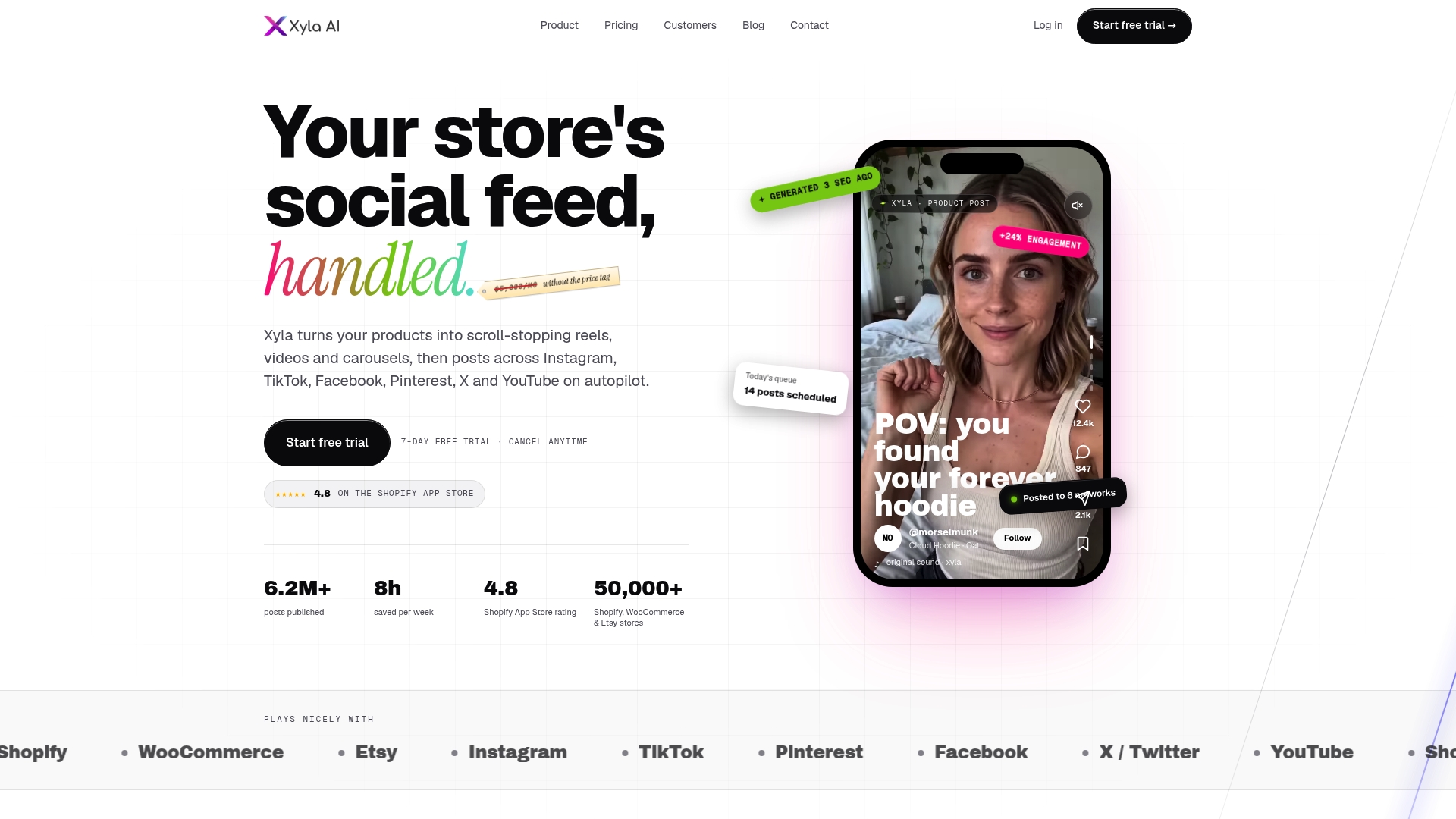
That means the voice chart you just built doesn’t sit in a shared drive collecting dust. It gets applied to every asset automatically, at the times your audience is most active, without you rewriting the same caption five different ways for five different platforms. For store owners currently doing this manually, that’s the roughly eight hours a week Xyla AI gives back.
Start with the step-by-step guide to automating your social posting to see exactly how the setup maps to the voice framework above, or try the free tools first if you want to test a few caption variants before committing to a full workflow.
Sources
- Consumers’ brand personality perceptions in a digital world: A systematic literature review and research agenda
- Online Brand Personality Scale study (2025)
- Social media style guide: Template, examples & tips for 2026
- How to build a winning social media branding strategy | Adobe
FAQ
What is a brand voice example?
A brand that describes itself as “direct, warm, and playful” might write a restock caption as “Back in stock after 400 people asked, and yes, it’s the color everyone wanted.” That single sentence hits all three traits without stating them outright.
What is the 5-3-1 rule for social media?
The 5-3-1 rule is a content-mix guideline suggesting that some posts should come from other relevant sources, some should be personal or brand-related, and some should be promotional, keeping self-promotion from overwhelming the feed.
What is brand voice?
Brand voice is the consistent personality a brand expresses through word choice, tone, and behavior across every piece of communication, especially the informal back-and-forth of social media replies and captions.
What is the 3-7-27 rule in branding?
Definitions of the 3-7-27 rule vary across marketing sources, and it isn’t a standardized framework the way the voice attributes discussed above are. Treat any specific numbers attached to it with caution and focus on the concepts rather than the exact figures.
How many voice attributes should a brand define?
Most style guide frameworks recommend 3 to 5 core attributes, since fewer traits are easier for a distributed team to apply consistently across captions, replies, and platform-specific content like the templates Xyla AI generates from product listings.


